Description:
Bodie is joined by Tom Appel, publisher of Consumer Guide and co-host of the Car Stuff Podcast, for a wide-ranging conversation about reviewing cars, buying them, and where the EV market is headed. Tom shares his experience driving the Lucid Gravity, including what impressed him and the software glitches that made an otherwise compelling luxury EV difficult to recommend without reservations. The conversation turns to what new cars actually cost today, increasingly long auto loans, and the things Tom and his daughter learned while shopping for a new compact crossover. They also talk about unusual option packaging, three-cylinder engines, Volkswagen diesels, the rise and fall of enthusiasm around the Ford F-150 Lightning, and how quickly consumer expectations can change. Tom and Bodie get into vehicle safety and airbags, including how difficult it can be to design around every possible type of crash or rare safety incident. Finally, they discuss the EV industry's transition from CCS to NACS charging and whether another change in charging standards could add confusion for buyers already hesitant about making the switch to electric.
Other Podcasts:
Guest Links:
- Tom Appel on LinkedIn
- Consumer Guide Automotive
- Car Stuff Podcast
- Tom Appel on Bluesky
- Tom Appel on X
Hosted by Simplecast, an AdsWizz company. See pcm.adswizz.com for information about our collection and use of personal data for advertising.
[00:00:21] Hello everyone and welcome to Kilowatt, a podcast about electric vehicles, renewable energy, autonomous driving and much, much more. My name is Bodhi and I am your host and I'm going to do very little, if any, audio processing on this particular part of the episode because I'm sitting in what is one of my favorite spots in Kenai.
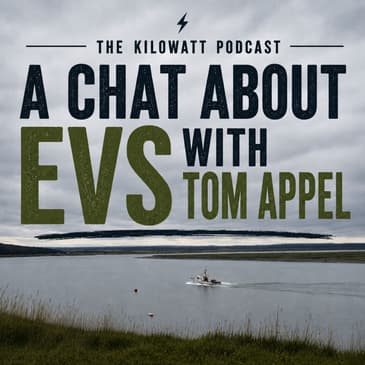
[00:00:41] It's not the most beautiful spot in Kenai, but it's on the bluff, it overlooks the fishing boats that are coming in and out and yeah, it's just very peaceful. Like this has been one of my favorite places to come and hang out since I was a kid and I'll put a picture in the show notes, not in the show notes, I'll put a, I'll make the show art, the picture and you can kind of see.
[00:01:06] Again, not the prettiest space, but if you stay here long enough, you'll see eagles, you know, playing, hunting, you know, trying to mate each other, all that stuff. Right now there's just a very small seagull you might hear. I'm going to keep the processing pretty, pretty low on this.
[00:01:34] Like I said, just so you can maybe get the ambiance of where we are. I actually paused recording. I took a picture of one of the fishing boats coming in and that's going to be the picture for the show art. But yeah, this is, this is, this is my happy place. Anyway, another place where I'm really happy is interviewing super talented and kind people. And one of those people happens to be Tom Appel. Tom hosts the car stuff podcast.
[00:02:02] He's also the publisher of consumer guide and the website consumer guide.com where you can go and, you know, check out car reviews and all that good stuff. And we start off the podcast by talking a little bit about what consumer guide does. So I'm going to let Tom explain that because obviously he's going to be able to do it better than me. But then we just kind of dive into everything lucid and, you know, EVs in general.
[00:02:29] We just kind of have a, it's just really a conversation and it was a fun conversation. So I really appreciate being able to have Tom on. So without further ado, let's go ahead and welcome Tom to the show. Hey, thanks for having me. Yeah. Well, I mean, recently I was on the car stuff podcast, the consumer guide car stuff podcast. Why don't we start off with that? Cause I talk about car stuff all the time on the show. Now what, what is the consumer guide? Yeah.
[00:02:56] Consumer guide for people who don't know goes all the way back to 1967. Uh, obviously we were print at the time because there simply wasn't anything else. By 1970, we had developed our best buy picks and that sort of became, um, the brand of consumer guide. Consumer guide also for people who may be vaguely remember used to review things other than cars, lawnmowers, chainsaws, watches. We did all that stuff.
[00:03:23] So it just, it became very hard as a, to make a business case for reviewing things, especially things that didn't have like a model year, um, kind of introductions cadence. So, uh, we, we, we, we, we became just cars sometime in the aughts. Uh, and we've been going ever since then we went print. Um, we abandoned printed 2008. There was no money in that anymore. We used to have a monthly magazine, uh, that I really enjoyed working on with, and the covers are kind of famous.
[00:03:53] If you're ever at a garage sale, you will see back issues of consumer. All right. Sitting there. Uh, people collect those, which is kind of fun, but yeah, today we are a new car review site. We maintain our best buys. I review as many cars as I possibly can. Um, and, and we do the podcast, the consumer guide car stuff podcast has been around now for like six years. I do that with Jill Simonillo fellow, fellow veteran journalist, and I enjoy doing it.
[00:04:19] And, and, and the podcast gives me this excuse to easily talk about things that I don't have time to write about. It's more conversational. It's a little bit more current. And, uh, I love doing the podcast. You did recently write about where did, uh, ashtrays go in the car. I did. Um, I, I sort of forgot about ashtrays.
[00:04:43] And if you watch a commercial from, for German cars for Germans from like the nineties or earlier, everyone's smoking. Like, but ashtrays disappeared from American cars pretty recently. And if you want to spend the money, BMW will sell you a smoking kit. Uh, it's about 50 bucks. It gets you an ashtray. That's actually fireproof. And it gets you, you know, for the 12 volt outlet, an actual lighter. Uh, a thing that disappeared some years ago.
[00:05:12] For BMW, that seems downright reasonable. I would assume they would charge you 150 bucks for it and then $5 a month so that you can let your cigarette. Yes. Yeah. There's a subscription to your cigarette lighter. But BMW is being very altruistic. All money goes back into cancer research and all that stuff. I'm sure. Yeah. Yeah. I'm sure it's. Yeah. Well, Tom, I wanted to have you on cause you, you have a lot of unique points and I brought this up with Jill, like the car stuff podcast.
[00:05:41] It's just like two people having a conversation and that's really like how I, how I prefer to conduct my interviews and it's fun and, um, really easy to listen to, but super informative. So recently you got an opportunity to drive the lucid gravity and Jill was in the Trinity road race and she was the navigator in a gravity. What were your thoughts on the lucid gravity?
[00:06:09] I really was looking forward to driving this and I wanted to get lucid's take on something other than a big sedan. And I don't know what it was with Tesla and what it was with Lucid, a lucid in terms of launching products that were large luxury sedans, a segment that is disappearing so quickly. It almost doesn't exist anymore. Um, if you look at like Mercedes-Benz S class sales or BMW seven series sales, you're like, where are the sales going? And they're going to large SUVs.
[00:06:38] I mean, this is, this is where lucid needed to have a product though. I think they've priced it a little high. Um, but the gravity is midsize crossover starts around 80 grand goes to about 140 grand, depending on how you equip it. I drove a mid-level GT grand touring. Uh, and, and, and this vehicle mostly impresses and mostly impresses in a very big way. It is roomy. It is comfortable. It is well put together. I think it's stylish. Um, there's tons and tons and tons of power.
[00:07:06] I don't remember the horsepower number, but it's about 800 horsepower from the dual mortars set up. And the vehicle is absolutely insane. And it's what you would expect from a cutting edge EV company. And yet, and yet, um, glitches, the kind of glitches I think that will freak people out if they happen on a test drive. And I was actually meeting with Jill Simonillo for dinner someplace, my cohost.
[00:07:31] And as I left, I got a warning signal on the dashboard about my hood needing to be closed. I hadn't opened the hood. I, I don't know why this happened, but it decided, the car decided that because my hood was open, which it was not, as it turns out, it was going to give me limited power. So I'm pulling away from a light. People are honking. I'm not getting any throttle. It didn't seem safer than if my hood was actually open.
[00:08:00] Uh, so I had to get out of the car, uh, pretend to close the hood. I slammed down on it a few times, got back in the car, restarted the car and everything was fine. But this happened again, unrelated to the hood. I just got the weird, uh, cut back in power and the cut and throttle response for no reason whatsoever. Pulled over, turned the car off, turned it back on and everything was fine. But if that happens on a test drive, you don't buy the car. Um, no, not for $80,000.
[00:08:29] No, no. Um, so that was that. And it's a shame because this is exactly where Lucid needs to have a product. Actually they need a compact crossover or something closer to 50 grand, but I think that's on the way. So we'll see where that takes them. But in the meantime, they're running out of cash. Um, I think it's a race against time because Lucid's owners, which are largely the, um, the Saudi sovereign wealth fund may be losing interest in funding this little project.
[00:09:00] You know, they own like 60% of it. And, and, uh, Saudi, one of the Saudi princes, and I can't remember which one just bought like 6% of the company, uh, which is just no small amount. 6% doesn't sound like a lot, uh, but it's a lot. Of a company. Of a company. And he bought it himself. One guy. Yeah. That's insane. Um, so my, my general feeling is, is the Saudis will allow this to go for as long as they want. It's 5%. I was wrong.
[00:09:30] I was off by a whole percent 19 and a half million shares is all he bought. Um, but once they kind of get tired of it, I just think they'll just buy the company whole cloth and do what they want with it. I don't, I, I think Peter Rawlinson was a really good engineer who is the former CEO, not the current CEO. He was a really good engineer. He was a really good marketer. A lot of people didn't like him because he was such a good marketer.
[00:09:54] But, uh, my, my daughter and I went in 2017, we went to the Monterey car show and we were in the booth and I was there to interview one of their folks. And I'm sitting with this guy who has this very posh British accent and he's explaining the motors. And I just thought he was an engineer. And I later, I found out he was the CEO of the company. And I was like, why wouldn't, why wasn't I recording that interaction?
[00:10:18] But we had like, he lovingly described, as you know, uh, automotive engineers are just so proud of the work that they do, whether they're doing, you know, I talked to a ribbing engineer that designed like the suspension in the rear of the R1. And he's just pointed different things around the room of other things that he designed around the space that we're in. Um, so yeah, I mean, definite passion, but they, I think they went the wrong way.
[00:10:44] And they also kind of went after the wrong audience because they really sought that higher end. Um, I mean, you have to be higher into four to $260,000 sedan, but they really went after that market. Whereas I don't think there, there's much opportunity there. There's already established players. What are your thoughts? Yeah, no, I think that's exactly the problem. And now you've got Mercedes doing my back big sedans.
[00:11:09] And, um, I, there's plenty of competition in a segment where there isn't that much interest. And also in terms of the sedan, the Lucid Air, um, it covers a maddeningly huge, uh, financial square. It, it, it's, it starts at 80 grand and goes to 250 grand plus options. You can't do that with one car.
[00:11:31] Um, I think it confuses people as to what the vehicle is and, and, um, they're probably to some extent disappointed by the lower end versions of that. Yeah. You know, it's really funny. Peter Robinson on earnings calls used to say, you know, a lot of people don't understand how affordable the Lucid Air is. It starts at $77,000 or whatever that number is. Yeah. And I was like, I don't think you understand what affordable means.
[00:12:01] It's no, it's funny. And we have this number too. I don't want to get too far off topic on you, but you know, we use the number that is generated. The depending on who's counting dollars that day, but it's about 50 to $52,000 is the average transaction price of a new car. That's what we keep hearing, but you have to remove from that. The crazy people who buy full size pickup trucks and load them up because they're really bringing that average value up. The average value of a pickup truck sale in the U S I think is just over $60,000.
[00:12:31] So what you have is, is the average American who's buying a new car. They're really playing more like 40, 45 grand. So that's what affordable is or affordable enough for people making the decision to buy a car. Um, and there's this compression at the bottom end too, where smaller cars, smaller vehicles have gotten more expensive. So it's just a lot of stuff right around 40 grand. Uh, that's what affordable is right now. Um, and it's, it's tough for consumers to go much higher than that.
[00:13:00] And the crazy number now where something like 30% of all car loans are over a grand a month. That's, that's a big commitment. The seven year car loans, seven year car loans are crazy. Actually, that's a number. Now we're starting to talk about is how upside down people are on their loans. And there's something like the average person who is upside down is seven grand upside down. That's an enormous amount of money to roll over into a new loan.
[00:13:29] Well, yeah, I mean, not to call anybody out, but I do know somebody in my life. He, this is largely sucked now, but, uh, they used to get so impatient. They would just go out and buy a new car and roll whatever debt they had into the new car. And it just ballooned. It was just ridiculous, but he never went, you know, he always had plenty of money to pay the bill, but it was like, man, if you could just be a little patient, you would save so much money because this is coming due at some point. Yeah. It's, it's basically wasted money.
[00:13:59] You're just, you're just paying interest on interest. Mm hmm. A hundred percent. Well, well, I mean, that's a nice transition into our next topic is as a car reviewer, cause you get a new car every week or so, right? Yep. Yep. Okay. As a car reviewer, when you go out and look for a new car, and I know you just found a, you and your daughter were looking for a car. Um, what kind of things are like red flags?
[00:14:25] What kind of things are just like little bugaboos that just bug you about, uh, different, you know, cars? What are you looking for with the, with the eye of a car reviewer? Yeah. So my daughter, she's 27 and she was probably 26 when we started this process, but she bought a car, um, wanted, wanted to buy a new car. She'd finished grad school. She had gotten a job. She had saved some money. So everything was there. And we kind of had a price in our head to not go over 35 grand. That was kind of where we wanted to be.
[00:14:55] And she was looking at some compact crossovers, perfect for a young woman who has a large dog, you know, everything about that worked well in the categories filled with excellent product. Um, and, and half of her wanted to not do this and just have me pick a car for her. But I'm thought as an exercise, as an auto writer, I should really go through this process. And she deserves, I think the opportunity to really know what she wants from a car. And now full disclosure, she was coming out of a Nissan Juke.
[00:15:25] Um, so a car that was quick, good handling and really unrefined. It was loud. It was buzzy, but she liked the Juke a lot. She just wanted to get into something just a little quieter because she had a commute to face down. So we drove most of the cars in that category. And it was interesting what we were determining were, were sticky points for her. And, and we didn't expect some of these. One was getting comfortable in the seat.
[00:15:54] She's, she's pretty small. Um, she's like five, two, five, three, something like that. She's not, she's not a large person. She's not tall. And sometimes she has a hard time seeing out of a vehicle. So that was a thing. It turned out too, she became fussy about interior materials quality. Who knew that a young consumer would care, but she did. So that became an issue too. Quietness was a thing. Ride quality was a thing. And then she really wanted power.
[00:16:22] Um, she really wanted a fast vehicle and her Juke had been quick and pretty responsive. So those were kind of the parameters we were shopping for there. And then affordability was a thing too, but everything kind of was coming in, in the same price range. So we didn't talk about money as much as we might have. Um, and, and, and ultimately we drove some stuff that mattered.
[00:16:42] We did look at a Dodge Hornet, um, which was around briefly, but it was quick, make good use of space, but a lot of question marks about, you know, where that was going to go in terms of resale value if something happened, because it's already gone. And then amazingly there's the Alfa Romeo Tonali, which was based on the Dodge Hornet, which was out there. And we were looking at year old models because they were so darn cheap and they had a pretty good warranty on them.
[00:17:11] But ultimately an Alfa Romeo seemed like a dangerous play. So it really came down to the kicks, the tracks and the Mazda CX-30. Um, and the CX-30 ultimately won for refinement for power. It was the most expensive and it did get the worst fuel economy. But if she was going to be spending a long time in the car every day, that, that was the place you wanted to spend that time. I had a Mazda, a 2012 Mazda CX-9 before I got my Tesla.
[00:17:40] Uh huh. Three row SUV and it was leather. And here's the thing, people would get in that car and we took, we try to take as best care of our cars as we can, but we live in Arizona, you know? So the heat and the sun really takes a number on the cars. But when people get in that car, they would be like, oh, this is really nice. This is a Mazda. And frequently they'd be like, what is this like two years old? But no, I mean, it had leather seats and the, the, the, the other stuff with it did not have Apple CarPlay.
[00:18:08] Unfortunately, that was the next year they put an Apple CarPlay. But other than that, I mean, it was a really, really nice car. Terrible on gas. We owned one. We owned a CX-9. My wife and I owned a CX-9 of that vintage. And that, that was the big V6, the old 3.7 liter V6 that they shared with Ford. I can't remember the origins of that engine, but smooth and powerful. And yeah, it just sucked gas. I remember we were getting like 16 or 17 miles per gallon somehow, but my wife has a lead foot. Yeah.
[00:18:38] I ended up justifying the purchase of my Tesla based on how much money I was paying in gas. It was all, it was like half of the, half of the payment was gas, but gas. It occurs to me, I'm going to need to talk to you again at some point in the future because my wife and I are looking for a car for her. And we are, her, her need to drive to Wisconsin on a monthly basis. We live in Chicago, maybe coming to an end and we were probably going electric. So nice.
[00:19:09] Yeah. We'll need to check in. A hundred percent. Please do. Um, so with, with the CX-30 or some of the other cars that you were looking at, was there anything that you kind of, that kind of stood out to you that you're like, Hmm. Um, or it, you don't have to specifically call out one particular car model because I understand you, you know, you want to continue getting loaners, but was, is there, do car companies do things and you're just like, I just don't understand this. I guess maybe is a better way to put it that wouldn't get you in trouble.
[00:19:38] One of the weird things, and I don't mind talking about this one at all, the Nissan kicks, which is, which is not very much fun to drive, but it does appeal. I think to young shoppers because the tech is there, the equipment is there very weird packaging of some options and to get heated seats. Um, I think the kind of thing a young person considers a serious luxury thing to get heated seats, you had to buy the top trim level. Um, which was kind of a bummer and that was expensive really.
[00:20:07] It kind of drove things, uh, towards the luxury end of that segment. But yeah, you had to, you had to pay for the big sunroof and a bunch of other options in the premium premium audio system just to get heated seats. And that was, that was frustrating. And the, uh, my, my daughter picked up on this, but we drove, I said Chevy tracks. It was actually the Chevy, um, um, um, trailblazer, which is very much like the tracks. Available with all wheel drive.
[00:20:36] That vehicle, um, some shoppers are going to know that's a three cylinder. They're going to feel it. They're going to hear it. And it's kind of a tough sell once you're fixated on the fact that that engine just does a little bit more dancing than other engines do. I had, uh, a three cylinder. I think it was a Chevy sprint. Does that sound right? Like the eighties. Yeah. Yeah. Yeah.
[00:21:00] I had one of those and, uh, I ended up, um, can't remember exactly what we were doing. I mean, I, my buddy and I used to, we used to say days of thunder cause it was a manual and then you had to act like you were in a race car. Um, and he said days of thunder. And then the car just kind of like hard stopped. And then that never ran again. There was that crazy period of time when those were still around, you could find sprints and geo metros and those cars, a lot of which were three cylinders.
[00:21:31] Suzuki one liter, three cylinders became valuable when gas prices surged. When was that? 1999, 2000. There was a huge gas price surge. And all of a sudden people were trying to dig up these old cars and selling that for a premium. It's like, yeah, I don't, I don't think you want these cars. I was driving back and forth from, uh, during the first war in the Middle East.
[00:21:58] Well, not the first one, I guess the second one, um, in the two thousands, early two thousands. And I ended up buying a, what was it? I bought a, uh, Volkswagen Jetta diesel. The TDI. Love that car. It was, it was such a good car. My wife and I owned a TDI. Uh, it was the, the wagon. We had the Jetta touring wagon with the diesel and the, uh, six speed manual.
[00:22:23] And she loved that car and everything about that car, you know, hit exactly what she wanted. And she might, my wife also somewhat petite. So she fit great in that car and she was seeing 44 miles per gallon on the high, on the highway. Uh, and it rode and handled like a German car. And then they bought it back from us. Yeah. Yeah. Mine was, mine was before the scandal that, that, I mean, I bought it right around that time, but I did, I bought it used. But yeah. Yeah.
[00:22:52] I knew a couple of people that were like, I'm going to hold onto this. And then ultimately they just took the cash. I was thinking about something. I hope you don't mind me taking a little side tour here. But no, please. I was thinking about something. I was thinking about the diesel problem at Volkswagen diesel gate and all of that. And one of the interesting things was how quickly their message pivoted from diesel to electric. Like just like that, they were the, the electric car company.
[00:23:18] And one of the things that they were talking about initially, and we all bought into because why not? They're talking about it was the fact that they were going to become a manufacturer of diesel platforms for other companies. I'm not diesel electric platforms for other car companies. And they were, I think it was the M M E Q. I can't remember the chassis. Yeah. I mean, M E B. Thank you. Yeah. That architecture. And they were just going to sell it to everybody. And it was going to make Europe electric. And it was just so optimistic.
[00:23:48] And none of that happened. Well, we were all optimistic in about electric vehicles in 2016, 2017, when that went on the, I think the Ford, I think the Bronco in Europe is based on the M E B platform. Okay. Yeah. I was thinking about that optimism too. And I remember just before COVID, the rollout of the F-150 Lightning and everyone was excited about this vehicle.
[00:24:16] Of course, Ford was also advertising a $40,000 version of the car. I think that lasted, you know, a week, but they were all excited about it. They had 200,000 hand raisers. People were going to get this thing and be delighted with it. It had fantastic range, fantastic power, and everything about this was going to be good. And somehow I think COVID added to the pessimism, but they couldn't hold the line on prices. There were some delivery issues with more affordable versions of the vehicle.
[00:24:45] And then the world just lost interest in the F-150 Lightning. It was depressing because it was a pretty good vehicle. So I think there's a couple of different things on the Lightning. I mean, we're going to totally go off topic, but this is okay. This is the way it goes. I think there's a couple of things is that dealers were charging so much more over what the actual price was. And Ford would be like, we're not going to give you any more cars. And obviously that wasn't true.
[00:25:15] But, you know, you could go and pick up a $75,000 truck for $100,000. I don't, I think that kind of sours people. And that kind of feeling sticks with you for a while. But on the other side, you know, Ford, because of COVID and like you said, they did raise prices significantly. There was a promise of a $40,000 or $45,000 truck. And that truck was not compelling.
[00:25:40] The fire department I work for, they have a couple of the electric Ford trucks at the low end, whatever they're, I can't remember what they call them. They're the Lightnings, but they're the work truck, whatever that's called. And they're fine. You know, they're nice enough trucks. They have a little bitty tiny display and, you know, whatever they're, they're good enough trucks, but they're not, they didn't cost $45,000 or whatever the Ford was saying they were going to start at way back when.
[00:26:07] No, I think they got to 60 and then they started rolling back the price a little bit, but also that price uncertainty makes it difficult to be a consumer. Why would you buy at any price point if you're worried about the price coming back down at some point? So, and it's not like the manufacturer is going to give you your money back. So, um, I, I think that confidence in the vehicle just fell away too. You didn't know what you were buying for what price.
[00:26:32] Actually, it's funny because Tesla was famous for changing prices all the time, but it was a really weird demand driven thing at Tesla and they could do it quickly. Um, just because their distribution system is so efficient, not distribution, but their price and marketing and ordering system that they can literally change prices every day. Which a regular manufacturer. Yeah. Yeah. And conventional manufacturers can't do that, but, but consumers seem to be okay with that for some reason.
[00:27:01] When, when my car dropped down to 48,000, that's when I put, that's when I bought it. I was like, this is the time. Um, and, uh, I I've said this on the air several times, but, uh, my wife and I had a discussion about it and I was looking at the ionics and, and the EV sixes and stuff. And her, she said, you're going to do what you're going to do. And I said, cool. And she went on a, she went on a camping trip and I thought the conversation was over. She did not.
[00:27:29] And I bought a car and she's still with me. Oh, but, but you know, uh, this is a, this is a reminder to everybody, you know, make sure you understand what your partner means when they say something. Cause I mean, I was like, okay, well, I did guess this conversation's over, but it was not, it was. Yeah. It's, it's funny too. When we got married, my wife and I sort of determined that I would be allowed to buy a cheap Wrangler.
[00:27:57] Um, and I just wanted a Wrangler as a convertible. And when we got married way back in the nineties, you know, the Wrangler was a simpler, more affordable thing. And you could in fact garage it and never put the top on it and stuff like that. And every year we got around to that point where it was a year later when she said I could go out and buy a Wrangler. And she seemed less and less convinced that it was a good idea. I don't like, needless to say, I never bought a Wrangler.
[00:28:21] Uh, it never happened, but I really, I really wanted to top off manual transmission Wrangler. My father-in-law had one and he moved to Arizona to be closer to us. And he had it for about half a summer and then he bought a Ram. Um, yeah, turns out he was like, Oh, this is no problem. He's like, I drive around Reno all the time. I was like, it's not the same. It is not the same. He's like, I'll be driving. I was like, not when you're at a stoplight and that stoplight is going to feel like it takes forever.
[00:28:51] And it turns out. Yeah. I did. You know, that's a different conversation too, but the convertible has completely disappeared from the American landscape. I'm trying to think of affordable convertibles that are left. I think it's just the, uh, the MX-5 Miata and the, um, and the Mustang. Is it? Is the Camaro not? I don't know. Yeah. We're, we're, we are without a Camaro at the, at the moment. Are we? Yeah.
[00:29:20] There'll be a Camaro. There's a Camaro coming back. That may not be a coupe. So yeah, that that's, that's something that's coming, but yeah, you have to be rich now to buy a, to buy a convertible. Interesting. Or you just need to own a chop saw or a chop saw, but a sawzall. Yes. You can do it. Yeah. You could do that in a weekend. Make sure you don't hit the, uh, the airbags as somebody who's, who deals with airbags on a regular basis.
[00:29:50] That is not a thing you want popping off in front of you or in your face. I don't even know where the side impacts airbags are hidden anymore. There used to be above like the rail above the glass on the side, but is there anything popping out of the B pillar anymore? I don't know. Oh, um, so it depends on the car, but B pillar for sure. They typically will have curtain bags that drop down from the top. Okay. Right.
[00:30:14] Um, you know, some will have a airbag that pops out of the door, just a little bitty one. So it cushions you in, in the, the airbags. I mean, you get, it's like getting punched in the face, but like early on when I was a brand new firefighter, there were a couple of videos and this was like in.
[00:30:35] Like 94, like when I was a volunteer back then, 93, 94, we're talking very long time ago and firefighters didn't know anything about airbags and they'd be reaching there, reaching inside the window to grab something or help somebody. And those airbags were very, very temperamental. And they would just, they would just go off for whatever reason. And the firefighter would be smashed in between the door and the, or, you know, the, the door in the, in the airbag, or sometimes the door would be open and they just kind of like, they were taking firefighters to the hospital.
[00:31:05] It wasn't like an epidemic, but the videos were bad enough to, to, to scare me, 18, 19 year old me. So yeah, we don't really have those issues anymore. I don't think I've ever had an airbag deploy when we were doing like extrication or anything like that. Interesting. We seem to be at the threshold of no more additional airbags being added to the system. A couple of years ago, Buick tried to do a center mounted airbag in the Buick Enclave. Like a panoramic airbag?
[00:31:35] It was, it was supposed to pop open between the passenger and the driver so they wouldn't slam into each other. Huh. I think that was primarily, and I don't know what came of that, but it was around for like one year, one model year. And then, and then it just didn't catch fire. They couldn't get consumers to be interested in it. So that was that. And they're still talking about, I think, roof mounted airbags for the rear seat passengers, but I don't know where that's going. It's a lot of added cost. Yeah.
[00:32:04] Yeah. Yeah. And I mean, it's our, not just, I don't want to sound insensitive, right? But in a 24 year career and, and years before that as a volunteer, as a firefighter, like some crashes you look at and you can be like, I totally understand why this person passed away. Cause this is a savage accident.
[00:32:30] And some crashes were so minor, you know, compared to the injuries that people sustained. They, they looked from the outside. That's why we don't diagnose the cars. We used to back in the day, we used to diagnose the cars and then determine what's wrong with the people. Now we don't do that. We diagnose people despite what the car was like. Interesting. Interesting. Yeah. So because of that, um, it, it is so hard.
[00:32:55] I had a conversation on the Daily Tech News show about the Hummer being so heavy and people were upset because we hit a smaller car. It was going to really make an impact on the smaller car. And I was like, yeah, but maybe, but it's like, these things are so random. It's like, how fast are you going? Where does it hit exactly? No two accents are ever going to be the same. I've been on car versus trains where people have died. I've been cars versus trains that look worse where people have survived. It's like, it is not, um, it is really hard.
[00:33:23] Like, obviously we want to build the safest car we can, but does, uh, just adding willy nilly things that maybe don't really prove this, the safety out. Does that, is that a benefit or not? Was that a way of saying that without sounding insensitive? No, no, I exactly get it. And, and one of the issues is that shortly after an accident of some specific and perhaps rare, uh, occurrence is, is to immediately start demanding a device that would have prevented it.
[00:33:52] And ultimately we can't protect against everything. And there was that story out of, um, was it Toledo? Uh, it's very unfortunate, but a family of five were in a vehicle running idling with the air conditioning on and three of the people died of carbon monoxide poisoning. Um, well, cars are better than that. And that rarely, rarely, rarely happens. And, but there's conversation now subsequent to that. Like we have to install carbon monoxide filters.
[00:34:21] We have to add cabin filtration systems and all this. And it was like, this was extremely rare. I don't know that it makes sense to add the mass and the cost to every vehicle for a thing. Not only that was rare, was probably a function of a lack of maintenance. Like the, the exhaust was probably in a bad way. And it, and I don't know this yet. I keep checking if this was a retired police car, it was an Explorer.
[00:34:46] Um, if there had been holes left in the floor of the vehicle when they were removing the cage and things like that, if that's how carbon monoxide got into the cabin, which is not something a new car manufacturer can really protect against. So there's a lot going on there. And we, we, we do as a society like to overreact to this stuff, but ultimately we probably need to take a broad step back and see if there is something reasonable that can be done that doesn't add a hundred bucks to the price of every new car. Yeah.
[00:35:15] I mean, I, for sure. We don't want to, uh, discount, you know, uh, I mean fleet vehicles are kind of, I guess it would depend on the fleet manager, but notoriously bad about different little things here and they're not getting fixed. We had a fire truck and, and I worked for three different fire departments, fourth, if you have four, if you include volunteer. So good luck figuring out which department it was, but we had a fire truck that when you opened up the door, because there would be oil that would drip onto.
[00:35:44] Um, hot metal. And then that oil would, you know, turn into smoke and that would go directly get sucked up directly into the cab. So when you open the door and when you came back from getting, you know, from being done with a call, you'd open the door. You'd have to let it clear out because the smoke was just that bad. It was like somebody who was smoking weed in there and comically opened up the door and it's the smokes rolling out. And we were in that for like three more years. Yeah.
[00:36:12] So this, I guess that's my, uh, my, if I ever get cancer there, there's the proof. Um, so with this, Tom, uh, if we have time, do you have time? Cause I know I told you 30 minutes. Sure. Um, you, you had a, you kind of posed the question to me and I thought it'd be a good way to end the discussion. Um, is the transition and, and correct me if I'm posing this wrong, but is the transition to CCS or from CCS to NACS?
[00:36:41] Is that causing confusion in the market and lower sales? Is that right? Did I just do a good job? Yeah. Yeah. I'm just, I'm wondering, maybe even slightly worried that at a time where people who are looking at electric vehicles are probably scrutinizing them a little bit more than they might've back when there was a federal tax credit.
[00:37:25] Um, and, and that's going to ultimately be like something we turn, we point at 10 years ago. I would laugh at, um, but I don't know fire confusion. Maybe. I mean, it could, it could be in the, like, if you were looking at a vehicle and everybody's committed to going to NAX. I don't know if everybody has in North America anyway, but if you're looking at like a CCS car and you're like, well, I could buy this car.
[00:37:54] I can, we'll say the Rivian R1S for instance, cause that's as far as I know, still CCS, right? Okay. Um, I should probably make sure. Oh, it was the Explorer by the way, that was in on the MEB platform, not the Bronco in Europe. Okay. Um, but anyway, if you're, if you're looking at a car that has a CCS, uh, port and, but then you can, for about the same price, you can go over to this lot and buy a car that's got a NAX port.
[00:38:20] That's, I would imagine that's probably affecting people's buying decisions more than, um, I'm just going to wait to see how this thing kind of all sorts out because, because Tesla was able to, uh, open source or, um, I don't know if it's quite open source. They, they, they opened it up and then the society of automotive, automotive engineers made it into a standard and that kind of thing. I don't know.
[00:38:44] I mean, I've, I've not been to Chicago in a couple of years, 2019 was the last time I was there, but, um, looking around at charges around where I am, everybody's got both. Nobody has Chattamo anymore, but everybody's got both. No, I worry about Chattamo owners. I mean, those cars now are golf carts. You just keep them near the house. Yeah. Actually, most of them too, didn't have any range anyway, so it hardly matters. No, no range. And we were talking about this before we hit record and it's very slow charging. Yeah.
[00:39:14] We, uh, consumer guide was very fortunate being kind of a pioneering test organization in that we got Mitsubishi to lend us an IME for a year. And yeah, and, and, and it worked nicely. And we had employees that lived very close to the office and they actually sort of rather enjoyed, uh, the experience. And we had a level two charger at the office, so we were able to keep that pretty well charged for the local people. But I live not that far from the office.
[00:39:43] It's like 17 and a half miles each way. But ultimately if I had it for the weekend, I would have to charge someplace. Uh, cause I think the, the actual stated range was like 80 miles or something like that. Also that car was way too small for me. Well, uh, I, I actually, I would love to talk to you more about the IME. I know you just recently had somebody on from Mitsubishi to talk about their plan for North America.
[00:40:07] So where would people go to find out more information on the car stuff podcast and consumer guide? Yeah. So check us out at consumer guide.com. Um, but you can download the consumer guide car stuff podcast, any place, uh, new episodes every Tuesday morning, very early. So we, we always hit that target. So new episodes right then and there. Um, and that's the stuff. And we're in social media too. You can check out the, uh, the car stuff podcast, Facebook page.
[00:40:35] We'd love to get more people there in on the conversation. We talk about our guests and things like that there. Awesome. Well, Tom, thank you so much for coming on. I really appreciate it. Well, the pleasure was mine. Thanks for having me. Love your podcast. Thanks buddy. Appreciate you. Okie doke. I want to thank Tom for coming on the show and being so kind and generous with his time. Uh, I just like getting to know Jill and Tom has allowed me to get to know, uh, Sam Fiorani, who was on recently.
[00:41:06] And man, uh, just, uh, I can't even express my gratitude enough. So cool people. So, and then other people who found the show through car stuff podcast, uh, other people that are listening to their show have come over to the show and hopefully you go and listen to the car stuff podcast. Cause they talk about EVs quite a bit there and I always learned something new. So I would imagine you would too. That is it for me today.
[00:41:36] I'm going to, I'm going to, uh, roll up the window. Cause the person who sat next to me or parked next to me, got in the backseat and started smoking weed, which I don't necessarily have a problem with, but it's coming directly into my car. I'll just roll out my window here, but, uh, Oh yeah. My car. I forgot to say, mention this at the beginning. I'm not going to talk about it this episode, but I actually was given a rental car in Anchorage.
[00:42:05] Uh, it was a Chevy bolt, 2023 Chevy bolt. It has about 250 miles of range. And I, they would get, they gave me this at midnight and I was like, all right, I don't know what the charging infrastructure looks like in Alaska. The last time I was here, I know there was a Tesla supercharger. I would imagine there are other super or DC fast chargers in the area. And, um, I was right, but there, there was a little bit of a learning curve with this bolt in charging in Alaska and remote areas.
[00:42:34] So we're going to talk about that, uh, next, next episode. And I'll give you my review, my, my retro retro retroactive review on a 2023 Chevy bolt. I'm going to give you a little spoiler here. I actually really liked this car. I don't like the look of the Chevy bolt, but I, I'm really having fun driving it. So, uh, I could definitely see myself owning one. All right, everybody. Thank you so much for listening to the show and I will talk to you all soon.