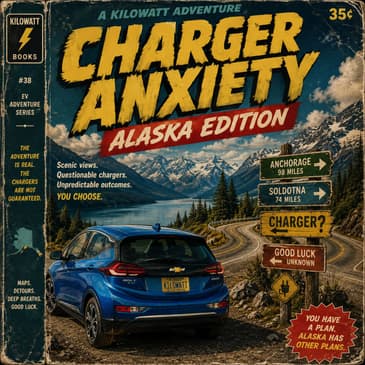
This week, Bodie covers Volvo’s upcoming EX50, Oregon’s revamped EV rebate program, and Ford’s newly named Fathom electric pickup. On the Tesla side, he discusses whether owners should be able to transfer purchased FSD after a vehicle is totaled, the Roadster’s latest “very soon” promise, Tesla’s new North American map update, and the decision not to bring back a manually adjustable FSD maximum speed. He also looks at extended-range EV maintenance and whether their gas engines may require less attention than you might expect. The second half of the episode turns to a 2023 Chevy Bolt rented for a quick trip through Alaska. Bodie shares what he liked about driving the Bolt, the features that surprised him, and the differences he noticed compared with his Model Y. He also recounts the much less predictable experience of finding working DC fast chargers while traveling between Anchorage and the Kenai Peninsula, and what the trip taught him about taking a relatively slow-charging EV through Alaska.
Other Podcasts:
Live With It:
- Vocaster Two: The EASIEST Audio Interface for Podcasters - Live With It — YouTube
- Live With It – The DTNS Product Review Show — PodLink
Publications:
News Links:
- Volvo’s next electric SUV will start in the upper $40,000 range
- Oregon's EV Rebates Are Back. Here's How To Get Up To $7,500
- Ford's Affordable Electric Truck Finally Has A Name And A Price
- Should Tesla Allow FSD Transfers on Totaled Vehicles?
- Tesla Roadster Is Supposedly (Once Again) Coming 'Very Soon'
- Tesla Rolls Out New Maps Update in North America
- Tesla Won't Bring Back FSD Max Speed Option, Speed Selection Improvements Coming
Hosted by Simplecast, an AdsWizz company. See pcm.adswizz.com for information about our collection and use of personal data for advertising.
[00:00:21] Hello everyone and welcome to Kilowatt, a podcast about electric vehicles, renewable energy, autonomous driving, and much, much more. My name is Bodhi and I am your host and it is very early. I've been trying to get my voice prepped for this show and obviously I'm not quite there yet because I thought I was, but I'm not.
[00:00:46] All right, in this episode we are going to, this weekly episode, we are going to talk about news. And before we do that, first thank you all for being very supportive. We got a lot of very nice notes over the week so it's very kind of everybody. Thank you so much. And then the Live With It episode that I was on is finally out that you can watch and I'll put links in the show notes to that as well.
[00:01:16] Live With It, if you don't know, is with Roger Chang and Sarah Lane and they just review products that you actually live with and use on a regular basis. You know, like products that you actually use. So I think it's a pretty unique take on the review show. So Live With It is on YouTube. You can also subscribe on Apple Podcasts or, you know, any other place that you get your podcasts. So I'll put links in the show notes to that.
[00:01:44] And let's see. Oh, if you emailed me a story and I are a news article and I haven't talked about it yet. I will. It's been a busy week. So I will get to those or at least some of those stories that were emailed in. Let's see. Oh, I mentioned last episode that I was going to talk about the Chevy Bolt that I rented in Alaska. And that will be at the end of the show.
[00:02:08] And last but not least, we have a new Patreon supporter, James. James, thank you so much for supporting the show. So direct Patreon support or direct patron type support is really what moves this show forward in terms of being able to pay the bills every single month. So a big giant thank you to James. And I know I owe you a message, James, and I will definitely respond to that soon.
[00:02:39] It's been a this week is already started off very busy and it's only things are only being added to it, which is mostly good stuff. All right. Oh, if you want to be like James, go to support kilowatt dot com and you can support the show there. And you can support through Supercast or Patreon. And I have some issues with Supercast, but we can talk about that at a different time. But yeah, thank you, everybody. And thank you, James.
[00:03:08] All right. Let's start off with our EV news, which I'm in the wrong section for that. Starting off, Volvo's next electric SUV, the EX50, will start at price wise just under $50,000, which is going to compete with the Rivian R2. You know, obviously the Model Y, the SUVs in that price range.
[00:03:37] We don't have a lot of details about the EX50 just yet, but we do know that it's going to be built on the SPA3 platform, which is the same platform that the EX60 is using. It's going to be closer in size to the Ioniq 5, the Toyota BZ or the Honda. Honda. Honda is not making electric vehicles anymore. The Ford Mach-E. It's going to be built on an 800 volt platform.
[00:04:05] And built in Slovakia, which I thought was interesting. We are expecting Volvo to unveil this car by the end of the summer, and then it'll arrive sometime in 2027. So, I mean, this is super cool. Another, I mean, affordable is a relative term, but another semi-affordable EV at the $50,000 price range is a welcome addition.
[00:04:33] A welcome addition, because when that car goes on sale or the leases come up, that'll bump it down to a more affordable used car for everybody. I mean, not everybody wins immediately, but it's much better than where we were. Not all the cars. A lot of the cars started at, you know, $75,000. We're bringing that price down, finally.
[00:05:00] Next up, Oregon revamped its EV credits. And, you know, I think it's pretty generous. It is not generous in one way. They take away from the rebate a little bit. But, you know, I think the overall EV incentive program is pretty generous. So, what changes is how much you can get for a plug-in hybrid, pretty much.
[00:05:27] So, in the past, you would get the same amount whether you got a plug-in hybrid or whether you got an actual EV, battery electric vehicle. And now, they've dropped the incentives down a little bit if you get a plug-in hybrid. So, let's go over that. The incentive tops out at $7,500, which is pretty crazy. But there's some layers to this incentive. So, let's go through the layers.
[00:05:56] It breaks down like this. There's the standard rebate, which anybody qualifies for. The vehicle has to be under $50,000. And the standard rebate is $2,000 for an EV, $1,500 for a plug-in hybrid. And that has to be a new vehicle under $50,000, not a used one. And you can't buy it from a private seller, although I'm not sure you'd buy a new vehicle from a private seller.
[00:06:25] But all of these incentives, you have to purchase from a dealer. So, that's the standard rebate. Pretty easy threshold to get as long as you're buying a car under $50,000. And then we have the charge ahead, which... And this incentive is only available to household incomes that are in between $51,000 a year and $251,000 a year.
[00:06:54] Which I thought it was weird to put a lower end on the income limits. You know, it makes sense to have... You know, you can't make more as a family more than $251,000. But it seems weird that you can't qualify unless you make $51,000 a year. Which, admittedly, is not as big of a threshold as it was, let's say, 10 years ago. Anyway, it just seems weird to me. But moving on.
[00:07:21] For this particular tier, you will get... If you buy a new EV, $7,500. And if you buy a new plug-in hybrid EV, you're going to get $5,000. So, that's, I still think, pretty generous. In the past, it just would have been $7,500 across the board, no matter what you bought. And then there's the used charge ahead tier. And this has to be a qualified used EV.
[00:07:50] And we'll talk about that in a moment. And you're looking at $4,000 for an EV. Or no more than 30% of the car's price. So, if you buy a car for $10,000, the max you get would be $3,000, for instance.
[00:08:13] And for the plug-in hybrids, it's $2,500 or no more than the purchase price. So, if you go out there and buy a used Leaf, like a legacy Leaf, then, you know, maybe you spent $2,200 on it. You're not going to pocket $300. I mean, you're basically getting a free car, but you can't make money off of it.
[00:08:42] I mean, I guess you could sell it, but there's some rules in there as well. So, let's go ahead and talk about some of those rules. Applicants can receive either the standard rebate or the charge ahead rebate. They cannot receive both when you're buying a car. Individuals are limited to two total rebates from 2018 through the life of the program. So, you only get two. But that says individuals, not households.
[00:09:09] So, it could be four or more, depending on how many people are in your household. Businesses can receive 10 rebates a year. That seems unfair to me. I mean, if you're only going to give individuals two, 10 rebates a year for businesses seems a little much. Vehicles must be purchased or leased while the rebate program is open. So, you can't do this after it ends and claim money.
[00:09:40] The vehicle, like I said before, must be purchased or leased from a certified dealer or manufacturer. Private party purchases do not qualify. And then, as far as the vehicles themselves go, they need to be in good working condition. They need to be capable of traveling at least 55 miles per hour. Cannot be a salvage title.
[00:10:06] Must have the ability, if it's an EV, to drive at least 75 miles. And if it's a plug-in hybrid, it needs to be able to travel at least 10 miles just off the battery. And then, to keep people from just buying these and then flipping them, the applicant must keep the vehicle and maintain it in Oregon, or at least have an Oregon registration for at least 24 months or two years.
[00:10:37] So, I mean, still seems, still, in today's day and age of incentives or rebates or whatever you want to call them, this seems like a pretty generous one. And finally, this is a little bit of old news by this time. This news came out, I think, Thursday, last Thursday. But Ford now has a name for their affordable pickup truck. It is called the Fathom.
[00:11:06] We don't have a lot of details, right? But the name, and we kind of have an approximate, you know, we know what class the truck is going to be in. So I'm just going to run down the details that we have, just in case you haven't heard. By the way, the name Fathom is unfathomable to me. I don't understand. It doesn't seem like that's the best name that they could have come up with.
[00:11:31] But Kay Hart, who's the general manager at Ford's Model E business, said that Ford is playing off both meanings of the word. One meaning of the word is measurement of depth. And the other one means to understand something. Which, I'm going to be 100% honest, seems very highbrow for a mid-sized pickup truck.
[00:11:57] Now, if you were buying, like, some sort of steampunk shelf from a fancy, really expensive store. Okay. Like, or some sort of Victorian Ikea. I would understand Fathom. But I don't understand Fathom for a mid-sized pickup truck. But it's not mine to name. Now, I actually got this news from Chris, who beat Ford's PR team to my inbox by four minutes.
[00:12:26] Which, Chris, I still owe you an email. Chris, I think Ford should probably hire you for getting information out quickly. Let's see. I will say Ford is not prioritizing my inbox for press releases. But I do appreciate that they send them. Okay. So, back on to the Ford Fathom. This will be built on their universal EV platform.
[00:12:56] It's going to be, like I said, a mid-sized truck. So, think Toyota Tacoma, Ford Ranger, Chevy Colorado. Those are going to be mid-sized trucks. So, it's going to be bigger than a Maverick. Which, I actually thought that it would be around the same size as a Maverick. So, how big it is surprises me. Now, it's not massive. It's not much, much bigger than the Maverick. But it's bigger. A little bit bigger.
[00:13:24] In terms of specs, we don't know what the specs are. But we do know that they're going to have a large, high-res touchscreen. The truck itself is going to have native Apple Maps, which I think is great. It will support Apple CarPlay and Android Auto. It'll come with Blue Cruise. But the base model, you'll have to pay extra for Blue Cruise. And I would imagine you get a certain amount of, you know, two years free of Blue Cruise.
[00:13:52] And you've got to start paying for it with the other models. But bi-directional charging, which is interesting. I mean, they have the technology. Why not use it? It'll have a digital key, which is, you know, you can unlock it with your phone, which is very, very welcome. After spending the time with the Chevy Bolt and having to remember to lock and unlock the door with the key fob, that was not a thing that I liked about the truck or about the vehicle.
[00:14:18] So it'll come with a frunk, no official word on battery size or range. But we can expect one of the models is going to be around 300 miles. And we can also expect, you know, I would expect that the base model is probably 240, 260, somewhere in there. We do know that they're using prismatic LFP battery cells, so lithium iron phosphate cells.
[00:14:42] The truck is expected to arrive in 2027, and for sure it will start just under $30,000 with the destination fee. So not too shabby. Okie doke. That concludes our EV portion of the show. And now we're going to move on to our Tesla portion.
[00:15:05] I will say that I started recording this episode at 6 o'clock this morning, and it is now like 8.15. So the first half was, all right, everybody, that completes our EV news. Let's go ahead and move into our Tesla news. By the way, if I sound different, it's because I started recording this episode at 6 o'clock this morning,
[00:15:33] and I was able to record all the EV segment, but then I had to stop because I had things to do. It is now 8.15 at night, and I am now recording the Tesla news and the rest and the Bolt review and all that stuff. I'll record that all now. But if you notice that my voice is different, that's awesome because it should be warmed up now. But if you notice that my energy is the same, it's because I was tired this morning,
[00:16:02] and now I'm tired because it's 8.30 at night and I'm old. So, you know, I'm working on different ways to get this thing out on time. I've mentioned before, I very much have this completion mentality. If I start something, I have to complete it before I move on to the next task. So I was like, you know what? I can record for a little bit this morning. Let's see how far I can get, and then I can finish it later. That is very uncomfortable for me.
[00:16:28] It does not sit well in my heart, but, you know, got to do things. Otherwise, I just avoid it, and that's not helpful either. All right, moving on to our Tesla news. Not a Tesla app had a headline that asked, should Tesla allow FSD transfers on totaled vehicles? Meaning if you crash your car and it can't be repaired,
[00:16:53] should Tesla allow you to buy a new car and transfer full self-driving to that car? My opinion is yes. You know, Tesla has made so many promises with FSD, and to this point, you know, they're working through the process of fulfilling those promises, but they haven't done it yet.
[00:17:15] So in my personal opinion, until they have reached level 5 full autonomy like they promised us back in 2017, if you bought FSD, you should get it free until that promise has been met, no matter how many Teslas you buy. The only difference, and the only thing I'll be on Tesla's side here, is if you sell your Tesla, and then you don't buy another Tesla, maybe buy a Rivian, and then you go back to Tesla,
[00:17:45] well, then I think Tesla has a point not to transfer FSD. But my opinion is, you bought FSD, you bought into a promise, some people bought into a promise multiple times, you should continue to receive what they're calling FSD, I'm using air quotes FSD right now, until they actually have FSD. That's my personal opinion on this. All right, moving on to our next story.
[00:18:15] The new Tesla Roadster. It's funny to say new Tesla Roadster, because it was announced in 2017, which was nine years ago, almost nine years ago, because I think it was announced in November of 2017. To this point, we got a preview when it rolled out of the Tesla Semi, the back of the Tesla Semi trailer. But we haven't really seen much. You know, it's been on display at different Tesla events, but we haven't really seen the full demo,
[00:18:44] and that's been promised multiple times over the years by Elon. And we just haven't really got it. Like, we were supposed to get the full demo in December, and then that got pushed, and then it got pushed again, and then it got pushed again. So it's hard to say. Even back in June, Elon said that, you know, the demo would be a month away, and now here we are in, what is it, August?
[00:19:14] Almost the middle of August. Today is August 12th. So, you know, no demos, no releases. It's kind of hard to take anyone from Tesla, give them any sort of credit when they say that it's going to happen soon. But Tesla design chief Franz von Holzhausen recently was on Jay Leno's garage, and he just said,
[00:19:42] when Jay Leno was kind of giving him a hard time about where the Roadster is, he just said very soon. What does very soon mean? I don't know. Because it was originally going to be released in 2020, and then 2022, and then 2024. Now it's 2026. It's unlikely to be released this year. What is very soon? I mean, we might get it, maybe they show it off this year. But I'm not sure that the...
[00:20:10] I'm not sure the Roadster is coming out very soon, is what I'm saying. It will come out eventually. I do believe that. But yeah. If you're reading headlines and getting excited because Franz said that this is going to come out very soon, I would temper your expectations, to put it mildly. All right. Next up, Tesla is updating its map system in North America, which is pretty cool.
[00:20:40] It's supposed to be better for people who... Really, it's supposed to be better for people with routing and stuff like that. But really, if you have FSD, you're going to really benefit from what it sounds like. I just went out before I started recording and I checked my car and it's actually currently downloading the update. This isn't one of those software updates that you're going to get an alert and then it asks if you want to download. This will just automatically download if you're connected to Wi-Fi.
[00:21:09] So mine started automatically. Like I said, it was about halfway done when I went out to check on it. So if I notice anything notably different, I will let you know. I don't have full self-driving, so I'm not sure. For me, it'll be all that different. But maybe for somebody out there who has actual full self-driving, when you get the update, maybe you'll notice a little bit better. Or maybe it'll be more apparent, I should say. And then...
[00:21:40] This next story kills me, man. Tesla isn't planning on bringing back a feature that allows you to manually set what you would like your maximum speed to be. So if the speed limit is 75 and you don't want to go over 77, your car says, too bad, I'm going to go as fast as I think you want to go. So the old system allowed you to say, I don't want to go over 77 miles an hour.
[00:22:08] The new system does not allow you to do that. The new system just allows you to choose a speed profile, and that could be sloth, chill, standard, hurry, Mad Max. Obviously, you know, they get... They start, you know, a little bit more tame and get crazier as you get up to Mad Max. I'm not sure... I'm not sure this is a good user experience. It may be that some days
[00:22:37] I'm okay with the car taking control and going as fast as it thinks I want it to go. But there are other days when I might want it to be more... closer to what the speed limit is. Maybe that's because it's during rush hour or whatever. And I realize that you can choose these speed profiles, but maybe I don't want them. Maybe I just want it to be...
[00:23:07] I don't want it to go faster than 50, for instance, for whatever reason. So because of this, yeah, Tesla's just saying we're not going to do that. Over time, the car will learn based on your personal preferences. And... then it'll determine how fast the car is going to go. I don't understand this. This seems like Tesla's taking all the liability on by saying, hey,
[00:23:37] if you think the maximum should be... maximum speed should be 55 in a 55, but we think you would prefer to go 60 and you get a ticket, you're still the person who has to pay for that ticket. You should be able to control the maximum speed of your car. All the way up and to that point, I would say if you're on FSD and you say, I want to go no faster than 57 miles an hour, then the car has some latitude all the way up to 57 miles an hour.
[00:24:08] But, yeah, I think... I'm just not a fan of this. But, the speed limit's kind of an important thing and if you're... If the car is knowingly breaking the law because it thinks that you're going to want to break the law, that's not a good thing. Now, if you have FSD and there's a way to slow that down, to slow the speed down with like maybe a steering wheel knob,
[00:24:37] maybe I'm missing something, you can go faster by pressing the accelerator and the car remembers that you pressed the accelerator, but you can't push on the brake because as soon as you push on the brake, it disengages. Maybe this is something that would be beneficial in the future when FSD is all figured out, but right now, this just... It just seems irresponsible to me. If you don't want to go over a certain speed, you should be able to say, I don't want to go over 55 or whatever it is.
[00:25:07] If you don't care, you should also be able to say that. Like, I'm okay with the car making all the choices if the person in the driver's seat who's going to be taking the responsibility makes that choice, but I'm not okay with it in this situation. It doesn't seem like it's... It seems like it's irresponsible on Tesla's part and then also, you know, kind of puts the driver in a bad spot because no judge
[00:25:36] is going to throw the case out because the car was driving too fast in FSD. you're still responsible for that ticket and then Tesla might be responsible later. They might get hit with some sort of lawsuit or taken to small claims court, but it's still going... Your insurance is still going to go up. You're still going to be responsible to pay the ticket. So, anyway, I just... That seems like a silly decision on Tesla's part. Again, when they hit level 4, level 5 autonomy,
[00:26:06] which they're not there yet no matter how much people want to write in and tell me how close they are, they're not there yet. When they hit that and have that ability and they're willing to take on that liability, then I don't... wouldn't have much of a problem with it other than it needs to be safe. It's not like humans don't speed. All right. So, that completes our Tesla news.
[00:26:36] Let's jump into our Chevy Bolt review. Now, this was a 2023 Chevy Bolt. I don't remember exactly what the trim level was. It wasn't... it wasn't super fancy. So, I just want to make that out of the gate. It wasn't like the best trim you could buy, but it probably wasn't the worst one either. It was probably whatever, you know, they're using for fleets. I rented from Avis. So, when I found out that I had to go
[00:27:06] to Alaska, I was like, okay, Alaska in August is kind of expensive. If you're not familiar, that's when all the tourists go up there. When I went up in April, it was about, I think it was like $80 for the three days that I had the car. It might have been like $120, but it wasn't much for the three days that I had the car. when I went up this time, I was in Alaska for 48 hours. So, I didn't even have the car for 48 hours, but I was in Alaska
[00:27:36] for 48 hours and it cost $546 to rent this car. And it was actually somewhat affordable because what I told Avis on the Avis website, I said, I don't care what car you give me, just give me the cheapest price. And that's what the cheapest price was after taxes and all that stuff. So, when I got to the ticket counter at like 1130 at night at Avis, not the ticket counter, but the rental counter, the person asked me my name. I gave her my name.
[00:28:06] She's like, I don't have your reservation. We went back and forth. Turns out she was spelling my last name wrong. So, once we've got that figured out, she asked me for my email address and I said, like the one I booked with and she's like, well, I don't have any other one. And I said, okay, like I'm not sure because I have several email addresses I have business accounts. And I was like, can you just tell me which one you have there? Because I don't, I don't know which one I used. And I started off with, you know,
[00:28:35] Bodie at 918digital.com and she said, so that's your email address? And I was like, I don't know, can you confirm that that's the one that I used? And I was like, I can look it up, hold on, and I'm trying to look it up and there's lots of people behind me waiting to get their cars and, you know, they want to leave. But it turns out Avis in Anchorage is not part of Avis rental car and they don't have any of your information. So she wasn't confirming. She literally, all she got was my name and what car I picked. She didn't have any other information
[00:29:04] on me whatsoever. And this became a very bad customer experience, I'm not going to lie, from the get-go. The lady was very nice, it's not her fault, but I actually prepaid for my rental and she's like, yeah, I don't have that. You didn't prepay us, you need to pay us now. That's the kind of conversation we had at 1130 at night after I got off the plane. And, you know, I always try to be nice and polite to people and I don't try to be mean,
[00:29:33] but I was definitely thinking to myself, I will never rent from Avis rental car again based on this experience. It was awful. So, the people who checked me out were very nice. When I say check me out, like when they did the inspection with the car before I left, all very nice. I was able to drive the car away, they said, do you have a Chevy Bolt? Do you have a problem with electric vehicles? And I'm like, of course I don't, I don't have a problem with electric vehicles. Well, I get in the car
[00:30:04] and I realize I don't know how to drive a Chevy Bolt. After, you know, just kind of getting myself acquainted, it's fairly easy. You know, it's not, it wasn't too terribly difficult in terms of learning how to back up and stuff. It took me a little bit to learn how to use the HVAC system like the climate controls because it was dark and I couldn't see that there were buttons to make everything easier. But initially, you know, driving was fine.
[00:30:34] I drove to my hotel, which was about three minutes from the airport, parked my car, got in, went to sleep, woke up the next morning and I had a little on the way back to my car when I was, when I was going to the airport, excuse me, I had a little moment where I was like, I'm in Alaska. I know Solvatna has supercharger or like DC fast chargers for Teslas, but I don't know if they have anything else for any other car and I'm about to travel 160 plus miles
[00:31:04] in a car that's got about a 250 mile range. Before I leave Anchorage, I should, when I wake up the next morning, morning, I should check to see if they actually have, you know, CCS chargers in Soldatin or Kenai and if they do have them, are they working? Because I don't want to drive all the way down there and be stranded. Now, Avis did put a level one charger in the car, so that's nice. So I had that ability
[00:31:34] if I needed it to, I can drive to one of my family members house and plug in. But other than that, like I did not have, I did not have super high hopes that I was going to get, like they did have the CCS chargers, but I was like, man, fingers crossed, are these, are these going to actually work? And we'll get into that in just a second. So just, you know, to set the scene, I'm driving from Anchorage to Soldatna to Kenai. Soldatna and Kenai
[00:32:04] and Nikiski are on the Kenai Peninsula and they're all fairly close, as close as you get for Alaska. And then, I'll be driving from Nikiski, stopping in Soldatna and then driving to Anchorage when I leave. So that's, that's, that's my route. And in there, I was in, you know, Kalifornsky Beach and all that stuff. If you want to look all that stuff up, you can. By the way, in my community that I grew up in, so many weed dispensaries, so many.
[00:32:33] And there was a brothel that was not technically a brothel, but everybody knew it was a brothel that is now a ministry. It was called Edie's and now it's like a ministry, which made me laugh when I drove by it. But anyway, the next morning I wake up and I'm like, okay, I'm going to see what this car has to offer. I will say the climate control, very nice. Actually, you know, let's start with the exterior. I don't like the look of the Chevy Bolt. It's functional, but it's not a car
[00:33:03] that I look back at when I park it and go, that's mine. But when I got inside, I found it to be surprisingly comfortable. The, where the instrument cluster sits and the shape that it's in, no matter kind of where I had the steering wheel and I'm 5'10", no matter where I had the steering wheel positioned, I could see that instrument cluster pretty easily. Whereas my wife's like Kia, for instance, I can't really, I have to have the steering wheel right in the right place to be able to see everything. This one was
[00:33:33] very easy to see. So that's really good. The layout of the car was nice and did have Apple CarPlay. So I spent most of my time in that and that worked really well. Actually, the only problem I had was when I was trying to connect it, it gave me like connect to this my Chevy, whatever, and when I connected my phone to it, there's a button on the screen that shows you, that tells you to pair, but I thought I was
[00:34:02] already in pairing mode and so at first it didn't work, but then when I realized I needed to hit the pairing mode, then it worked fine. So no issues with the Apple CarPlay. In terms of like the overall driving experience, it was easy to drive, it was very comfortable. Cabin noise wasn't, you know, it wasn't noticeably worse than my Model Y. It actually felt like fairly comparable to what the noise that I have in my Model Y
[00:34:32] compared to the Bolt. The big difference that I found is when you step on the accelerator of the Model Y, you go, but you're not like pulling to the left or pulling to the right or the car doesn't get squirrely. When you get on it and accelerate, for safety reasons, you have to accelerate really fast, the car just is rock solid. The Bolt, on the other hand,
[00:35:00] when I accelerated quickly for safety reasons, I noticed, it got a little squirrely and it pulled to the right. I don't know if that's a Chevy Bolt problem or if that is a problem with the rental car that I happen to have. Maybe that's specific to that, but, you know, it's not as fast as my, or it doesn't accelerate as quickly as my Model Y does, but it's still, you know, pretty torquey because it's an electric vehicle, but it did get
[00:35:30] a little squirrely and it felt mildly unsettling when it pulled to the right because it would just keep pulling. So, I didn't really push that too terribly much, but yeah, that was, that was really my only complaint. Oh, especially when you were accelerating with the Model Y, the steering changes when you're accelerating. So, if you make
[00:35:59] a micro movement to the left or to the right, you don't really feel it because the car adapts. With the bolt, you definitely, if you make just a small turn to the left, it feels like it's overcorrecting to the left. And it wasn't necessarily scary, but it was noticeable enough that I picked up on it and didn't want to do it multiple times. But in general, the car, if you're just driving around, the car drove fantastic. And it felt really good to drive. Like,
[00:36:28] I looked forward to driving this car. I don't necessarily think that it's something that I would choose over my Model Y, but I would definitely consider it as a second car or maybe a car for my kids because it felt safe, it felt solid. The only thing that would give me a little bit of pause is if they were, you know, if they decided to be stupid teenagers
[00:36:58] and step on the gas and it does pull to the right, then that might cause problems for them and me. Like, I wouldn't want my kids to get hurt and I wouldn't want my insurance to go up either or anybody else to get hurt for that matter. So, again, that's the only thing. In terms of features that I just was tickled by, there were audio controls on the left side of the steering wheel where you can make the podcast that I was listening
[00:37:27] to either skip forward, I think it was by 15 or 30 seconds, or skip backwards by the same amount. And that was just right there on the steering wheel. there was like these little paddles and there were just little buttons on the backside of the paddle. So, that was cool. And on the right side there was a volume under the same paddle. So, that was a really, really, really cool experience figuring that out because I didn't, I was just playing with it because I didn't know what was going on and there is a little delay
[00:37:57] when you hit the skipping button before it actually skips. So, I was playing with it and the podcast was doing weird things. So, it took me a second to figure out what that weird thing that it was doing that I was causing it. I thought maybe because I was in the middle of nowhere, maybe my sales service was bad and maybe the, you know, I was just running out of bandwidth or whatever. But no, it was me. It was all me. Now, as you might expect,
[00:38:27] between Anchorage and Soldotna is not a lot. there's a lot of abandoned cars and a lot of trees and beautiful lakes. That's what's in between Anchorage and Soldotna. But I checked on a better route planner and actually used the Apple CarPlay or Apple Maps feature to find chargers and that actually worked really well. It didn't necessarily mean that the chargers were working. It just meant that it found them. So, the first place
[00:38:57] that I stopped was in Sterling, which is outside of Soldotna. And there's a, there's a, there's a chain called Three Bears in Alaska. And I stopped at Three Bears because I was like, oh, well, Three Bears is a reputable chain. It's probably got chargers that actually work. And the, the Tesla, or not the Tesla, the, the Chevy Bolt can only charge at 50 kilowatts. It's very, very slow at charging. But the good news was the EV chargers
[00:39:26] at the Three Bears, they were EV, EV gateway chargers. And they only charged at 50 kilowatts. So, I was like, well, this is a perfect match. Um, but unfortunately, I kept getting an error. I eventually called customer support because I tried multiple chargers. There was, uh, let's see, four, uh, uh, DC fast chargers and I think four level two chargers. I didn't try the level two chargers,
[00:39:55] but I kept getting an error when I was trying to, to charge on the DC fast chargers. And, um, I called customer support eventually and they said the problem was there was some sort of power problem at, at that location. So I had to move on. So I went to a better route planner and there were blink chargers and free to move chargers in Soldatna. So I went to the free to move charger, which is in the same location as the blink charger, which happens to be a Ford dealership, which was nice.
[00:40:25] So I, I tried the free to move charger first and I downloaded the app. The process was confusing. I didn't, I couldn't figure out how to add the charger I was at in the app and it wasn't showing up like it was showing a free to move chargers in like Washington and I don't know, it just was a mess. So that definitely was a dead end. And now I'm starting to feel a little bit of anxiety.
[00:40:54] I know in the back of my head, I can go to one of my family members house and do the level one charging. But I also know in the back of my head that that's car is going to pretty much sit there until I leave in order for me to have enough charge to get back to Anchorage. There were all sorts of level two chargers in the parking lot of the Ford dealership and I was like, man, that is not what I need. And I, I was driving out and I noticed that they had a DC fast charger
[00:41:22] that was a blink fast charger and I was like, awesome. There were two charging cables off of this charger and the spot was open and I can charge and I was like, fantastic. So I go over there praying that it charges, plug everything in and it works. Um, I was very, very excited about this. Uh, because, you know, I had quite a bit of energy to put in the car. You know, I walked over to Fred Meyer and walked around Fred Meyer for a little bit and, you know,
[00:41:52] just walked to Petco, just little things here and there so that I can, uh, fill my time out of the car. And, uh, I, I, the car charged up to, you know, 80%, um, and it took, man, at least 45 minutes if not a little bit longer. But then after that, um, I was good to go. I checked my credit card statement and it only preauthorized me like $15 charge. So it only charged me $15, but I knew that was going to change. And eventually that number
[00:42:22] was $24. So it took me, it cost me $24 to charge, uh, the, the 7-11 or whatever it was, the grocery store or, um, convenience store next to the charger. It was like $4.50 or $4.60 a gallon. So it definitely would have been more money in gasoline to fill up than it was at the, the EV charger. So that was nice. Um, one problem that was, man, just kind of prevalent
[00:42:51] all over the place was the screens were very, very hard to read in the sun. And we're talking Alaska. Alaska is not Arizona. You know, a lot of the time I was there was kind of overcast in different portions of the day and it was just very difficult to read the screen. So I was just praying and hoping that I was doing the right thing to get these things to work. Um, but yeah, that was pretty much my charging experience
[00:43:20] on the way to Kenai. Leaving was a little bit of a different story because I went to the same DC fast charger and like I said, there was two charging cables there. The second charging cable that I didn't use the first time I tried that one that did not work. That was not working at all. So I plugged the one in that I used the first time. Everything worked fine there. And hopefully this is all making sense to everybody. Um, and then I was able to get back to the airport and the nice thing about
[00:43:50] the dealership or not the dealership, the rental company in Anchorage is they told me I didn't need to bring it back charged because that would have been a nightmare. Um, but on the return trip, you know, I had about 147 miles roughly remaining on the battery and I, I, you know, basically was like, I'm going to be going up to Anchorage going through the mountains. What should I do here? And the Gemini was like, you should charge to
[00:44:20] at least 200 miles, uh, so that you can make sure that you make it. And I did, uh, I don't remember exactly. I think I probably had like maybe 40 miles left on the battery when I turned it in. Uh, the process of turning it in was fine, but I'm not going to lie. The, the, the, the moment, uh, of, of when I was getting down into Slaughter, again, I spent 48 hours in Alaska, so I didn't have a lot of time to, um,
[00:44:50] just, just spend time to learn about the car or find different alternatives as far as charging. I was, I was going to go with the ones that worked and that was it. Um, after going to three bears and that not working and the free to move and that not working, I was very stressed out that this was not going to be a good, um, experience for me and I was going to have to tell this story and it was going to be that I was stranded because I couldn't get my car to charge.
[00:45:19] But in the end, you know, everything worked out for the good. And I think that second charging session cost me about $20. So all in total, I was about $45, less than $50 for sure, for charging my car, which is great because Alaska, I would have had to fill up in Soldotna when I got there, I would have to fill up in Soldotna when I left, and then I would have to fill up again when I got to Anchorage to turn the car in. So that part of it was a positive.
[00:45:49] So if we're looking at all of this and we're just kind of looking at the takeaways in terms of what I thought of the Bolt, and I know that was all of this is a very long and drawn-out process, and hopefully everybody's with me and you're not bored or confused for that matter. The exterior of the car did not win me over, but the interior is comfortable, the instrument display was great, the cabin noise was reasonable, it was easy to drive,
[00:46:19] and fun to drive, which was something I honestly didn't think that. I've ridden a Bolt before, but I'd never driven one. The controls were thoughtful, whether it was the climate controls, to turn on the heated seats, or to change the volume on the radio, or I didn't play with the radio at all, so I don't know how that went, but everything felt very intuitive and thoughtful. The biggest negative was
[00:46:49] not the Bolt. The biggest negative was the charging experience on the Kenai Peninsula. The power problem with the first charger, and then couldn't figure out how to use the second charger, that was not a great experience for me, and that's the experience that people have had since they started driving EVs, so that's not new, but that is something to think about in the area that you're going to be in, especially with companies in North America moving away from CCS
[00:47:18] and to the next charger, there's not as much incentive for companies to build a CCS charging stall for you if you're going to have a car that has CCS. It's not to say that they won't, it's just going to be like they don't have a huge incentive to do that. If they're using federal funds or state funds, they definitely probably have
[00:47:54] a reputable adapter that goes next to CCS so that your charging experience or charging opportunities are maximized. But overall, it was a fun adventure. I mean, the reason I went to Alaska wasn't fun, but my experience with the Bolt was a fun adventure and I really, really enjoyed it. I did, this is not the Bolt's fault, but I did
[00:48:24] stop at Taco Bell after I left the charger in Soldotna and I was like, I had a brand new shirt on and I changed out of my funeral clothes. I had a brand new shirt on, fairly new shorts on and I was like, I really want a bean burrito. I don't eat beef or pork. So I was like, I really want a bean burrito and a quesadilla and there's a Taco Bell right there. And I was like, but if I eat the bean burrito, there's a chance that it might spill on my shirt and these are the last of my clean clothes. And this is really an indictment on Taco Bell.
[00:48:54] But I decided to get the bean burrito anyway. And I don't know if the people did not fold the bottom because I kept the wrapper on because I was very careful, but it just all came out. The entire burrito pretty much just came out on my shirt and on my pants and I was in a time crunch and I wasn't sure if I could, you know, if I even had enough time to pull over and change my clothes. I ended up pulling over halfway
[00:49:23] and changed my clothes and then when I got to the airport I'm rinsing out bean burrito out of my clothes, which made it look like it was something else entirely when I was in the bathroom. So it was an embarrassing experience. But I'm happy to say that the shirt that I spilled the burrito on is the shirt that I'm wearing today and it there's been any problems. I also bought some shout when I was at the airport and tried to shout it out as much as I could. But yeah, it was gross and embarrassing.
[00:49:53] I didn't want to go through security like that for sure, but I was able to change my clothes into somewhat clean clothes. Not clean clothes, but somewhat clean. All right, everybody, I think I've taken too much of your time rambling. If you have thoughts, you can email me Bodie, B-O-D-I-E at the I have received a lot of congratulations and a lot of condolences. Congratulations on the
[00:50:20] 10 years, condolences on my hand. Thank you everybody for all of that. A lot of folks have been enjoying the interviews recently, and we have more interviews coming up. So thank you very much for the encouragement on the interviews.
[00:50:50] We'll definitely continue with those. I have to space them out though. It's not more work to record and edit an interview, but it is a lot more work to set interviews up. It's a lot more time consuming. Maybe someday this show will make enough money that I can have a producer and I can just scoop that off my plate, but as of right now, it's a single person operation. So I would like to do more of them and maybe when I retire, I can have the
[00:51:20] time to do that. But as of now, you know, three or four a month, maybe two or three a month is probably reasonable. But I can get enough interview requests. I couldn't do one every show, but I could do one pretty close to every show. And I could do one with every show if I didn't have scruples, if I didn't have morals, or, you know, if there are so many people that pitch me on having
[00:51:50] somebody on that has nothing to do with what we talk about in the show. And sometimes I'll do that if I think it's a meaningful enough interview, but it's pretty rare. So, but yeah, I appreciate everybody's kind words. That's a really long way to say that. So I can tell that I'm tired because I am definitely rambling. If any of this made sense, just shoot me an email and said, made sense to me, or it did not make sense to me.
[00:52:21] All right, everybody. Thank you so much for supporting the show, being a part of the show, contributing to the show. I appreciate each and every one of you. Have a wonderful day. And I will talk to you soon.