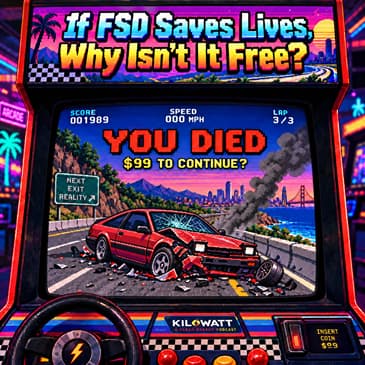
Volkswagen is recalling more than 22,000 ID.4s over a potential battery fire risk, while Einride has deployed fully autonomous electric trucks in Ohio. Rivian is getting into the Halloween spirit with a Ghostbusters-themed software update, complete with a special Ecto-1-inspired R1S, and BYD has filed a patent for a new battery cooling system that submerges battery modules in a specialized liquid. In Tesla news, the company has officially adopted the name "Dumb Summon" for its original Summon feature as part of a broader rebranding effort in Europe. Tesla has also renamed Full Self-Driving to Tesla Assisted Driving following discussions with German regulators, who are now supporting the company's push for broader European approval. A Reuters investigation examines Tesla's campaign to pressure European regulators and raises questions about the safety evidence supporting its claims. The episode closes with a personal discussion about Tesla's argument that delaying FSD approval could cost lives, and whether a company making that claim should charge customers for the technology.
Click Here to Support the Show
Other Podcasts:
Publications: News Links:EV News
- VW ID.4 Recalled Over Fire Risk, Owners Told Not To Charge Past 80%
- Pssst! Wanna See A Driverless Electric Truck?
- Rivian brings Ghostbusters to its vehicles in 2026 Halloween update
- BYD puts battery cells directly in cooling liquid in new patent
- Tesla Officially Renames Original Summon to ‘Dumb Summon’
- Tesla drops ‘Full Self-Driving’ name in Europe after Germany pushback
- How Tesla Is Pressuring European Regulators To Approve FSD
Hosted by Simplecast, an AdsWizz company. See pcm.adswizz.com for information about our collection and use of personal data for advertising.
[00:00:21] Hello everyone and welcome to Kilowatt, a podcast about electric vehicles, renewable energy, autonomous driving, and much, much more. My name is Bodhi and I am your host. And on this episode, we're going to cover news, the EV and Tesla variety. This is a very late weekend edition. I'm recording this at 942 PM on Sunday night. So because it's so late, Tuesday's episode might actually be an interview.
[00:00:51] I haven't quite figured out what I'm going to do just yet, but I'm interviewing somebody tomorrow morning. So that might be Tuesday's episode or we might jump into news because I still got quite a bit of news and things to talk about. So it just kind of depends on how Monday and Tuesday goes for me, what that episode will be.
[00:01:07] And then our weekend edition episode or the one on a Friday, as long as Tesla actually, you know, has the Tesla Roadster event on the 15th, which is Thursday, that will be our weekend episode. And if I can record it on Thursday and get it out on Thursday, it will be the weekend episode, even though it's being released on a Thursday, which is a weekly episode technically.
[00:01:33] But on these kind of events, I kind of like to release it as soon as possible, as soon as it's possible for me, not as soon as it's released, just as soon as it's possible for me. Anyway. All right, let's go ahead and jump into our EV news. Starting off, Volkswagen is recalling 22,524 ID.4s. There is a fire risk with the high voltage battery, but it's unknown what the exact issue is.
[00:02:01] All of the incidents reported occurred when the car was charged over 80%. So the temporary bandaid here is a couple of, they have a couple of solutions. One is obviously don't charge the car past 80%. That's a big one. The other one is they have these stickers that they want to put in key places to remind you not to charge the car past 80%.
[00:02:27] I'm not sure if they're going to send you the stickers and let you put them on themselves, or if they'll make you take it to a dealership and the dealership will put the stickers on. But that seems silly. The other one, which is obviously, to me, seems like the most obvious way to go is to include an over there update that will keep you from charging the car past its 80%.
[00:02:51] I would imagine that's going to be the most reliable above the stickers or relying on people to actually follow your directions and not charge the car over 80%. Now, the good news is, if there is good news in this situation, there's only been 22 incidences of, or incidents of fire between January 18th, 2024 and August 7th, 2026.
[00:03:20] So 22 is not that many. The recall does include ID4s from model years 2023 to 2026. So whatever the fix happens to be, all of those model years, or all of the included model years in the recall will get the fix. But VW is, they think that only 0.1% of the cars in that model year, in those model years, are actually affected.
[00:03:46] So, I mean, it's not, this isn't a run around with your hair on fire kind of news, but it's a, let's be aware of this kind of news. But good on VW for getting this fixed. All right. We've talked, you know, with the Tesla Semi event, we've talked quite a bit about electric semis.
[00:04:09] In the past, we've talked about Inride's semi and autonomous driving efforts in the, a little bit, not a lot, not a lot. But Inride, which is a Swedish company, they have deployed two autonomous electric trucks. Autonomous, by the way, not, not driver, uh, supervised, but autonomous electric trucks in Marysville, Ohio. And they are working with Ease Logistics, which is a Columbus, Ohio company.
[00:04:38] But the trucks have no cab. So, it's not even, if they wanted to put somebody in there to monitor or sit in the driver's seat, they couldn't, because it doesn't have a cab. The trucks operate at level four autonomy, meaning they can drive themselves without a human driver under specific conditions that meet level four. So, level five autonomy, according to Society of Automotive Engineers, is you could pretty much do this, operate in level five whenever.
[00:05:06] Level four is full autonomy in certain conditions, like the weather has to be right, and the road conditions need to be just right, and that kind of thing for it to be able to operate in level four. If it's outside of those parameters, then it can't. That's, that's level four.
[00:05:23] So, Enright has been transporting freight between warehouses in Ohio since September of 2026, and they're collecting real, real world data on things like mileage, cargo loads, and, you know, reliability before expanding their operations.
[00:05:42] This is part of a larger project, which will include a 166-mile truck automation corridor, which would connect Columbus, Ohio, and Indianapolis, Indiana. Now, if you happen to be living in that area, and I know Rob Dunwood, my co-host for Beyond the Post, which is that podcast I do about being a creator. By the way, new season, season five just dropped. You can find a link in the show notes if you're interested.
[00:06:11] Rob lives in Columbus, so I'm going to ask him to keep an eye out as he's driving around and doing things. But one of the cool things that these trucks can do is platooning. So, you have like one truck that's in the lead, and then you have a bunch of other trucks that are following the lead truck, like a platoon. That will happen along the I-70. And if you live in that area and you happen to see this, don't take a picture unless you're a passenger or have a passenger take a picture. But take a picture and send it to me.
[00:06:40] If you're a driver, do not do that, please. Like I said, the researchers are studying how autonomous trucks perform in real-world conditions. And in the article, it said including Midwest rain and snow. However, some of those conditions might take them out because of level four rules. But I'm sure they've thought about this stuff.
[00:07:05] And then in the article, there were other examples of what Enright is doing in terms of autonomous trucking. But they're really similar to this one, so I didn't include it. Kind of as a side note, if I could just add a Tesla story real quick to this. Tesla started installing semi-mega chargers at pilot travel centers, which is expanding the charging infrastructure for electric trucking. Mostly in this case in the southeast, but I'm sure that they're doing this everywhere.
[00:07:34] There's a route that their buyers, the people who bought the Tesla semi, are expected to be traveling. So, all right. Let's talk about Rivian's annual Halloween theme. It is out now, and it is Ghostbusters themed. So, I thought this is so cool. First of all, Ghostbusters, one of my favorite movies as a kid. Still one of my favorite movies as an adult.
[00:08:04] The original Ghostbusters movie, loved it. Could not watch it enough. Probably ruined the VHS because I watched it so much. Fantastic movie. In terms of how Rivian deployed this Ghostbusters theme to their cars, there's changes to the displays, the lights, and there's different sounds and effects. There's a spooky voice assistant. You know, you can do a scavenger hunt and find hidden characters in different places in the interface.
[00:08:33] And then there is a Ghostbusters game that you can play when you're parked. And some of the Halloween themed features can be found in Rivian's mobile app and the smartwatch. I don't have a Rivian, but I really want one based on this. And the charging station screens at Rivian's charging stations, they also have the Ghostbusters theme as well. So, they're really deploying it across the whole Rivian platform.
[00:09:01] In terms of doing something really cool, like a really cool one-off, Rivian built an Ecto-1 R1-S. So, this is the, if you're familiar with the Ecto-1 in the movie, it's like an old ambulance slash hearse from like the 60s, right?
[00:09:26] The Ecto-1 R1-S is obviously, it looks very futuristic, but it is, it's got, I don't know, it's got, okay. So, okay, sorry, not good podcasting. This is, this is truly like fills my soul with happiness, right? They made a video and I don't know if you're familiar, but if you're of a certain generation, you know who Slimer is. It's a little green ghost.
[00:09:55] They made this video, it's not very long. It starts off, there's some odd lights above a house and then it shows Slimer eating a bunch of food out of the refrigerator. And Bill Murray's driving the Ecto-R1 and it's got the old timey sound. I've heard people love my sound effects. So, that was, that's the Ecto-1 sound. Anyway, Bill Murray's driving this thing and he drives the Ecto-1 up onto a lawn.
[00:10:22] He flips a virtual switch on the infotainment screen, which I'm assuming you will have as an option in your car if you have an R1 or R1-2 or R2. And then it activates the ghost trap, which happens to be in the frunk of the car and Slimer is pulled in from the house, safely stored into the ghost trap, which is in the frunk. All of this met my wildest dreams as a child.
[00:10:52] I would like, I would buy a raffle ticket to go to charity. I'd buy a raffle ticket to win this version of the R1. I think I would have, if I won, I would have to take this stuff off the top of the car because it's got, you know, the, um, I can't remember what the, oh man, what's the, what are the devices that they use? Ghostbusters.
[00:11:24] I'm going to look this up. Proton pack. It's got a proton pack on the top and the ghost trap, like I said, was in the frunk of the car. But I would love, I would have to take the stuff off the top. Um, but I would keep it, I would keep it white. I would keep the ghostbusters logo on the side of the car. Um, I would love driving this around every day. It'd be amazing, but, uh, I'm sure they won't do that.
[00:11:46] Now here is the only bummer and the only negative that I have for this is Halloween mode is only available from October 9th to November 2nd. And that's it. Then you don't get Halloween mode anymore and you don't get the ghostbusters anymore. And I think that is a shame one that should be a mode available forever. And if you don't want to pay for it, charge a little bit and let it, let us, let us have it forever.
[00:12:14] Again, uh, that would be amazing. Uh, I, I, I think I want to scout a pickup truck for my next car, but if the R2 came with this, um, 24 seven, I would really like, I like this. I like the R2 a lot. It would be a, it would be a hard choice for me just because it has this ghostbusters feature. All right. Um, that is if they extend it past November 2nd. All right.
[00:12:44] We're going to talk about batteries or real quick. And I think this is cool battery technology. I'm going to tell you though, it is a patent application. It is not something that's currently being built. So I want to be very clear on this, but BYD has a, a new patent that they filed for to keep batteries cool by submerging the battery modules directly into a special cooling liquid.
[00:13:11] So the way that most battery packs are cooled is through indirect cooling. And it's not to say there's not, there's not other, um, batteries out there that use submersion cooling. Cause there are, and I'll tell you why the BYD one is different, but how most battery packs like in your EV will cool is there's these cooling plates or channels that carry coolant alongside the battery modules.
[00:13:36] So the heat has to travel through the modules and the, the cooling plates to, to be able to reach the coolant, to transfer that heat away. BYD's approach is to put the battery modules directly into this cooling liquid and allow the heat to transfer away directly, which is super cool. Um, the best way I could think of describing how this works is if you had a cooling plate
[00:14:06] and you put a warm soda on that cooling plate, eventually the soda will cool, right? It may not even be cool. You could leave it there for probably a day, depending on how cold the cooling plate was and you would maybe be able to drink it. Nobody likes to drink warm soda or at least nobody I know. So if you took that same soda and you put it in a cooler with ice and water, it's going to cool that can much, much faster.
[00:14:35] And that's how this technology works. The liquid that, uh, BYD is using, and I would imagine other companies use this as well, is called dielectric fluid and it doesn't conduct electricity under normal conditions. So if something fails, it's not like it's going to all of a sudden become a hazard under normal conditions.
[00:14:59] So I don't know what the abnormal conditions would need to be, uh, in place for it to conduct electricity. I would imagine there needs to be something foreign inside that fluid that does conduct electricity, but I don't know. I'm not a battery engineer. Um, but needless to say, this isn't like water or some sort of, you know, automotive coolant type stuff. This is, this is very special, specific fluid to keep the batteries cool, but also not, uh,
[00:15:29] conduct electricity. The design for this, uh, and this is what makes BYD a little bit different from what I understand is it has two compartments to keep the electrical components away from the dielectric fluid. So there's a lower chamber, which has the battery modules submerged in the cooling liquid. And then there's an upper chamber. And that is where most of the electronic equipment is.
[00:15:56] And BYD routes different electronic components through the top of the liquid filled compartment to the, um, to the, uh, to the top chamber, the upper chamber. And by doing this, they are reducing the hydraulic pressure, the pressure from the liquid on the seals. And ultimately the way that they're doing this could help prevent leaks.
[00:16:25] So why all this matters is the direct immersion improves heat transfer to help keep the battery cool and more consistent temperature, which provides for better thermal management, which includes improves like battery performance and longevity. It also could, you know, help for a place like in Arizona, for instance, where it's just really, really, really hot. Oh, you know what? I don't think I said this at the beginning. This is for stationary storage only.
[00:16:54] This is not for automotive uses. And the reason why is, you know, if you're, if you're driving around and you have a, um, you have a bunch of fluid, even if it's kind of thick moving forward and backwards and making turns that throws the whole balance of the car off. So not, not a great application right now for automotive use.
[00:17:20] I'm sure at some point in time, they might be able to find a way to make this work for cars. But right now it's just stationary storage. And I will tell you just to kind of anecdotally, right? When I was, uh, in Idaho as a firefighter, we did a lot of wildland, a lot more than I do now. And we had a 4,000 gallon water tanker.
[00:17:43] And based on whether that truck was empty, full or half full, it, um, it performed very differently. If it was full, it was slow, sluggish. And you had to be really careful with the turns. If it was empty, it was very fast. You still have to be careful with the turns, but the water wasn't going to like the motion of the water wasn't going to carry you through a turn and flip the truck over. Right.
[00:18:10] But when it was half empty, that was the most dangerous because that was when the water was moving the most. So when you would stop, you could feel the water hitting the front of the water tank and continuing to push you as you were trying to stop. So yeah, um, having liquid in, in like that in an automotive, uh, use would definitely be
[00:18:35] a challenge just for people who are not trained to drive with that kind of, um, uh, movement. It probably also wouldn't be a great consumer experience just in general, but getting back to this patent, I think this is really cool. And I do think we'll probably see this in BYDs battery storage applications at some point, and probably not that, not that far away. If I had to guess. All right.
[00:19:04] That is our EV news. Our Tesla news is a little bit shorter, but before we get to that, I do want to let everybody know if you want to support the show, you can do so for as little as a dollar a month, you can get rid of the ads. So all you have to do is go to support kilowatt.com and you can choose to support the show through supercast or Patreon. All of the money that gets, uh, that is provided by, uh, our supporters, by our patrons, that
[00:19:33] money goes right back into the show to pay for things like Riverside. So I can do interviews, upgrade equipment. Um, you know, there are a bunch of other subscriptions that you have as, as a podcaster to make your job easier. It goes to pay that kind of stuff as well. So patreon.com forward slash kilowatt or support kilowatt.com. Okie doke. Let's move into our Tesla news. Tesla has officially introduced a new feature, which is replacing an old feature, which isn't
[00:20:03] really new at all called dumb summon. So the original summon feature, which Tesla introduced, I don't know, however many years ago is or was, I guess, used internally with Elon Musk and the Tesla executives as they used to call it dumb summon. So it allows their, the allows owners, Tesla owners to move their vehicles, uh, straightforward or backwards using the Tesla app or a compatible key fob.
[00:20:31] If you have a car that's old enough for that, it's very useful for getting out in and out of your car and tight parking spaces or a garage without being having to get inside. Just kind of anecdotally here, when I was using my daughter, my daughter went on some vacation. I remember where they went and they were storing their car here at the house and they were letting me drive it because I didn't have a UV at the time.
[00:20:57] So I was getting a really good opportunity to drive an EV and they have FSD and they had at this time it was summoned, but they had dumb summon, uh, which is what it's called. Now I was parked at a safe way and I got out of my car or out of their car, went inside, did my shopping, came back and another Tesla driver had parked so close to the car that I could not even open
[00:21:23] the door a little bit without hitting their car. Like they were so close to the car. I do not know why they did this. I do not know what was in their head. I don't even know if they recognized that they were that close to the car, but it was just ridiculously close to the car. And I, I, at first I was like, well, I don't know what to do. I just, I guess I sit here. And then I realized that they had the summon feature. So I tried it through the Tesla app and I was able to move the car back.
[00:21:53] And get in and drive away. And to me, that was an amazing experience. It is not, uh, I just want to be clear. This feature is not to be confused with actual smart summon. This was just, you know, dumb summon, but just being able to back the car out so that I can get in without damaging my daughter's car or the car next to it was pretty cool. Uh, I thought I was very impressed. Let's put it
[00:22:20] that way. So dumb summon, uh, is now just a basic feature. It still sounds like you have to have, uh, FSD subscription and it's, I mean, I wasn't a hundred percent clear on this and maybe if somebody else there knows, let me know, but dumb summon, it seems like this is for Europe, not necessarily for, uh, the U S seems like this is a European thing. And if you have, uh, enhanced autopilot,
[00:22:50] that's what this seems like it was for. And if you have the full self-driving package, then you would get the actual smart summon, which allows, you know, the car to navigate through parking lots to either, you know, um, meet you at the front of the store, for instance, or they have banish, which is the other side of actual smart summon where the car will drop you off at the front and then find a place to park. And I thought this was interesting, but actual smart
[00:23:18] summon in the U S the car can be roughly 213 feet away from you or in North America, I should say. And in Europe, it's, it's quite a bit shorter distance. It's 20 feet away. So, uh, a lot, a lot more are a lot less room to a lot less freedom for the car in Europe. I want to get back to the
[00:23:46] name change real quick. German transportation officials raised concerns that the term full self-driving was misleading because the system still requires a human driver to pay attention. And here's the big part, remain responsible for the vehicle. So Tesla agreed to change the name to a Tesla assisted driving or TAD, which I think just really unimaginative, um, of naming there,
[00:24:11] but Tesla assisted driving or Tesla assisted driving basic for enhanced autopilot versions. Uh, now Germany is now supporting Tesla's efforts to obtain broader European, uh, union approval. Uh, there's still a lot of regulatory hurdles that Tesla has to overcome, but that's, that's a big, that's a big assist from Germany. And the reason why this is important is because Tesla right now,
[00:24:40] Tesla is going from European union country to European union country. And they are saying, Hey, here's full self-driving, please approve it. And then there's a bunch of stipulations that they have to follow in each country is different from the other country. And in Europe there, you have this freedom of movement. So maybe it'll work in say Croatia, which was recently approved, but then it won't work over here in France, which has not approved it. So if they get European union
[00:25:06] approval, that's just a lot easier for Tesla overall and for a lot of different reasons. Um, Germany is helping support that there was supposed to be, I can't remember if it was supposed to happen recently or if it was just, uh, in sometime in October, they were supposed to vote on this and they ended up delaying the vote until the beginning of December. So we'll see what happens
[00:25:30] here. Now, moving on to a different story, but still keeping with the theme of European FSD approval, a Reuters investigation has detailed how Tesla has been pressuring European regulators to approve full self-driving, which again is called Tesla assisted driving. Tesla has been encouraging
[00:25:55] owners and supporters to contact government officials and push for approval. And some regulators complain about being overwhelmed with emails from Tesla supporters. I wonder how many of those are actual Tesla supporters and not bots, by the way, not to say that, you know, people in Tesla and that own Teslas in Europe don't want this. It's just saying if you're overwhelmed, I don't know what is
[00:26:18] overwhelmed to look like. Um, unless, you know, some sort of bot campaign has been sent, but anyway, they're being overwhelmed with emails from Tesla supporters. So leave it at that. Tesla argues that Tesla assisted driving improves road safety and delaying approval could put lives at risk. Um, yeah,
[00:26:45] this, this, I have a problem with, but I'll talk about that in a second. Uh, not only do I have a problem with it, but seven traffic safety researchers question Tesla's evidence, uh, that their full self driving or Tesla auto assisted driving, geez, this, this is going to be difficult is going to be, um, they're, they're, they're questioning Tesla's numbers because instead of relying on actual crash
[00:27:12] data, according to these researchers, some of Tesla's safety analysis used events like a hard breaking or honking as an indicator of avoiding potential accidents, which, you know, you could, if you're being really generous, you could maybe give the hard breaking, but the honking doesn't, that seems weird. Uh, research researchers have also questioned whether testing with professional
[00:27:40] drivers accurately accurately represents how everyday drivers would use the system. I don't know what Tesla is doing because they don't make it abundantly clear when they're testing these or how they get their data. Regulators have raised several concerns. So the system's ability to exceed posted speed limits, which in Germany, they, they approved that it could go, I think it was 10%
[00:28:04] over whatever the posted speed limit was. Uh, so regulators, um, in the EU are concerned about the car's ability to exceed speed limits, how well it actually performs on icy or snowy European roads and whether drivers fully understand that they must continue supervising the vehicle. I think these are all valid concerns and Tesla could easily, or seems like they could easily, uh, assuage these
[00:28:31] concerns, but still some regulators in the European union remain concerned about the safety evidence that Tesla has provided and, you know, the overall approval process through some of these countries. Um, you know, the only thing that bothers me about this is not that Tesla's, you know, putting pressure on
[00:28:56] European regulators. Companies do that all the time and European regulators should have the ability and maturity to resist said pressure. It's not like they're, you know, sending goon squads to their house. They are sending it. It's an email campaign. It's not, not the end of the world. I'm sure it's annoying. Don't get me wrong, but it's not like a, I don't know that it's any different than any other company that wants to do business in the EU and wants regulators to vote a certain way. They're probably
[00:29:26] using very similar, if not these exact same tactics as other companies do or corporations. The thing that bothers me is that testing Tesla's arguing that FSD improves road safety and delaying it could, delaying approval could put lives at risk. That bugs me.
[00:29:48] Sawyer Merritt on X had a post about France in FSD and France is on, not on board with full self-driving, just to be clear. Um, but Elon replied to the post that Sawyer put up and he said, delaying the approval of FSD in France will cost lives. Maybe that's true. I don't know that we
[00:30:13] would be able to say for sure that it does or it doesn't, but maybe we'll, we'll give him the benefit of the doubt and say that that's true. Elon says delaying the approval of FSD in France, again, will cost lives. It's a bold statement. And let's say that it's true by that same logic.
[00:30:33] It's pretty easy to argue that charging $99, 99 euros or 99, whatever currency to have a feature that is critical to keeping people alive, charging that much money or any money for that matter is putting people's lives at risk. So if we're using that logic, you are gatekeeping a technology
[00:31:02] that will keep people's lives safe. I don't, um, to be, to be clear, I don't think FSD is that, but if you're, if you're making that kind of a statement and you're charging 99, whatever currency for it, then you are putting people's lives at risk because you are gatekeeping that safety technology.
[00:31:31] And you can argue all day long that Tesla's basic stuff is as good and provides, you know, it'll stop the car, apply the brakes when it needs to, and all that other stuff. And there are other cars that do that same thing. And I would agree with that. However, if you're just making that bold statement on X and that it will cost lives, then you charging 99, whatever currency will cost lives.
[00:31:57] And that, that should be on you if that's the case. And it should be on France for not approving it, if that's the case. Um, but you can't have it both ways. You, you can't say that this is going to save somebody's life by having this, but I'm going to charge you $99 to save somebody's life. I don't, I, that bugs me and you can come at me with all of the Tesla data that you want, but I've actually
[00:32:26] seen what it looks like when people die in car accidents. And I don't take that kind of crap. And I almost said a bad word lightly. Like I, I know what, um, automobile accidents can do to your body. I know what it sounds like when one person in the car dies and everybody else is alive and they keep asking, Hey, where is so-and-so and how are they? I know exactly what that sounds like. Cause
[00:32:52] I've spent over 25 years, 25 years full-time, 24 years full-time, almost 25. And more than that, as a paid on call firefighter, I know exactly what those questions look like. And I know what it looks like when those family members find out that their, their friend or their family or whoever they're riding the car with didn't make it. Um, and it doesn't happen often, but it happens enough.
[00:33:22] Like it happened a couple of weeks ago that we had a similar situation accident on the freeway and, uh, it sucks. So if you think that your technology is so freaking important, again, I'm keeping my language clean, make it free. If you think it's saving lives, make it free. Don't charge people $99 for it. And then maybe we'll have less people asking, did my family member make it?
[00:33:48] Where's my family member? Why don't you tell something? Why won't you tell me what's going on? Because this kind of stuff makes me very angry. If you think it's that important, put your money where your mouth is, shut up and make it free. Otherwise, shut up. Well, that took a turn.
[00:34:20] Um, by the way, I also think it's appropriate for Tesla to detail how they did all of their testing, present their data to the EU and then allow you to see if they can replicate that testing to verify Tesla's claims. But, uh, yeah, I didn't mean for that to go there. Sorry about that. I got angry. You don't like me when I'm angry. Um, I'm not sure how to transition out of this.
[00:34:47] If you want to email me, Bodie, B O D I E at nine one eight digital.com. You can find me on X at nine one eight digital, although I don't do anything on X. And if you want to follow me on LinkedIn, it's Bodie Graham, B O D I E, uh, G R I M M on LinkedIn. And in most cases, I'll follow you back. I I've gotten a lot of followers recently on people who want to tell me how to expand my podcast.
[00:35:12] And while I recognize the, their goal of making money, um, I don't, I don't, I don't, I don't have the money to spend or nor do I feel confident that I'm going to get my return on my money for that kind of thing. So if you're listening to this show and, uh, you want to follow me because you're interested
[00:35:39] in EV is great. Um, I'm not, I'm not interested in expanding my, my, uh, my empire at the moment, but thank you. All right. Weird episode, weird ending, weird ending to this episode. I'm going to, I'm going to let it go here. I don't know how to clean this up. So, uh, I hope y'all have a wonderful week. I hope you had a great weekend and I will talk to you
[00:36:08] on Tuesday. Thanks everybody.