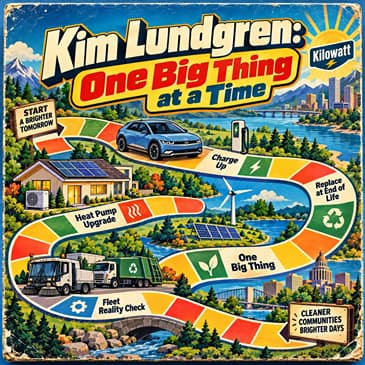
Kim Lundgren of Kim Lundgren Associates returns to Kilowatt to talk about electric vehicles, sustainability, and why going 100% electric isn't always the best approach. Kim starts by sharing how she chose a Hyundai IONIQ 5 for her teenage daughter's first car, comparing it with Volvo's electric offerings and explaining why charging, technology, safety, and long-term reliability influenced her decision. The conversation then shifts to municipal fleets and whether cities should be pushing to electrify every vehicle, including fire trucks, garbage trucks, and public works equipment. Kim explains why a more practical approach, replacing vehicles as needed and prioritizing applications where electric vehicles make sense, can be more effective than an all-or-nothing strategy. Bodie and Kim also discuss extended-range electric vehicles (EREVs), fleet maintenance, infrastructure costs, and the challenges of transitioning away from fossil fuels. Kim shares her One Big Thing approach to climate action, encouraging people to make meaningful changes when it's time to replace a vehicle or home equipment. And toward the end, Bodie discovers that something he's believed about the ozone layer and global warming since childhood isn't quite what he thought.
Other Podcasts:
Guest Links:- Kim Lundgren Associates (KLA)
- All Access With Andy Garcia: Kim Lundgren Associates
- Kim Lundgren on LinkedIn
- KLA on LinkedIn
- KLA on Instagram
- KLA on YouTube
- Hyundai IONIQ 5
- Volvo EX30
- Volvo XC40 Recharge/EX40
- Kia EV 6
- Cadillac LYRIQ
- Ford F-150 Lightning
- Scout Terra Pickup Truck
Hosted by Simplecast, an AdsWizz company. See pcm.adswizz.com for information about our collection and use of personal data for advertising.
[00:00:21] Hello everyone and welcome to Kilowatt, a podcast about electric vehicles, renewable energy, autonomous driving, and much, much more. Today's much, much more is a chat with Kim Lundgren of Kim Lundgren Associates. And Kim's been on the show before and she helps municipalities and companies and things like that move towards more green initiatives.
[00:00:46] So, but she takes, I think Kim has a very practical way of looking at things instead of let's rip everything out that's brand new. Let's look at replacing what's going, you know, what's on its way out with something that's better for the environment. So I think she's very reasonable in her, her recommendations.
[00:01:07] So in this episode, we are going to talk first about she purchased a new car and we'll wait on that to to spoil which new car it was, but I don't want to spoil it is what I'm saying. She purchased the new car for her daughter and Kim kind of went through the process of why she picked the car that she did and it was an EV.
[00:01:33] And then we're going to go, and then we're going to go, and then we're going to go, and then we're going to move on to fleets. And does it make sense to make your fleet 100% electric? I'm going to be honest, the answer might surprise you if I could give a little tease.
[00:01:49] But before we get to the interview, I do need to say, there are two swear words in the episode. I don't think they're the worst swear words in the world. And in my general life, I swear all the time. It's almost nonstop swearing. So it doesn't bother me, but I do want to let you know if you're listening with kiddos towards the end of the interview, a couple of swear words get dropped.
[00:02:13] Again, I don't think it's in the world. I left it in, but I'm just letting everybody know because I don't typically swear on the show. And if I do, it's really lame. Um, and then it's really funny. So we're going to talk about the car that Kim bought her daughter and her husband bought their daughter. We're going to talk about fleets. And then I found out something that I thought was true for nearly my entire life was not the case.
[00:02:42] Um, and Kim educates me on that. Uh, so that's at the end. So stay, stay tuned towards the end because it completely blew me away. Um, you know how sometimes when you're a child and you grow up, uh, you know, you either you were told it or that's just how it kind of formulated in your head over the years.
[00:03:01] And you think that it's fact and it wasn't. So you're going to hear me, um, learning on the podcast learning, uh, before we do get to the episode though, I do want to address, uh, the last episode when, uh, I was talking about, uh, full self-driving and Elon Musk saying that if France doesn't approve full self-driving, it's going to cost lives.
[00:03:27] I'm not going to address that on this podcast or in this particular episode, cause this is Kim's episode, but I will release another episode this week with my thoughts on it. I've gotten tons of emails, um, way more than I thought I wanted to be frank. And I've been going through and answering those emails as much as I could. I had a busy day. Um, but I'll address that more on a different episode. And I will also, uh, you know, make sure to reply to everybody's email. Uh, it's about 50, 50,
[00:03:57] mix between supportive and like, well, I think you're off the mark here. And honestly, I don't mind being off the mark. What I really appreciate to be a hundred percent honest with you as I appreciate that there, we have a community here that can respectfully disagree and share their opinions as to why they disagree or respectfully agree.
[00:04:19] Uh, it, uh, it, it actually, you would, you would think, uh, to have so many people, uh, email in and be like, I think you're wrong on this one. You would think somebody would be like, ah, that sucks. This doesn't feel very good. But for me, it makes me very excited because I am not interested in being a part of a community with a bunch of sheep.
[00:04:40] Um, and the fact that people feel that they can, you know, respectfully disagree with me, um, actually makes me quite happy. And I, I know that that might be counter to how some people see content, but yeah, it makes me quite happy. All right. If you're not a Patreon supporter or a super cast supporter, you will hear an ad right after I say this. Um, but if, if you want to become one, you can just go to support kilowatt.com.
[00:05:08] Um, and for a little, uh, $1 a month, you get rid of all the ads. So here's your ad. And now we're back. And if you didn't hear an ad, that's because you're a Patreon supporter or believe didn't have any ads to serve you in either case. Um, let's go ahead and welcome Kim to the show. Thank you. Happy to be back.
[00:05:32] I have to give you all of the flowers because, um, I use Calendly to schedule my, my bookings and you're the only one who's ever left a note. And I saw you scheduled and I was like, that's awesome. What do you want to talk about? And you're like, I left in the note. So, uh, that that's on me. I will start reading the notes again. Yeah, you should make them, make them not optional. So.
[00:05:58] Oh, that's a really good point. Normally it's PR folks that are scheduling and I already kind of know that they're going to be doing it someday, but yeah, no, you hope you have a, you have a standing invitation anytime you want to come on. Thanks. I appreciate that. Um, so today we're going to talk about two things. One, you recently bought an Ionic five for your daughter and two, we're going to talk a little bit about fleets and maybe is it necessary to electrify 100% of your fleet?
[00:06:28] So let's start with the IONIQ 5, the fun part. Do you want me to just dive into my journey here or you have a specific question? No, it's really like one, there are, there are quite a few when we say quite a few there, that's a loaded term here in the U S but there are quite a, quite a few EVs in that Ionic five price range.
[00:06:53] What was it about the Ionic five that kind of ticked the boxes that your family needed? So great. Yes. Let's dive into this and to give the listeners some context, we are a one car household. We have been for a very long time. Um, probably 15 years at this point. Uh, so, and we have an electric car. That's our primary car, our only car.
[00:07:21] So now that my daughter is turning 16, she turned 16 a few weeks ago and is in the process of getting her permit and then the license and all the things it's like, okay, well we can't, we can't be a one car household with three drivers, especially when she has to drive to school. So starting to think about, okay, what's the balance here? Um, deep down, I kind of believe that every kid's first car should be a total piece of crap. Like it should not be that they're spoiled and getting a brand new car.
[00:07:51] And I had to kind of rethink all the things, right? You know, for me living a fossil fuel free lifestyle as much as possible is a real priority. Um, also I was kind of going back and forth though. Uh, when my daughter graduates high school in a couple of years, my husband and I plan to leave the country.
[00:08:11] We have a house elsewhere and, um, that's part of our path. And so I started to think about like, okay, well, if we get her an older car, you know, then what are we looking at in two, three years when, you know, we're not here and she's at college and it's like, okay, I don't want her to have to deal with all the things.
[00:08:33] And so like, okay, fine. We will, we'll look to maybe get a newer car. Um, and so I started looking at, actually I was looking at the Volvos. Um, I had considered a Volvo for our current car, but my husband really wanted the Cadillac Lyric. So we went with that and I don't really care what car we have as long as it's electric. So I started looking at the Volvos and then I also was thinking maybe we go hybrid, you know, maybe I go for a hybrid that feels like a good balance.
[00:09:03] I started looking at those and really trying to understand for her and for us, like what, what we would need. Well, we wanted something that would be more of a, definitely like a five seater. So we wanted to be able to fit. I mean, I would have liked a little mini Cooper, a little, I feel like that would be so fun, but you know, she wants to fit her friends in there.
[00:09:24] And so I started looking at, um, the Volvo, I think it was like the XC Recharge or something. Yeah. And I was looking at those and I love how they look on the outside. So, but I went in to test drive it and I was like, it felt so old and dated. And this was like, I want to say it was a 2024.
[00:09:46] 2024. So two years inside was, it felt very compact, um, but fine enough for my daughter, but the screen, the kind of digital screen that is everything these days, you know, your ways or Google maps or whatnot.
[00:10:06] And the music, it's like, it was much smaller than I expected to be, which maybe I'm just used to huge ones, but it also just felt a little dated and it did not have an easy way for like Apple CarPlay to hook up. You had to have the phone plugged in, which isn't that big of a deal. Right. But it's all these like little steps, like as you know, her phone technology upgrades is the car technology going to be working with her.
[00:10:32] Um, so I was a little disappointed with that, but then I was like, they kind of convinced me to take a look at the EX30, which is a Volvo's new all electric. It's a smaller little kind of, they call them SUVs, but they're not really. They're like these kind of hatchbacks, but like, you know, mini SUV, I guess they call it. But this, and I really love the look of it.
[00:10:54] It was nicer inside, uh, a better, like more technology as far as the screen goes, easy Bluetooth hiccup, hookup rather, that just is going to be more smooth. I'm just trying to think about what are the things my daughter's going to care about, right? She needs directions. She's be able to easily move her music. She's going to answer the phone through the, you know, the, the car. And so wanting to make sure that those kinds of things were there for her.
[00:11:23] And I guess it's, it's just been a while since I've been in a Tesla and drove a Tesla, but the, I guess it is like the Tesla in that everything is on the screen in the middle of the car and the dashboard, as opposed to right in front of you. So right in front of you, you don't see anything. You don't know how fast you're going. You don't see your directional on like, and that concerned me a little bit. Um, that like a brand new driver having to constantly look at the car.
[00:11:51] To the side. And it wasn't even like, you know, off centered. It was like centered and facing back as opposed to kind of facing towards. And so again, I loved the car driving. And for me, I might have gone for it, but I really just was not feeling like it was going to be a fit for a 16 year old first time driver.
[00:12:13] And so I started looking at doing a bit more research and looking at other options. Um, and that's when the Ionic five came up. It was interesting. Cause I, there's so many of those, um, you know, YouTube shows, people comparing this car to that car. And one of the ones I looked at, the guys were like, um, never before have we ever, or would we have ever imagined we'd be comparing a Hyundai to a Volvo, but there they did. They were, they were comparing that EX30 Volvo to the Ionic five.
[00:12:42] And I have to say like all the things I had identified and so much more, the IONIQ 5 had fast charges faster than a lot of the other electric vehicles, which that's huge for someone who's needing to go places, right? Like that's always the factor that comes in as the charge time.
[00:13:02] Now, starting in the 2026 model, the IONIQ 5 hooks up directly to the Tesla supercharging. So it has the Tesla charger. Um, yeah, the next port. Yeah. The same port, which makes it easy. And then it's just an adapter for everything else. We have the Tesla charging station at our house and we've been using an adapter now that we have the Cadillac. So cross-referencing that over. So that felt like a win.
[00:13:30] And then for the price, I could bet get a brand new one, like still in my, the top of my price range, but still in the price range for what I was going to pay for a used Volvo. And so it just started all kind of adding up. Uh, there was more space in the Ionic five. There was a good balance, at least for me, I felt like a good balance between the technology and manual things. Sometimes you just want to do things manually. Like, like windshield wipers for me are like a must manually.
[00:13:58] I can't tell you how many times Tesla moved to location of the windshield wipers on us while we had our Teslas. It's like, why would you do that? Why would you move the windshield wipers? Like that's something I'm turning on all of a sudden, right? It's a total downpour and you need your wipers and them on the highway, but I can't find them.
[00:14:17] Uh, so those kinds of things I think do away with and, and great is she loves it. We gave it to her, um, on her birthday and it's been great. I've been driving it. So I'm kind of considering it like my little temporary car until she fully has her license, but it's been fun to drive. It's smaller than the Cadillac. So for me, I kind of like it a little better, a little bit more maneuverable. Um, it's actually cool because while driving on the Ionic five, at least, I don't know if it's all the models,
[00:14:46] but in this 2027 model, you can adjust how, well, you can adjust if you're doing sport driving or, you know, efficiency, eco driving, you can also do a special one for snow, but it can, you can change it all while you're driving. And the other thing is, you know, with the electric car, sometimes it's the, um, the one foot driving, one pedal driving, and some folks aren't comfortable with that.
[00:15:11] So you have a range of like how much you want to be able to feel like it's a full electric car as opposed to a regular one. And that's something else you can change while you're driving. So I was kind of impressed with those, those pieces and we are pretty happy so far with this car. Nice. Nice. And I'm, I'm guessing this was a surprise for your daughter. So what, uh, what, what, what, when you were considering things, you mentioned like, you know, five seats and that kind of thing.
[00:15:41] What were some of the things that were, that kind of ticked her boxes in terms of an electric car or just a car in general? I mean, anytime you can get a car, like my parents bought me, it was a used car, but my parents bought me a car on my birthday. And I walked into the garage and there it was, and it was awesome. Like that's super exciting. Um, a lot of good memories, but what, what, what's the kind of things are, is she looking for? Cause I honestly don't know. My kids only recently started to even care about driving and they're 14 now.
[00:16:11] Yeah. So, um, and their thing is, is, you know, what kind of car are we going to get? And I was like, you, you live in a land of Waymo and someday soon cyber cab. I was like, I can pay for you to go anywhere in a Waymo around our house for cheaper than I could pay for just the insurance, not even talking about buying the car. Oh yeah. Well, we, so she wasn't really totally sold on the all electric, just like I wasn't at first for her.
[00:16:40] But then I'm like, you know what? I'm just going to do it. And, and it was interesting because she kind of changed her mind because a lot of her friends over the last several months have gotten their licenses. They're driving now. And she's like, you know, mom, she said the other day, I'm really glad we went all electric. My friends have been complaining how much gas costs. Oh yeah. Yes, it does cost a lot and it's probably going to keep rising at the rate we're going here.
[00:17:10] And so from that perspective, she was pretty happy with the electric. Of course, she's not seeing the costs of the, um, you know, her car on our house electricity bill, but she'll certainly see him when she has to hook up.
[00:17:25] Um, and that's another thing. The apps have gotten so much better where you can just charge, whether it's ChargePoint or Tesla, whoever, right to your, your wallet or, you know, right from your phone, right from the app, you put in a payment method and you don't have to worry about having each different companies, you know, sign in and log in, which is nice.
[00:17:46] So really kind of making it a bit more seamless to go from place to place to, to charge. Um, but yeah, for her, it was the space, the color. So originally we were going white, kind of really been digging white cars lately. And of course I feel like that, that was like the color du jour the last two years or something. Cause I feel like they're everywhere. We ended up going with this, um, this bluish color. Let me see.
[00:18:11] Oh yeah. It's almost like a blue silver muted, but very pretty. Yeah. It almost is a little grayish. Yeah. Gray is a better way to go. This is a hard thing to Google and it's not coming up. Right. I wonder if it's even, if it just says it on my app. Uh, lucid blue. Yes, that's it. Okay. That's it. Lucid blue.
[00:18:41] Yeah. Yeah. I think the ionic five is a really pretty car and it was, it was in between when I bought my model Y, it was in between the ionic five, the EV six or the, or the model Y. And ultimately because of the next port, uh, which wasn't called the next port, what about it? But only because of that, uh, I, that's, I wanted to be on the Tesla supercharger network. Yeah.
[00:19:06] And the other two cars didn't have that ability. But after my wife and I bought a Kia carnival hybrid and it has the same interface as every other Hyundai motor group vehicle. And I really like it. I don't like the way you change the, the, the temperature because it's also in her car. Anyway, it's also the volume for the stereo. And if you have the right button pushed or it's changing the temperature or changing the fan speed. Oh, interesting.
[00:19:33] And when I'm driving, I, I don't know how to change it. So, um, I'm not a big fan of that, but in general, I, I really think a Hyundai makes a good car, good interface. You know, some of the things in the fit and finish are cheap, but it's also a Hyundai, but everything else feels very luxury. It feels very much quality. Like they put quality where it's important to put quality.
[00:19:58] Agreed. Yeah. So like a perfect example, we got the SE model of the IONIQ 5, which is like kind of the base and it felt like it had everything she needed it. But then it's like, Oh, you're the trunk doesn't automatically open. You have to like lift it open. And I'm like, huh? Weird. Is that such a savings right there? I don't know. I would have never thought that that is such a price tag, but what the heck does she need? You know, she can open her trunk.
[00:20:26] She's capable and young. So like that to me seemed like I did not care enough to spend more money to get that, uh, to get that particular feature. It does have like the heated seats in the front, which is important here in Boston. You know, you need that heated seat. It makes a difference, especially if you're driving alone too. Why turn on the, all the heat for the whole car when you can just have, you know, your seat. But yeah, I was very impressed with Hyundai. Um, I really hadn't had much experience with Hyundai.
[00:20:54] In years, I, gosh, I think it was 1995. When I was in college, I, um, I was at UMass Amherst, but I did a national exchange program to Oregon State University. And my dad lived out there and my stepmom let me use her car while I was there. And it was one of the old like Hyundai Excels. Is that what it was? Yeah. Yeah. Yeah.
[00:21:22] Like the little hatchback car. That thing had over 300,000 miles on it. And it just kept going. Um, so I, I knew them from that of just being like their cars that last. Um, but I really had no other expectation. And so I was really impressed. And I have since met a couple other folks who have Ionic 5s and have had them for years.
[00:21:43] And these are people who do like a lot of research before they make a decision like this and they love it. So I'm pretty excited. I think overall it was the right choice for my daughter. Um, especially, you know, for her to like have this car for the next 10 years and not have to worry about anything. Um, having, you know, everything covered.
[00:22:05] But I know you mentioned earlier too, like the insurance and all of that. Yeah. That starts adding things up for sure. Especially when you add a teenage driver.
[00:22:16] Also the, the, the, the used EV prices are such now that you're not really saving a ton. I was on a group chat last night and we were talking about a Chevy Bolt and somebody asked what the use price was. And I was like, I think they're around 15 or 16, but a 2019 Chevy Bolt with 70,000 miles on it is $17,000 in my area from Carvana.
[00:22:40] I didn't do a lot of research, but yeah, that's a lot of money for a car that at one point in time you could buy it for $26,000 when it was new seven years ago. It seems so interesting, right? Because I mean, first off, cars lose their value immediately, right? Drive it off the lot. But they've been saying that EVs don't retain any value whatsoever. So have these prices just inflated because, I mean, I saw a ton.
[00:23:09] So I started looking at Carvana. That's kind of where I was starting doing all my research and I was looking at the Teslas and I did see, I'm like, okay, we can get like a 2024, 23 Tesla for $25,000.
[00:23:25] And that seemed like, okay, that seems reasonable. Especially like given all the things, but I just didn't end up going that route. I guess I was struggling with Carvana because I'm like, what's the coverage?
[00:23:41] And Tesla's so hands-off as it is with your vehicle. Again, I come back to like, oh, I kind of want her to have a dealership to go to for service if she needs and not have to be like, go through some app and get into a queue and, you know, if there's an emergency situation or whatnot.
[00:24:02] Yeah. And there is a component, especially when you're new in life and new as a driver and everything you experience is new. So, um, and it works both ways with dealerships. You can definitely be taken advantage of, but there is, I have had, uh, I've had things in my life where a mechanic was able to steer me in the right direction because they saw that I was over my head and they were able to help me out.
[00:24:29] And I've had Tesla help me out too. So I want to be fair to them. But, uh, if, if I was 16 and somebody told me it was going to cost $10,000 to replace my brakes, I mean, I wouldn't have replaced my brakes. I didn't have $10,000, but I also would have thought that's the price and I wouldn't have gone anywhere else. Right. Right. And not knowing the difference. Yeah, for sure. Well, good. I'm glad that you got a car that works out and your daughter will be taken care of and Hyundai's got that nice long warranty.
[00:24:57] So yeah, she's, she's good for a while. For sure. That was the goal. Well, sweet. Um, let's, let's switch over to fleet. Um, you said that you had maybe a take on the electrification of fleets that would be counter to what people think you would have. Why don't you tell us a little bit about that?
[00:25:21] So, of course, you know, I work with local governments all over the country and some of the efforts are they're aiming at is trying to lead by example with their municipal or government operations. And the greening the fleet is always top on the list. Right. And so, okay, what can we do to green this fleet? And, you know, I've had, it's, I wanted to talk about this because this has come up in two or three clients.
[00:25:47] Just in the past, like couple months where, you know, maybe the sustainability office is like pushing on fleet. And of course, local governments are different. Some are very centralized. And so there's like fleet manager oversees everything. It doesn't matter if it's a vehicle for the police or fire DPW, whoever it goes through this person. Other places are more decentralized. And so like every department manages their own vehicles.
[00:26:12] You know, there's pros and cons to each, which, you know, it's not really what we're here to talk about today. I think the point is you've got the sustainability office or just whatever the leadership saying we want to be taking action on climate change.
[00:26:27] We want to address our fleet. And it immediately like puts people on defense of like, you're not touching this pickup truck or you're not going to touch the street sweeper and the fire engines and, you know, looking at all these things. And there are just some applications that are so obvious and easy, like all your light duty things.
[00:26:49] You know, there are plenty of departments that just drive around the building inspectors. They just drive around. They don't need special equipment necessarily, you know, on their vehicle. They don't need to have some crazy auxiliary battery like the police do. It's like you're driving around, you know, Board of Health. They just drive around.
[00:27:10] And so like a passenger car, a pickup truck. There are plenty of options for those. Sure, you can, you know, and you do it at replacement. We're not saying replace cars that are still good. But as you're replacing them, you know, replace to that more efficient or to that electric option. And my whole thing is let's not get everybody so upset about the bigger thing, because as soon as you say electrify the whole fleet, that's when they start losing their mind.
[00:27:40] And, you know, does it really make sense to try to go find an electric street sweeper? Or, you know, like how many miles is this thing doing a year? Like, let's put things into context of like, where are they really going? How much are they really using? And let's not forget that at the end of the day, our municipal operations are usually one to three percent of the total community.
[00:28:04] And so I feel like a lot of times we see folks butting heads with their different departments, departments that they usually need to be on board with their work, public works, police, fire, you know, building department. Get them in a way, engage them in a way that recognizes that there's just some equipment where we really don't have the technology to do that today. And so we're not going to stress about it. We're not going to put the pressure on there.
[00:28:31] We're going to identify the vehicles we do have that it is relevant for and just start making the changes slowly. I think it's really unnecessary for folks to try to force these things down everyone's throat. You do have cities like New York is a great example. New York City, they love being the guinea pigs. They'll try anything out. And it's great because the kind of weather they have, you know, they have more resources to do that.
[00:28:58] They're dense streets. Like if they can get this application working, then you pretty much can use it anywhere. They put a lot of wear and tear on their vehicles there. There's so much going on. Obviously, it's such a huge city. So it's a great place like, OK, let's just see how New York is doing it. There's also the big expense that comes in. I have a client that they've done some awesome stuff and they wanted to bring in this electric waste hauler.
[00:29:28] It's very expensive. It's much more expensive than the other typical waste haulers that are running on diesel. So they made it a point to kind of identify a route that works for that vehicle, particularly an environmental justice route, so that we are not putting our dirtiest vehicles in our porous neighborhoods, making sure that we're balancing some of these things equitably.
[00:29:58] So I find, though, that it's more of a demonstration to show like, OK, this technology, some of it's here, some of it still is learning and we're figuring it out. But we don't need to go full throttle on our entire fleet. Is a waste removal vehicle a garbage truck? Yeah. OK. I just want to make sure. I've never heard that. Is that what I called it? A waste removal vehicle? Something like that. No, I think I said a waste hauler. Yeah, waste hauler. That's right. Yeah.
[00:30:29] Yes, that's a trash truck. OK. Yeah, you know, recently I was on another show called Live With It talking about fire trucks. Someone was talking about the electric fire truck and the Pierce Velocity is $2 million. And it's not, I mean, it's not, it's a plug-in, not a plug-in hybrid. It's a more like an E-rev.
[00:30:54] Oh, no, it's actually more like a plug-in hybrid because it does have a motor that will spin the wheels if need be. But it's $2 million. You know, our last fire truck cost $700,000. And, I mean, we run the wheels. Like, the last time I was on duty, we had, I think my truck in the first 24 hour ran 12. They ran seven. And then the next day, I think they ran eight and we ran nine or something like that.
[00:31:20] So, like, it's, and we're not driving, you know, half a mile down the road. It's miles. It's not tons of miles. But, you know, five, six miles there back and then five, six miles there back again turns into a lot of miles. But, yeah, $2 million just to go electric is a lot. It's a lot for even, even rich communities, you know, communities that have a lot of extra money to spend.
[00:31:50] That's a lot of money. And you really have to make sure that it works. In terms of fleets, though, I did want to ask you, where do you think E-revs fit into fleets? Because Scouts coming out, I mean, obviously the Scout is not for, for fleets. But Scouts coming out with their E-rev pickup truck. Like, the, another thing I think is really interesting is Ford moved the Lightning to, or is moving the Lightning to an E-rev. And Ford has a ton of fleets.
[00:32:19] Where do you think E-revs fit into that equation? I mean, I think they'll, they'll definitely make a difference. I don't know. I haven't really thought so much about that.
[00:32:36] I think you're probably going to find, for fleet vehicles, especially some of the public works focused positions where they are more of a, you know, for example, in warm, excuse me, colder climates, you know, every, every truck in public works sometimes has to also be a plow. Hmm.
[00:33:01] And so, I feel like that would be a good application for the E-rev type of pickup trucks. Folks might be more inclined to do that. That's often, plowing is often a big reason why folks say that they can't use electric trucks.
[00:33:18] Because if everything needs a plow and if we have crazy storms that go all night and you can't have so much of your vehicles down, I feel like the E-revs give a little bit more of a stretch to make that, you know, overnight plowing work. So, I can certainly see that those will be coming in. It's, price is always going to factor in like you were just talking about. I don't know.
[00:33:43] Do you know what the differential is right now between the E-revs and the, just the regular gasoline? We don't, because there's no E-revs currently in the U.S. There's, BYD has E-revs, right? But we can't really compare that to a North American, or not North America, because they're in Mexico. But we can't really compare that to what we're paying here in the U.S. But I think the Scout was supposed to start right around 58.
[00:34:12] And I think it's expected for the E-rev to be in the 70, you know, high 60s. So, maybe $10,000. This is just a complete and total guess, though. Because until, with everything the way that things are being priced at the moment, when they announced it two or three years ago, it's not exactly the same pricing structure. So, you know, I'm sure some things are going to change.
[00:34:37] Yeah, and I wouldn't be surprised if the push for them changes with the fuel efficiency standards getting abolished. So, it'd be interesting to see how the, because that just becomes like this whole cyclical thing, right? Like, oh, well, they're great. Yeah, we'd love to go electric, but there's no manufacturers that are providing these options. So, we have no choice. That becomes the balance.
[00:35:06] And so, it will be interesting to see. I think you'll still see that some states will continue to incentivize these vehicles and provide grants to municipalities and counties to test them out to see how they can work under different applications.
[00:35:25] And I think if you can get that grant money, you know, get some kind of funding support, then, yeah, you know, the cities that are ready to try it and test these things out is a benefit to everybody to just see, like, what works, what doesn't, you know, what are the kinks. But I will say, you know, you've got some parts of the country. I mean, obviously, I'm based in the Northeast, but I always think of New York.
[00:35:47] New York State, for years, I mean, they've been very active, as has New England and a lot of other places, on climate action for, like, the whole century, right? So, really, starting in the late 90s to some extent. But in that early time, like, late 90s, early 2000s, New York State made a huge commitment over to CNG for their vehicles.
[00:36:16] And there's a ton of stations that went up for CNG, which I'm sure you're familiar, are incredibly expensive. This is a huge network of compressed natural gas, CNG fueling stations, and the special vehicles to maintain, you know, that can run on CNG. And then the market just tanked out underneath them.
[00:36:40] And so, I feel like a lot of folks are hesitant to go to another place that's like, okay, we made a huge investment in infrastructure. And now there's almost no vehicles available for CNG. And so, you become very limited and become such a challenge. So, I mean, that's where I do think the EV jump is a bit easier, right? We already have electrical. It's not like we need all new pipes and infrastructure for electric cars.
[00:37:10] I mean, we do, but not to the same cost extent, I guess. There's still an additional cost. But, yeah, I think there's – it's going to be interesting to see how these things come into play. You know, the EREVs are a great example. Like, how much push will they get?
[00:37:30] How much opportunity will they get in America with the current administration and the current clear focus on, let's just use all the fossil fuels imaginable. So, a few people can keep getting richer and the rest of us can suffer all of the impacts that come with that. Yeah, there is – and I have another question, but I think it will be longer than what we have time for about carbon taxes.
[00:37:57] But there is a – with Ford, you know, they do great in fleets. If they make their work truck an EREV, I think it will do great. But, you know, the more kind of libertarian side of me is like, well, if it's more efficient, companies are going to go with the more efficient thing that's going to save them money that will eventually make them more money on the other side.
[00:38:27] But that also comes with the – you know, your fleet mechanics need to know how to work on them. Obviously, if it's under warranty, it's going to go to Ford. But we have, you know, we have mechanics for everything except for our fire trucks that take care of the city's fleet. And that ranges from hybrids, EVs, and ICE cars. So – and on top of that, they're also working on the street sweepers and the waste haulers and all the other things that go with that.
[00:38:56] So, you know, you have to train your folks up too. You can't just leave the folks actually doing the work to kind of just, I guess – that's the word I'm looking for – to just – Figure it out. So, yeah, they actually need to know how to fix these things. They do. And that certainly comes up a lot, the workforce training that's needed. And honestly, sometimes the biggest no's from, you know, the fleet managers are just simply like,
[00:39:26] I don't want to deal with something new that I don't know and I have to train my team on. And I'm retiring in three years, so I don't care. You know, like that absolutely comes up in some places of like there's just folks fighting new things and change, which I can understand to an extent. But, yeah, I would love to see folks looking more at efficiencies and, you know, but I feel like if we were, there would be far more of a like uproar over this rolling back of the fuel efficiency standards.
[00:39:56] I mean, gas prices are going through the roof. Let's not forget that our taxes still subsidize that shit, right? Like we're paying them on both ends. It's like when will it stop, you know? I can appreciate the, oh, let the market play out. Well, we've never actually let the market play out. That's a total bullshit line. We subsidize these fossil fuel companies billions of dollars and then they make billions of dollars a quarter. Every quarter they're making a billion dollars.
[00:40:25] Is like, are we kidding right now? And then the solution is to not force everyone to be far more efficient with the fuel, which, by the way, will be running out. There is only so much. It is a finite resource. Like when we talk about affordability as our number one issue in this country right now, like how are we not thinking that gas prices are part of that?
[00:40:49] And I don't know why any political party at this point coming up to the midterm elections would even think that supporting something that reduces our ability to save money on gas, which we're paying a ton for on both sides of it. You know how that can't be a part of the story. That to me is a huge clear misunderstanding and appreciation for the affordability challenges that most Americans are facing right now. Yes.
[00:41:14] We have a real naval gazily politician group at the moment, and it doesn't matter whose naval they're gazing at. They're just that's where their focus is and nothing else matters. And it's really unfortunate. Yes. Anyway, Kim, how would people find out more about what you're doing? Yeah. Kim Lundgren Associates dot com is where you can find us and see the work we're doing with our local government clients. Always happy to move the needle with folks and get them thinking about what they can do.
[00:41:42] We also just recently had an episode of All Access with Andy Garcia, which is on PBS. Yeah. So that was really exciting to be to be highlighted on that show with for our work and for our clients work, but really just trying to get out to folks that like, hey, one big thing moves the needle here. You know, it's we've got a lot of stress on us. The outside world is feels like coming in at all sides.
[00:42:09] We're all kind of just struggling to do our best, do right by our family and, you know, make ends meet and feels like there's so many things out of our control at this point. And so we're really trying to get folks to think about, you know, those that are in the financial position and do so or are at a decision point.
[00:42:27] So if you need to get a new car, if you need to replace your heating cooling system, if you are replacing your roof, things that you've saved for to do, we want you to think about, you know, one big thing that could actually be a positive contribution to what feels like a very overwhelming global challenge. Right. So if you're changing out your heating and cooling system, at least take a look at the electric heat pump. Right. Do the comparisons for yourself. Most utilities have rebates to make the change.
[00:42:57] And the fact of the matter is the heat pump is a more efficient way to heat and cool your home. That's just a fact. So, yes, of course, if you go all electric, your electric bill will go up. But that's often because you've removed a fossil gas or an oil bill. Right. So, yes, it will go up, but it hopefully less than what your natural gas was. But because of the efficiency of it. So it's those kinds of things.
[00:43:25] So rather than like feeling like every single day you have to do all these thousands of things to do right by, you know, the planet and future generations, we're trying to go with this like one big thing campaign for the next few years and see if we can make any progress towards those 2030 targets. Because unfortunately, we can see that the impacts of climate change are not slowing down in any way. It really doesn't matter who's sitting in the president's office. We're watching the impacts and the hazards destroy our communities every day.
[00:43:54] You know, as a firefighter, what we've been seeing from a fire standpoint, the smoke, the hurricanes, the flooding, the heat. I mean, it's it's not really a debate to have anymore. People are literally dying because we can't seem to curb our addiction to burning fossil fuels at an exponential rate.
[00:44:17] Yeah. Yeah. And a lot of that, I mean, we're at the end here, but a lot of that has so many so much to do with initiative started and initiatives ended. You know, like even when I was a kid, this was not something that when I say a kid like fourth and fifth grade, I remember they didn't call it climate change then. They called it global warming, but I'm 51.
[00:44:44] So when I was in the fourth grade, you were talking about global warming in fourth grade. Yeah. Yeah. Because it was the at that time it was the hairspray was putting the holes in the ozone. Oh, OK. So I don't know. Cold ozone layer is different. Yeah. But they did talk about how it was the holes in the ozone was heating up the planet. Was it false? That's totally false. What?
[00:45:08] I know. I can understand it that a hole was created by our hairspray and now there's more sun getting through. That's what I always thought. No. Oh, no. Oh, no. All right. Well, anyway, even back then. Clearly, we have another topic to come back to. Man, isn't it weird how sometimes you hold those things for your whole life? And now at 51. Well, that's why I was like, wait, how much younger than me are you?
[00:45:38] We were not talking about global warming in my fourth grade. And I'll tell you, even in my intro to environmental science class freshman year in college, we had one paragraph on global warming. Oh, really? That was 1993. I remember talking about it definitely in high school. And I don't know if it was global warming. I think it was more of the planet stuff. You might be thinking the whole nose on there. It still might be the whole nose on there. But anyway.
[00:46:09] Well, also in high school, like the spotted owl big stuff. Yes. If you remember that, that became a big thing. So I can appreciate like the whole, we had the 20th anniversary of Earth Day when you and I were in high school. Yes. So maybe more attention. Yeah. Yeah. Earth Day was only 20 years ago. Earth Day was 20 years old when we were in high school. Oh, 20 years old when we were in high school. It started in 70, 75, 76. Okay. Yeah. Okay.
[00:46:39] Good. Good. Good. Well, yeah, that's nutty. Kim, thank you so much for informing me as we went through the podcast. No worries. Had I known, we would have started with that. We should have. We should have. This whole time. This whole time. You thought it was that darn hole in the ozone layer. Yeah. I mean, I didn't think that was the only reason. The quick cliff notes on that. Yeah.
[00:47:02] So what was interesting about that was the chemicals that were causing the depletion of the ozone layer. We're just from very specialized industries. And so it was a much easier thing to tackle. Like, okay, we're banning those. We're banning the use of those chemicals. We have just a couple small industries to help figure it out as opposed to, you know, fossil fuels.
[00:47:28] That is integrated into every single second of our life. We don't even realize how much. I mean, every bit of plastic. Yeah. I'm sitting in front of a ton of it. Yeah. We all do every day and we don't think about it at all. So much to do. For sure. Thank you so much for coming on and sharing with us. Yes. It's great to see you again, Bodie. Take care.
[00:47:58] Okie doke. I want to thank Kim Lundgren from Kim Lundgren Associates for coming on the show and just kind of hanging out and having a really nice chat. Again, Kim is easily one of my favorite guests and she can come on literally anytime she wants. Like, I actually have another idea of some things that we could maybe do on our next, the next time she comes on. And I'm not going to share it here because I haven't pitched it to her yet.
[00:48:26] But yeah, she makes me laugh. I learn a ton and I don't know. I just think the world of her. So Kim, thank you so much for coming on the show. So I will put all of Kim's links in the show notes. So if you want to check out what she's doing or if you want to see it, Andy Garcia, PBS special. What was that called again? I'm blanking. I actually watched it. Oh, that's on the wrong. I just deleted a bunch of stuff. I shouldn't have deleted out of Microsoft Word.
[00:48:56] Okay. Andy Garcia. PBS. Show. It's kind of like a little mini documentary. It is called All Access with Andy Garcia. So I'll put a link to that. I think it's about six or seven minutes long. It's not very long.
[00:49:16] But yeah, definitely worth watching to see the kind of things that Kim does with the company and how she works with municipalities and cities and stuff like that. Super cool stuff. And again, and I think Kim is just awesome. All right. If you want to email me, it's Bodie. Many of you already know this, but Bodie, B-O-D-I-E at 918digital.com. You can also find me on LinkedIn at 918digital.
[00:49:43] If for some reason I owe you a message, whether it's about the Elon FSD topic or if it's about anything else, I am working through a queue. So I apologize. Maybe I'll talk about too how CES is coming up and how my inbox is just flooded with stuff. And whether that's all coming from CES or not, I don't think it is. There's a lot of just, there's just a lot of stuff coming in.
[00:50:10] So it's hard to get through it all in a day. So anyway, whether I owe you a message on LinkedIn or Patreon or email, I will get through those as the day goes on. Thank you everybody so much. And I hope you all have a wonderful week. Fingers crossed. We're going to have a Roadster event on the 15th.
[00:50:31] And then, yeah, maybe sometime in the weekend I'll do a short 10 or 15 minute episode on Elon Gate or FSD Gate or Loss of Life Gate. I haven't decided how we're going to do that. But, yeah, I think it'll just be a nice chat. And maybe we'll talk a little bit about the flooding of the inbox. Because I mentioned it a little bit last episode. But, man, it's a lot. It is a lot. All right, everybody.
[00:51:01] Thanks so much. And I will talk to you all soon.