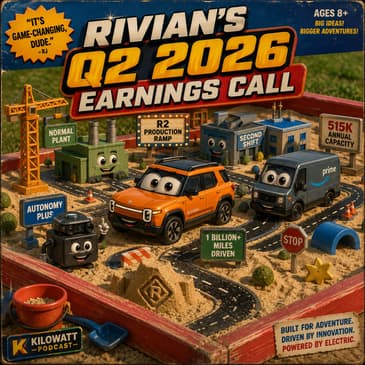
Rivian’s second-quarter 2026 earnings call puts the R2 front and center as production ramps in Normal and the company prepares to add a second shift. Bodie shares his own R2 demo-drive impressions, including the interior, ride quality, software, and the current state of Autonomy Plus, while questioning how many R2s Rivian has actually delivered so far. The call also lays out Rivian’s aggressive autonomy roadmap, with point-to-point driving expected later this year, hands-off/eyes-off capability targeted for 2027, and Level 4 capability planned for 2028. RJ Scaringe discusses stronger-than-expected reservation conversions for the R2 Launch Edition, what Rivian learned from the R1 production ramp, and the company’s approach to attracting first-time EV buyers. The episode also covers Amazon’s growing EDV fleet, Rivian’s ambitions for Autonomy Plus pricing, and the company’s developing relationship with Uber around future robotaxi deployments. Along the way, Bodie weighs Rivian’s timelines and expectations against his own experience with the R2 and the broader EV market.
Other Podcasts:
News Links:- Rivian Q2 2026 Earnings Webcast
- Dandy's Fun House - 6 Million Dollar Man Part 1
Hosted by Simplecast, an AdsWizz company. See pcm.adswizz.com for information about our collection and use of personal data for advertising.
[00:00:02] Hello everyone and welcome to Kilowatt, a podcast about electric vehicles, renewable energy, autonomous driving, and much, much more. My name is Bodhi and I am your host. And on this episode we're obviously going to be covering the Rivian Q2 2026 Earnings Call. And yeah, this is not maybe necessarily the longest one I've ever done, but we do have a lot of clips to get to.
[00:00:30] But before we do that, I want to thank Gene for upping his pledge on Patreon, which was very kind. Gene is a very supportive member of this community, always has been financially and just with his time. So Gene, thank you so much. I really appreciate it. If for some reason you would also like to support the show, you can do so at supportkilowatt.com. And when you go there, you can choose to support the show on Patreon or Supercast.
[00:00:57] But yeah, Gene, thank you so much. It means a lot. All right, let's go ahead and dive into Bodhi's opening remarks. In the second quarter we began deliveries of R2 vehicles to external customers. We expect R2 to be a game changer for our customers and a driver of Rivian's long-term growth and profitability.
[00:01:21] Importantly, in the U.S. automotive marketplace, starred for a high-quality EV choice, I strongly believe R2 is an attractively priced option for everyday ventures that will resonate with a broad set of consumers. Many reviews of R2 are outstanding. One journalist wrote, quote, R2 is one of the best new cars I've driven in years. Another praised R2 as among the finest vehicle designs in the world. Early customer feedback of R2 is positive, and I have to say I love it as my daily driver.
[00:01:51] Strong R2 reviews and increasing brand awareness are directly translating into accelerating customer touchpoints with our products. In the second quarter we hosted over 57,000 demo drives, a Rivian record. While it's early in our ramp, we are pleased with the reservation conversion we've seen to date for launch edition R2s. Turning to our manufacturing footprint, our team in normal is focused on the production ramp of R2.
[00:02:16] As a reminder, R2 production started with a single shift, and we expect to scale to two shifts by the end of the third quarter. We are seeing good progress in new team member training and process improvements for the ramp of the first R2 shift. Additionally, members of our supply chain team are spending time on site with suppliers as we look towards supporting the ramp in the back half of the year and into next year. In Georgia, construction of our next manufacturing site is progressing well.
[00:02:44] The combination of our normal and Georgia facilities provides Rivian the path to scale to 515,000 units of annual capacity with plenty of room for future expansion. As an update on our Amazon partnership, Amazon now has over 40,000 Rivian electric delivery vans active in its fleet, delivering packages across thousands of cities in North America.
[00:03:07] In addition to the EDV standard pack variant already on the road, we're developing new variants with a larger battery pack and all-wheel drive to support Amazon's needs. In the second quarter, we surpassed 1 billion miles driven on the Rivian commercial van platform. All right. So, a couple of things real quick. First, Starve for Choice. He says that the R2 was a welcome addition in a, and I think it was a segment in Starve for Choice.
[00:03:35] That segment, the SUV EV segment, mid-size SUV EV segment, is not Starve for Choice. There's quite a bit of choice there, actually. Maybe not as much choice as what you would find in, I don't know, China, for instance. But more choice than what you would find at the, let's say, $25,000 price point for reasonably, like, whatever the equivalent of an electric Honda Accord would be. We don't really have that.
[00:04:03] That would be Starve for Choice, is what I'm saying. All right. The other thing, and I'm going to mention this several times, I feel like, throughout this earnings call, is that how many R2s did they deliver? Because they didn't say. They just said that the conversion rate was higher than they thought multiple times. And they said that, you know, basically they were pleasantly surprised. But what does pleasant really surprised mean?
[00:04:30] If they thought they were going to get one and they got five, I'd be thrilled. But we don't know what those numbers are. And it's really hard, even though they are pleased. And I'm using air quotes. Pleased with their, with the conversion rate. I'm trying not to be negative. Even though they're really used to the conversion rate, that does not mean that they're actually, you know, selling all that many of them. Not to say that they're not. Because I don't know.
[00:04:58] So, I would imagine that it's taking some time with, you know, scaling up production and all of the other things that go with that. But, yeah, I'm just, we'll have to keep an eye on it. Let's put it that way. Now, as far as the R2 goes, I did get a chance to drive the R2 on a little test drive. And I'm just going to give you my quick down and dirty thoughts. The exterior, just as nice in person as you see in the pics. Like, no notes.
[00:05:28] I looked around. The panel gap seemed reasonable. You know, the car just in general is just a really nice looking car. Interior, I thought was nicer than my Model Y. And I thought the seats were actually quite comfy. You got like the stitching and just the way that the seats were designed. Even though I think the Model Y might be some of the most comfortable seats you're ever going to sit in. I found the Rivian seats to be pretty comfortable.
[00:05:56] It sits up a little bit higher than the Model Y does. So, it was nice to be able to see all of the, you know, you just get a better view. Whereas, the Model Y is kind of slanted and back. More aerodynamic. The R2 was a little bit more like upright. I don't know how else to explain it. And you got better views. So, that's a nice, that's actually quite a nice feature.
[00:06:21] And then, the way that it rode, it rode like a truck. You know, the salesperson was kind of bawling on Tesla a little bit. And he's like, you're probably unhappy with the ride of your car. And sometimes I am. Most of the time I'm not. Sometimes it's a little stiff. But the R2 drove like a truck. And it drove like a truck that had, you know, aggressive or mildly aggressive off-road wheels on it. And that wasn't bad.
[00:06:50] I actually didn't mind it. But it was not like the smooth ride. Like, when you're driving in the Model Y, even mine, not the newer ones, but even mine, it's a little bit stiffer, right? And you're on smooth roads, it feels great. It would just, when you're on bumpy roads, you really feel all the bumps. But, you know, the Rivian, you're probably not going to feel all the bumps. But on smooth roads, it's going to feel kind of lumbering. And that's fine. There's nothing wrong with that.
[00:07:16] But most of the materials in the truck felt very quality, let's just say. It did not feel like they were cheap materials. The infotainment screen and instrument cluster was nice. Software was easy to use. There were some things you can do on the stock. Either the stock that's on the left side of the steering wheel or the right. It was too much for me when I sat down and did the demo with the salesperson. So I didn't mess with that too much.
[00:07:46] But you pretty much changed the gears or you changed the drive modes the same way you would in a Tesla. But, you know, all the stuff that the stock did, very cool. But I was just a little overwhelmed by it. So that was that. Now, I do have thoughts on autonomy, but I'm going to share that a little bit later in the show because there's a specific question about autonomy. So let's go ahead and dive back into RJ's opening remarks.
[00:08:12] Turning to our technology roadmap, autonomy remains one of the most important areas of investment at Rivian. In the not too distant future, we believe advanced assisted driving capabilities will be a key differentiator for customers and a substantial driver of market share. Our autonomy development is on track and we expect to begin rolling out point-to-point capabilities by the end of this year. We believe our rapidly expanding car park with R2 will accelerate our data flywheel to enable delivering hands-off, eyes-off capabilities in 2027
[00:08:42] and ultimately level 4 capabilities in consumer and robo-taxi variants of R2. Since we began monetizing Autonomy Plus in April, take rates are trending positively for the service and we believe further feature releases will drive continued increased uptake of Autonomy Plus. Later this year, we will host another Autonomy and AI Day where we'll provide more updates around our exciting autonomy and AI progress.
[00:09:08] At the end of 2026, we are targeting the launch of our third-generation Autonomy hardware. This includes RAP1, our first in-house designed silicon, and the addition of LiDAR. The development of our RAP1 chip is on track and we've begun final testing phases of production silicon. Finally, in May, we rolled out our Rivian Assistant on all R1 vehicles and plan to launch the feature on R2 with an over-the-air update later this year.
[00:09:34] Rivian Assistant is our new AI-powered voice assistant that is built to be a digital co-pilot with integration into the vehicle ecosystem and other external apps. Customers love this new future and its intuitive functionality across applications like Spotify and Google. In closing, I want to thank our team for their continued execution this quarter. We are laying the foundations for a future that we believe will be fully electric, autonomous, and AI-defined.
[00:09:58] The reviews for R2 affirm that our category-defining brand and vertically integrated and extensible technology resonates deeply with customers. I couldn't be more excited about the opportunity ahead. I thought their autonomy package in the vehicle was fine. It was like autopilot, but not as good. Which leaves room for improvement, to be sure. But it doesn't stop for stoplights. It won't change lanes automatically on city streets.
[00:10:27] It will change lanes on the freeway. But, you know, if you're not paying attention, you're going to run a stoplight or a stop sign. And that's going to be your fault. So I did find that to be problematic. Now, they're like, well, we're going to get point-to-point navigation soon and all this other stuff. I think Rivian might be a little optimistic on what they can, where they're going to be by 2027.
[00:10:52] But in terms of their software package, it's a good start, but it's not worth $2,500 or $50 a month, as far as I'm concerned. My wife's van does a lot of the same stuff for free. My car does a lot of the same stuff for free. So it's not, yeah, not in my opinion, groundbreaking yet. I do believe they'll get there, but probably not by 2027. All right, let's move on to our first analyst question.
[00:11:20] Our first question comes from Mark Delaney with Goldman Sachs. Your line is open. Please unmute and ask your question. Good afternoon. Thanks for taking the questions and congratulations on the R2 launch. Very exciting to see. So I'm going to start there on the R2. Can you share more on how the production ramp is progressing and any examples or metrics maybe you can share on that front to illustrate how the ramp is going?
[00:11:44] And then as you think about R2 over the next year, do you think the pace of deliveries is going to be gated more by a supply or demand? Well, thanks, Mark, for the question. We're also very excited about R2. Well, I guess first on the production ramp, you know, of course, ramping production of a vehicle, especially where it's a first-time launch of a new vehicle, is complex. It's an orchestration of ramping hundreds of suppliers.
[00:12:13] The suppliers all need to ramp at the same rate. Of course, our overall production output is throttled by or gated by the slowest moving supplier. And so the coordination to make sure everything's ramping consistently and in an organized fashion across all the different suppliers is really a key focus for us. And it's the reason we start on a single shift and get everything moving efficiently and effectively before we bring on a second shift. So saying that, this is a complex effort. There's lots of moving parts.
[00:12:42] And we went into it fully recognizing the complexity and having been through this with R1 and iterations in R1 with a lot of learnings and knowledge as a business that we certainly didn't have to this level with the launch of R1. And so where it stands today is we are ramping. We're continuing to make progress week over week. As you saw, we've updated our guidance to reflect the progress we're making.
[00:13:11] And, you know, the biggest category of focus for us has been supply base and making sure that all of our suppliers are ready to continue ramping to much higher levels as we look at the back half of the year. And in particular, as we start to plan for running, you know, fully utilizing the plant and running across two shifts. Now, on the demand side, there's enormous excitement around the product.
[00:13:39] And we've been really encouraged by the conversion of reservations to orders on our launch edition. You know, we, of course, had our own internal projections as to what that would be, recognizing that we're launching with the launch edition, which is a $58,000 version of the vehicle and most expensive version of R2. And that conversion rate from reservation to orders has been meaningfully higher than what we expected, which is a great signal.
[00:14:07] Now, of course, with that said, we are looking forward to introducing the other trims, our mid-spec and our base or standard spec as we look at the early part of 2027. But the excitement even for the launch edition and the higher price point of launch edition has been very, very high. I mean, in terms of ramping up, getting to scale, this isn't all that different than what every other company goes with, right?
[00:14:35] You might have a supplier issue. You might have an issue with the manufacturing process that you just didn't see when you were producing, let's say, 10 cars a week versus now you're producing 1,000 cars a week, right? There's some things you need to retool and fix and things like that. So that's not all that different. And I just took a look at all of the clips while we were listening to that last question. And I was like, man, I have a lot of clips.
[00:15:04] So I'm going to try to keep my input short here. But basically, Rivian's going through the same thing that every other car company does when it comes to launching a new product. And it probably is weathered better by a company like Ford or GM or Stellantis because they've just been doing it longer. But in general, we've seen those companies also fall flat on their face when it comes to ramping up production.
[00:15:30] So it's just one of those necessary things that everybody has to go through, I suppose. All right, let's move into our next clip. Your next question will come from George Gianaricas with Panaccord Gratuity. Please go ahead. Hi, everyone. Thank you for taking my questions. I wanted to focus a little bit on the EDV. Can you provide an update maybe on commercial adoption beyond Amazon?
[00:15:57] And as you expand pilot programs for non-Amazon fleets, what's the current primary governor on deployment pace? Is it TCO parity, upfront capital outlay, charging density, anything you could share there? Thank you. Thanks, George. I think the first point to just call out is the ramp up that we're seeing within Amazon.
[00:16:20] And so you're seeing this already in the numbers the first two quarters of this year, that Amazon is purchasing more vans. We're ramping up meaningfully from where we were in previous years. And that's absolutely a reflection of the TCO advantages that our EDV platform represents and enables.
[00:16:42] And we think that those cost benefits that are being so clearly realized by Amazon and so clearly evidenced by their ramping up of volume, we think that's going to translate to other commercial operators ultimately seeing those cost benefits and recognizing both to remain competitive, but also to address their own cost structures that they're going to be pursuing opportunities with EDV.
[00:17:11] Now, that has taken longer than we would have expected or we would have hoped for in terms of other fleets adopting a strategy towards electrification and a strategy of adopting not just an electric vehicle, but a highly connected intelligent vehicle. But the signal that's being sent through Amazon's significant ramping of this is really outstanding in terms of a billboard for the capability and a billboard for what the EDV is possible delivering from a business point of view.
[00:17:39] It doesn't, I mean, I could be wrong on this and it seems wrong to say it, but it doesn't sound like they got a lot of interest outside of Amazon since he really highlighted Amazon. But maybe there's just some things that he doesn't want to talk about that are in the pipeline, but not ready to talk about just yet. But if you're not familiar, the EDV is the Amazon delivery vans that people see.
[00:18:03] If you don't see them in real life, you probably see them online, pictures of them and stuff. That's the EDV, just in case it wasn't clear. All right, let's move into our next question. Maybe just on the autonomy plus. So, you know, you're going to be launching the point-to-point solution later this year. I'm curious where things stand today with autonomy plus.
[00:18:33] Just if there's a way you can give us a sense of, you know, take rates or kind of adoption trends. And then how do you see point-to-point driving both demand, but then also those take rates. So ultimately the subscription revenue opportunity. Thanks. We've been really encouraged by the take rates on autonomy plus to date.
[00:19:00] And I think in particular what's really encouraging is to see the status that we're at today in terms of customer engagement, customer usage of the feature, and of course related to that, the take rate around paying for autonomy plus. But we have very clear line of sight and visibility into what's coming.
[00:19:22] And so as encouraged as we are with the take rates today, we're quite confident that that will expand meaningfully as we add in additional capabilities and features. And there's going to be a whole, you think of it as like a staircase of features that ultimately leads us to very high levels of autonomy. But a really important step that's happening in the very new future is the capability of point-to-point.
[00:19:46] And, you know, just to restate what that entails, that means you can get into the car, type the address into the vehicle, and the vehicle will completely drive itself to that address. And initially that will be a feature in which it's like level two plus plus where your hands are off the wheel, but your eyes are still primarily on the road.
[00:20:07] Meaning you can look away for short extended moments of time, but you're not in a position to officially be reading a book or be responding to emails. Now, the step in 2027 is going further where we go not only hands off, but also eyes off. And that's really important because then not only is the vehicle fully driving itself and navigating to the address, but importantly, you're able to truly get your time back without the vehicle dinging at you, say, you know, to keep your eyes on the road,
[00:20:36] but actually be able to read a book, you know, be on an iPad. And so that's really, you know, into the like true as per the definition, level three capability. And then of course, into 2028, you know, that's when we bring on level four. And that's where the vehicle's capable of operating as a robo taxi, meaning there's no one even needed to be in the driver's seat for any operation of the vehicle.
[00:21:02] And, you know, you can put occupants in the back, you can use that capability for robo taxi applications. But you can also have that, which is one of the things we've been very excited about, have that as a really nice feature on an owned vehicle. And so we think of this as personal level four, where your own personal vehicle can drop you at the airport. It can pick your kids up from school. It can go to the grocery store and grab things for you.
[00:21:25] And that roadmap is something we're not only very excited about, but we think will fundamentally drive, you know, increasing levels of adoption on Autonomy Plus and its future variances we've just described. Now, with all that said, we also think we're at an inflection point from a consumer behavior and consumer mindset, where historically autonomous features were not the primary purchase criteria for most customers.
[00:21:54] Of course, there's technology early adopters for which this has been top of mind for them for some time. But for the vast majority of customers, this wasn't the driving purchase criteria. We think this starts to emerge to be much more of a primary purchase criteria. And it's one of the reasons we've made the decision to invest so heavily here.
[00:22:16] We think ultimately market share is going to be driven by the capability of the vehicle to drive itself. And of course, linked to that, the vehicle being software and AI defined. And those are two very like critical pillars of our technology roadmap and technology strategy. So this is interesting, right? Autonomy Plus comes with the R2 launch edition.
[00:22:44] So you buy the R2 launch edition, you get Autonomy Plus for free. There is going to be a $50 a month subscription, or you can buy it outright for $2,500. It's possible that the Gen 2 R1 platform, the R1S and the R1T, it's possible that they're seeing people pay the $50 a month for whatever they're calling Autonomous Plus.
[00:23:11] You know, I don't know what that actually looks like on the R1 platform, but I would assume that it looks a lot like it does on the R2. And again, that's not something I would pay $50 a month for. Point to point, and just in case anybody isn't aware, point to point when they say that, they're talking about whatever the equivalent to Tesla's Navigate on autopilot is.
[00:23:35] So you leave your garage and you put in your address and it takes you directly to the next, you know, to the location that you put in. That would be point to point. Yeah, I'm kind of struggling because my experience, and again, they told me that at the Rivian dealership that point to point was coming soon.
[00:24:02] So when it comes out, I will make another appointment at the dealership to see how that feature works. It may work great. But we'll see, and I'll leave my words, but it just seems like they're really far away from it based on what they put out, if I'm being honest.
[00:24:26] And then, man, I had this conversation with the salesperson who was telling me that he's like, well, these cars are advanced level two. And I was like, there's no such thing as that. He's like, no, no, there's like a level two. There's like beyond level two. And I was like, no, the Society of Automotive Engineers only has level one, two, three, four, and five. And there's no advanced, you know, it's functioning inside of this capability.
[00:24:55] So if it's outside of that, then it's a level one because it's not meeting level two functionality or it's level three. And that brings us to level three. Anyway, that's a bugaboo of mine, which every time I go to CES, it's like, oh, we're level two plus or level two enhanced. Nah, you're not. Anyway, they did mention level three autonomy, hands off, eyes off in 2027.
[00:25:25] Again, I think I've mentioned this before. I'm very skeptical that they'll be able to do that. At some point in time, they are going to have a car that has a LiDAR attached on the front of the car. And they're going to have new hardware as a new R2 customer. That, quite frankly, would make me very frustrated if I bought a brand new model.
[00:25:48] And it's going to get a LiDAR and some other, you know, upgraded hardware right after I bought the car. That would be a reason why I wouldn't buy the car. I'd wait until that kind of stuff comes out. And it's entirely possible that will come out when the R1 first and then follow in the R2 just based on what they got going in the development pipeline. But yeah, I mean, I don't know.
[00:26:14] So, it does, I do feel that I am just as frustrated with the messaging that Tesla gives off when it comes to this kind of stuff as other companies. And it's not just Rivian. It's not just Tesla. They just happen to be, well, Tesla for sure happens to be at the forefront of this. But, you know, they're a little bit further away than I think we're being told. Let's put it that way. Anyway, we'll see.
[00:26:43] I mean, I will, I'll drink a cup of coffee without half and half because I don't really like black coffee. So, I will drink a cup of coffee without half and half if I am wrong. That is my punishment. On air, you won't know it though because I don't like it but I can drink it. Anyway, I don't like being punished. Anyway, let's move on to our next question.
[00:27:13] Your next question will come from Rajat Gupta with JPMorgan. Your line is open. Please go ahead. Great. Thanks for taking the question. I had a question on the R2 customer profile. You know, any early leads on, you know, what that customer is proving to be. You know, existing electric vehicle owners, you know, first time electric vehicle buyers, Tesla crush shoppers. You know, just curious if you have any read on, you know, the customer profile of the early R2 orders.
[00:27:43] I'll have a quick follow-up. Thanks. Thanks, Rajat. The goal in developing and designing R2 is to have a very diverse set of customer profiles, meaning customers that were coming out of a wide variety of form factors, coming out of a wide range of brands, and from a broad spectrum of demographics. And that was the intent, that was the target.
[00:28:11] You know, we now have the benefit of being able to see the data to see, you know, who is actually buying R2s. And the great news here is that it is exactly that. We have a very diverse customer set coming out of a broad range of vehicles, which I guess perhaps shouldn't be too big of a surprise. The midsize SUV segment, the two-row, five-passenger segment, is the largest segment by far in the U.S. market. It's generally the largest segment globally as well.
[00:28:41] But the way that we've been able to really thoughtfully execute this vehicle in terms of packaging, storage capacity, performance, range, efficiency, you know, driving dynamics, both on-road and off-road, has created a very wide net for attracting this very diverse set of buyers. And, you know, maybe one of the most exciting metrics here is we have a significant number of first-time EV owners. And that's really powerful.
[00:29:09] So for someone to have their first time owning an EV be a Rivian, and for that bond with the brand, so to speak, to be created through that first-time ownership is powerful. But it also illustrates the strength of what we've created in terms of the product and the product market fit, that this is mobilizing demand for EVs that's been latent, that's been sitting on the sideline because the product that sort of would motivate someone to move from an ICE to an EV hasn't existed until R2.
[00:29:39] And so this is a great metric. Now, of course, there are EV buyers that are in the mix. You have folks who come out of Teslas or folks who come out of Rivian R1s, but the most important metric here is the very significant number of folks that have not owned EVs before. I take exception with the comment that a lot of people are sitting on the sidelines because the R2 didn't exist yet to go EV. That is so silly.
[00:30:09] You know, I would love to own an R2. Honestly, it would be a great car. I think in my heart, I really want to go with the Scout Motors for my next vehicle, but R2 would be great, right? But here's the thing, right? I'm not going to take the R2 off-road, nor am I going to take the Scout Motors off-road. I'm just not going to do it. And most people who buy an off-road vehicle or a vehicle that's capable of going off-road don't do that either. So, you know, there's the Equinox EV.
[00:30:38] If you want to spend a little bit more money, Cadillac's got their EVs. The Kona EV. There's lots of choices in this segment is kind of where I'm trying to go with this. And it's not because the R2 didn't exist. They're finally, you know, getting off their hands. It's because they wanted the R2. Maybe they held off of buying one because they saw the R2 was on the horizon. And they're like, oh, that looks like a good car I'd like to own. That's possible. But they're not sitting on the sidelines to buy an EV.
[00:31:08] And they're not going to do it until the R2 pops into existence. Like if the R2 was never announced and Rivian was never a company, a lot of these same people would probably just buy the car that met their needs. That's it. So one of the things that I really like about RJ is that he tends to be a little bit more pragmatic than Elon. But recently, I do find the marketing really creeping in on the answers.
[00:31:37] And it's kind of gross. Okie doke. Let's move on to our next earnings call question. Your next question comes from Ite Mikaeli from TD Cohen. Your line is open. Please go ahead. Great. Thank you, everybody. Just first, a couple of questions on the R2. RJ57000 demo drives. It's a big jump sequentially.
[00:32:05] Hopefully you can talk a little bit about what you're seeing in terms of conversions of those drives into orders. How many people are actually experiencing autonomy plus. And then secondly, just curious whether you do expect to deliver a material amount of the premium trims this year. Or will R2 sales just predominantly be the performance trim this year? Yeah, I mean, we're really excited.
[00:32:27] As I said in my open remarks, the 57,000 drives this past quarter is a record for Rivian. And so just the delivery of that, just enabling that number of drives, as you said, roughly doubling where we've been in the past. The team has had to really come together. And we did a lot of prep knowing that the amount of excitement on R2 was going to drive a significant increase in both exposure of the brand, touch points to the brand.
[00:32:54] But, you know, of course, that's manifested through these test drives. And so with that, we're not providing specifics around conversion, but that's a really important metric we look at internally. And that actually links pretty heavily to the availability of the other variants. And so to start, as you said, we have our performance variant, the most expensive variant of R2 that we've launched with.
[00:33:24] We'll be introducing the premium and then our standard trims as we look at early 2027. But we are witnessing a higher level of conversion than we expected, meaningfully higher than we expected, into the launch edition package, which was great. It's super encouraging. I think reflects just the amount of excitement around the product.
[00:33:46] But saying that we'd be fully recognized and are excited to also be launching the other trims and know that those will be coming, as I said, at the early part of 2027. I mean, I don't know. I kind of answered the question. So I'm not going to bash on it too much. I really want to know how many R2s do they think they can deliver by the end of the year? You know, that would be a great thing to know.
[00:34:13] Without knowing that, we just don't know if we're really seeing what if their expectations are being met or not. That's all just kind of behind the curtain. And again, I do think I do understand why they're not giving us that information. But I also kind of think it's a nonsense in a way that not for this show.
[00:34:39] But if I was a Tesla share or Tesla, if I was a Rivian shareholder, if I was a Tesla shareholder, I'd like to know too. But if I was a Rivian shareholder, I want to know where do they think they're going to be? What are they expecting with this new product that the company sunk billions of dollars into? When are we going to see that ROI?
[00:35:00] Are we going to see meaningful, profitable quarters that aren't bolstered by the partnership joint venture with Volkswagen? That would be a question, that legitimate question that I would have. All right. Let's see. You know, I have some other things written here, but it sounds more like complaints than anything else. So let's go ahead and jump into our next question, which is a good question.
[00:35:29] It's about the R1 ramp compared to the R2 ramp. RJ, I want to ask something that I know you've addressed in the past, but I think it's important just in the early days of the R2 ramp. You know, if we look back to R1, the days of R1 and early ramp, you know, there were, you probably bit off a bit more than you could chew, which is something I think you've acknowledged. There's a lot going on, a lot of different configurations.
[00:35:56] And if we look now, I know you, you know, talked about, you know, focusing on just the launch edition. But, you know, broadly within Rivian, there are a lot of different initiatives between, you know, RAP, and I'm sure there's multiple other, you know, future iterations planned, your autonomy roadmap, what's going on with network architecture, and then also just, you know, MIND also, just a number of different initiatives here. So maybe you can just talk us through, you know, how this time is a bit different versus R1,
[00:36:25] how you're approaching, you know, R2 execution, given that you still have a lot of things on your plate, and how you're looking at resource allocation in this environment. I mean, it does seem in some ways like yesterday we were launching R1, and then it also seems like it was a very, very long time ago. But, you know, with that said,
[00:36:50] the company that's launching R2 today is a very different business than what launched R1. And I say that with regards to the maturity of our processes, the maturity of the team, the maturity of the development sequencing. And, you know, when we look at the launch and what we're going through today in terms of ramping production, ramping suppliers, you know, what we're experiencing today is actually an artifact of what we did in the two or three years leading up to it.
[00:37:19] And so a big difference between R1 and R2 is the structured approach we took to what we call design validation builds. So those are vehicles that were to production spec, but built on our pilot line. We went through multiple iterations of that. And then subsequent to that, our manufacturing validation builds, where it was, of course, the production spec, but built in the manufacturing plant. And the MVB builds, those manufacturing validation builds, started at the very beginning of this year, at the beginning of 2026.
[00:37:46] And so that gave us time to work through issues around ramp, work through issues around design elements, of course, supplier-related issues as we were doing those validation builds. And so the number of unexpected surprises in now the production ramp-up of R2 is far lower, like incredibly, it's an incredibly different situation than what we had in R1. Now, that's not to say there aren't surprises.
[00:38:15] It's, you know, as I said at the start, you know, building and launching a new car is just an inherently very, very complex activity. And it's complex if you're, you know, a company that's been building cars for 100 years, or it's complex if you're Rivian. And so we've done everything we can to prepare. But, you know, as we now are going through the ramp, we're still, you know, being very thoughtful around how rapidly we ramp up our supply chain, making sure that all of our suppliers can ramp consistently,
[00:38:45] planning that very thoughtfully before we bring on the second shift. And a big enabler to help make that ramp process more seamless and more straightforward was the simplification of the product relative, certainly to what we did before. As you said, in R1, we didn't just launch R1. We launched R1T, R1S, and a commercial van all within the same three-month window. And then we had a very complex set of build variations, you know, essentially, you know,
[00:39:15] thousands of different possible build combinations for the R1T and the R1S. And in sharp contrast to that in R2, we have a very limited set of build combinations that we're building today, which is all embedded in the launch edition. Even within that, we've limited the number of color combinations. And so that was not an accident. That was highly intentional to facilitate a smoother and faster ramp.
[00:39:40] And that the decisions that we took around what combination of features we would have in this launch edition was also something we thought about a lot. And as I said before, we had a whole bunch of our own expectations around what take rate would be to convert a reservation into an order for the launch edition. And we've been pleasantly surprised that that conversion from reservation to order has been notably higher than what we expected, which is great news.
[00:40:11] And that doesn't, of course, mean we're not going to launch those other variants. So for any customers that are waiting for a standard trim or a premium trim, don't worry. We're on it. But those will be coming in the early part of 2027. So it sounds like they learned a lesson, which is all you can hope for. You know, they built design and manufacturing validation builds great.
[00:40:38] You know, they gave themselves time to make changes based on issues that came up during that period. They didn't have the pressure of, you know, only burning through money. At least when they're there, they have some money coming in, even if maybe they're losing a little bit of money on each car still, you know, and I don't know if they still are, but they used to be, you know, they were losing 10 plus thousand dollars on each car sold.
[00:41:06] I don't know if that's still the case, but anyway, the point is that they learned and they're moving on, which I think is good. I think that's great. One of the things that I should have done earlier in the episode is I should have given you the production and delivery numbers. So I'm going to do that right now. Claire McDonough, and during her bit, she's the chief financial officer.
[00:41:33] She said that Rivian delivered or we'll start with production. Rivian produced 12,613 EVs in the second quarter of 2026, and they delivered 12,194. I would imagine that very few of those, if any, make up the R2. But we're going to keep an eye on this number and what they did last year in Q3. And we'll kind of get an eye.
[00:41:59] Even if Rivian doesn't want to tell us how many R2s they sold in the next earnings call, we'll get an idea as to roughly how many are delivered based on, you know, some criminology of the actual delivering production numbers. I would imagine at the moment they're probably, well, I don't know.
[00:42:25] Depending on how production's going, if production's going swimmingly, they've probably produced more of the R2 platform than the R1, but I could be wrong. My neighbor just bought a brand new R2, and it's orange. It's great. It's a good-looking truck. All right. We only have two more questions, and then we have RJ's closing remarks. So let's go ahead and jump into our next question.
[00:42:53] Your next question will come from Andrew Prococo with Morgan Stanley. Your line is open. Please go ahead. Great. Thanks so much. Can you guys hear me? Yes. Awesome. Well, I guess before I get to my question, I do want to say I was three out of the 57,000 demo drives that you guys, you know, talked about. So as a potential future customer, I just have to give you guys some kudos here on what you've done with the R2 and just recognize that up front.
[00:43:20] But I guess just to get to my question, you know, we talked a lot about autonomy already, but I'm just kind of curious how you're thinking about the pricing side and potential uplifts to ARPU as you go to point to point and then eyes off in 2027 and how you're kind of thinking about enacting, you know, those pricing changes over time.
[00:43:41] Yeah, we certainly believe there's opportunity to grow pricing for our autonomous capabilities as we add those capabilities. But we believe very deeply that that needs to be earned through the expansion of the feature set and expansion of the capability. I'd say the other element here, which we have to be cognizant of is just the market dynamics around this.
[00:44:09] And I think it's going to be a very quite fluid around how some of these features get priced. As I said, we're going through an inflection point where customers are going from this being a nice to have feature in terms of advanced autonomous capabilities to a must have feature. There's a growing awareness around that capability set.
[00:44:33] And I really believe the transition to level three capabilities where you can go hands off, eyes off makes it much easier to implement or to use the feature. It's much easier to understand early adopters. It's fine to say you have to be hands on or eyes on the road, but you can be hands off. But for for the broad, full spectrum of customers that it's it'd be much easier to just say the car will drive itself. You don't have to look at the road. You don't have to touch the wheel.
[00:44:58] And we think when that happens, it'll make it far easier to explain, far easier to see mass scale adoption well beyond just early adopters. And with that, the desire and the expectation for these features to be in in technology forward vehicles. And so ultimately what what the pricing potential is, there is something that that we're actively spending a lot of time ourselves thinking about.
[00:45:24] But but ultimately, we believe it's it represents an opportunity to expand pricing beyond where we are today. Does that sound to anybody else like, yeah, we're looking at maybe increasing the price of our autonomy plus project or autonomy, whatever they're calling it? It does to me. It sounds like the price is going to go up, which I think is a mistake. But, you know, I am not.
[00:45:49] I am a podcaster in his basement, not a billionaire in his big house in Illinois. I'm just I'm not that guy. Not yet anyway. I hope they don't raise the prices. I think that I think that would be a huge mistake. I mean, maybe incremental increases, but doing what Tesla did, I think would be a huge mistake. Next up, we're going to hear and this is the last clip before we get to RJ's closing remarks.
[00:46:16] We're going to hear about the partnership with Rivian and Uber. And if you have been following this kind of thing, and you should, if you've listened to this show, because I talk about it every now and again, Uber just has they have like 19 or something partnerships on autonomy. They really spread themselves out in investing with companies like Lucid and Chinese companies and Rivian.
[00:46:40] And they're just like, you know what, we're going to put all of these things out and then we're going to see what works. And for a while, they're they're partnered with Waymo. That partnership has ended. But doesn't some people are saying that it ended negatively. It doesn't to me, it didn't seem like it ended negatively negatively. I'm having a hard time talking today. It just seemed like it ended. And that's OK. Sometimes those kind of relationships end. It's not a big deal. So anyway, let's go ahead and get to that last clip.
[00:47:10] Your next question will come from Philippe Bouchois with Jefferies. Your line is open. Please go ahead. Yes, thank you. And good evening. My first question is on the relationship with Uber. We've seen some tension between Uber and Waymo and their cooperation. And of course, there's a bit of uncertainty about the financial stability of Lucid and the fact that Lucid work with Neuro. So it's not as integrated a solution as what you offer in the partnership with Uber.
[00:47:40] So I'm just wondering how much of an upside to your relationship there is. Maybe not in the timing, but in the magnitude of what you could be working with Uber in terms of offering robotaxis.
[00:47:52] Well, you know, a core element of our approach is a strongly held belief that vertically integrating the vehicle and the technology stack together allows for meaningful both cost advantages and technical simplifications in terms of the vehicle architecture and autonomy hardware architecture.
[00:48:16] And so that means how sensors are integrated into the vehicle, the redundancies built around the controls, the way that we've architected the compute platform and the inference in our case. Because we brought silicon in-house, we have a very low-cost way to achieve very high levels of inference within the vehicle.
[00:48:35] And so we believe that the technical approach that we've taken from a hardware point of view creates a structural, a cost structure, I should say, that's, you know, highly advantaged for delivering level four.
[00:48:51] Along with that, we believe that the fact that we're building a neural net-based approach, an approach that's an end-to-end trained model with what we call LDM, our large driving model, means that the progress that we make on the consumer platform. So that's, you know, point-to-point, hands-off, eyes-off, level three, ultimately getting into level four.
[00:49:15] That LDM workflow is identical across all those different steps. So that staircase up to level four is one work stream. It's not multiple work streams where we have a level four platform and a level two platform, but rather there's one LDM, one end-to-end trained model. And the vehicles will have slightly different sensor topologies to cover corner cases differently between, let's say, a level three and a level four vehicle.
[00:49:44] And along with that, slightly different inference capabilities built around RAP1. But from a platform, from a model point of view, it's the same. And so that was a key shift for us, and I think it's a key shift for the industry in terms of how we approach autonomy, that historically prior to, let's say, 2022, 2023, the technology topologies used for level four were very different than the topologies used for level two.
[00:50:09] And we've seen that merge with the approach of using, you know, transformer-based encoding and these end-to-end models that is really to the advantage of our architecture, to the advantage of the data flywheel that exists through the deployed fleet that we have. But specifically on Uber, you think there's a big opportunity for you? Because, I mean, when you announced the partnership, you were one of several partners that Uber was working with.
[00:50:36] Is there an opportunity for Rivian to be actually a much bigger partner of Uber in autonomy? Well, I'd say the working relationship with Uber has been fantastic, you know, from the top of the organization through the working levels of the organization. So, you know, the engagement from Dara in terms of the importance of this relationship, along with the working level teams, it's been very positive. You know, we're working towards our next milestone at the end of this year.
[00:51:06] And, you know, deploying in a couple of cities in 2028 and then rapidly growing, following that to a large number of cities. And so this is, you know, we're quite encouraged by the relationship and the partnership. But ultimately, I do believe that the focus we have and the focus, I think, appropriately where we're placing our energy is making sure that the technology is ready.
[00:51:31] The vehicle is capable of delivering level four performance and doing it in a thoughtful way in terms of, you know, really clean execution at the vehicle level and really cost effective ways of delivering that capability. I have nothing to add to that. I mean, Waymo, excuse me, Uber, not Waymo, Uber has so many different partnerships.
[00:51:59] I just don't see how Rivian could kind of worm its way in as of right now. Now, if Rivian's tech proves to be in 2028, proves to be super reliable and everything that they say it's going to be as those other bets that Uber made drop off, then I totally can see, you know, Rivian having a place there.
[00:52:25] However, I do think, and I think RJ's a cool guy. I've never met him, but he seems like a really reasonable person. But I would imagine that maybe Rivian would like to have their own robo taxi service at some point in time. And partnering with Uber for now seems like a good idea. At some point in time, I think they'd probably just want to keep all the money for themselves and not share it.
[00:52:53] If I had to guess, that doesn't mean that's true. They're just, you know, I had to guess. This is also a nice way, because usually when you partner with Uber, they give you money and they buy your vehicles. This is also a nice way to boost those sales for the vehicle, you know, to get those delivery numbers up. And I mean, to me, that makes sense on that side of things too, while Rivian is still trying to get their feet underneath them.
[00:53:22] All right, everybody, that is it for me. I said I had nothing to add on that last clip, and yet I did. That's the problem with putting a microphone in front of you. You just can talk, and nobody can interrupt me except for my kids, which my son did while I was recording this. Apparently his iPad storage is full. Anyway, if you haven't noticed, this is a weekend edition. Because it's the weekend, I do want to invite you to go check out the Dandy Funhouse YouTube channel.
[00:53:51] Especially if you're Gen X or, you know, a boomer or an older millennial. And I don't have too terribly many people who are super young listening to this podcast based on who reaches out to me. But if you fit in that age demographic, Dandy Funhouse, Neil listens to the show. He's a real nice person. So I enjoy his YouTube channel, which again is called Dandy Funhouse. Not Dandy's, Dandy Funhouse.
[00:54:21] And he did a recent deep dive, and he does these great deep dives, which is why I like the show, and why I think you'll like it as well. On the $6 million man. There's so far, as far as I can see here, there's two episodes up. I just watched the first one before recording this. Highly recommend. I have not seen the second one, but he's definitely worth a look. I will put a link to the first episode in the show notes. Please go and check Neil out. Does a really good job.
[00:54:50] Like, I strive to get half as, not even half. I would strive to get a quarter as good as Neil is on camera. Because I don't feel like I have that presence. And he certainly does. So go check out his YouTube channel. Okay. I did promise we were going to get RJ's closing remarks.
[00:55:18] So before we do that, I do want to let you know, you can email me. It's Bodie, B-O-D-I-E, at 918digital.com. You can find me on X at 918digital. But I don't really spend a lot of time on X. So the best place to find me is on LinkedIn. And that is Bodie, B-O-D-I-E, and Grimm, G-R-I-M-M, like Mary Mary. And follow me on LinkedIn. I'll follow you back. Unless you're a bot. I will not follow you back if you're a bot.
[00:55:49] All right, everybody. Thank you so much for listening. And I hope you all have a great weekend. Because this was a weekend edition.