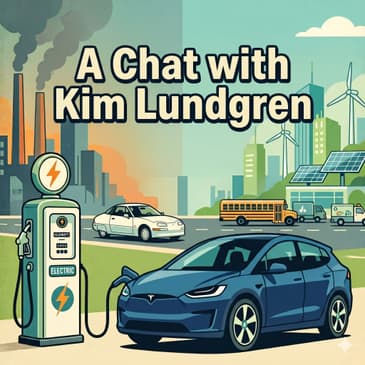
In this episode, we chat with Kim Lundgren, the founder of Kim Lundgren Associates (KLA). Kim shares her journey from being an pioneer in municipal climate planning to driving an original GM EV1 as a city official in the early 2000s. We explore the role local governments play in decarbonizing our communities, the evolution of clean school bus programs, and why "right-sizing" municipal fleets is a low-hanging fruit for sustainability. Kim provides a grounded perspective on why we aren't just "saving the planet," but rather ensuring humanity can continue to thrive on it.
Support the Show https://www.supportkilowatt.com/
Other Podcasts:
News Links:
*Show Art Created By Gemini
Hosted by Simplecast, an AdsWizz company. See pcm.adswizz.com for information about our collection and use of personal data for advertising.
[00:00:21] Hello everyone and welcome to Kilowatt, a podcast about electric vehicles, renewable energy, autonomous driving, and much, much more. My name is Bodhi and I am your host. And on today's episode, we are going to sit down and talk with Kim Lundgren, Kim founded Kim Lundgren Associates, and they mostly work with cities and towns on sustainability, although they do stuff outside of that as well. And we're certainly going to talk about that, but we're also going to talk about how to do that.
[00:00:51] Kim's journey in sustainability and how she got to where she is today. But we're going to start the conversation off with the EV1 because Kim actually had an EV1 as her daily driver, so she has lots of cool stories about it. And if you're not familiar with the EV1, General Motors built the EV1 and it was their first attempt at a modern electric car. So electric cars have been around for a very long time, but
[00:01:21] Kim's journey in the future. And from 1996 to 1991, GM tested out the EV1, which was a car that was actually designed and built from the ground to be an electric vehicle, not just some kind of conversion. It had a lightweight frame. It was, you know, a two seater, had an AC induction motor. Most of these EV1s were, you know, leased in places like California and Arizona. And I believe all of them had to be leased. You could not,
[00:01:51] purchase these cars to own. GM eventually decided this was not the path that they wanted to go. They pulled the plug on the program and then they took all the cars back. And then famously to the, the, uh,
[00:02:06] anger, I don't probably not the right word, but to the frustration of many just crush them. And, uh, I actually have a friend who worked for GM at the time. And one of his jobs was to take, you know, important parts out so that they could be crushed. So yeah, Kim tells us all about her experiences with that car.
[00:02:30] And honestly, it was just a super fun way to start that conversation. So with all that said, let's welcome Kim to the show. Thank you so much. Appreciate you having me. Yeah. So we're going to talk about a couple of different fun things. And it's really interesting that, uh, you're coming on today because immediately after this, I'm talking to a, uh, group, a political action group that wants to like, take the politics out of, of EVs.
[00:02:59] And renewable energy. So I think we're going to, these, these two show episodes are going to kind of dovetail nice together and they'll be released in the same week. But, um, let's start off with, with you. You are the founder of Kim Lundgren associates, which would be weird if you weren't, but you are. Um, can you tell us a little bit about KLA? And then from there, I want to talk a little bit about your kilowatt Kim and your EV one experience.
[00:03:29] Yeah. Bringing it, bringing it way back. So I can even start backwards there actually. So I've been spending most of my career, the last 25 years working in and with local governments. So cities, towns, counties across the U.S. specifically to take action on climate change.
[00:03:49] So we do everything here at KLA from, uh, greenhouse gas emissions inventories, climate vulnerability assessments. So essentially looking at where are the emissions coming from? And then how are the impacts of climate change that we're already feeling, um, disturbing our community? And where do we have weaknesses in, in each of our systems, human systems, um, economic systems, infrastructure, natural resources, things like that.
[00:04:16] And then we help them identify goals and strategies and actions to, to move forward on that. I think the biggest thing we focus on is helping them really understand that this is a real threat to their community that they have to move the needle on. And that involves bringing everyone to the table so that everyone's aware of what this means for the community and recognizes that there's so many solutions, including electric vehicles, that are right there at our fingertips right now.
[00:04:46] And, uh, and, uh, can, uh, can, uh, can really be something that folks move forward with. I think folks have a hard time thinking about this global issue. And so we try to remind them that, you know, it, it might be a global issue, but it, the impacts are being felt locally. Uh, and so also are the solutions are available locally and we really need everyone to play their role.
[00:05:08] So this is the kind of work I've been doing for 25 years, starting, um, working for a local government just outside of Boston called Medford, Massachusetts. Yeah. You, you, you talked a little bit about, and it kind of, uh, I think kind of dovetails nicely into the, the EV one, but you talked when you were at Medford, you got a, was it a grant from the government or just some money from the government to convert school buses to not electric or not even biodiesel,
[00:05:37] necessarily, but just to be a little bit cleaner. Yeah. Yeah. So it's called the clean school bus program. And I think it was, it was an EPA program. Uh, it was still active up until a couple of years ago. I don't, I don't know if it currently is. I would, I'm unclear on that one, but, um, the whole idea of it is, Hey, school kids are on school buses. You know, some kids all over the country are on for quite a long time every day.
[00:06:07] I know my daughter's on her bus for, uh, almost two hours a day. So there and back, it's a long trip for her. And so when you think about children, they breathe, um, they're actually lungs move much faster. They're smaller. They take in air in and out faster. And so the toxins that come out of the tailpipes of different vehicles, they breathe that in more. And so, um, asthma and other respiratory issues are a huge challenge.
[00:06:32] So the whole idea, and again, this was, I want to say 2002 or three, when we got the clean school bus grant, the idea was, Hey, diesel particulate filters can be put on these big diesel buses to make it so that what is coming out, the tailpipe is much cleaner and, uh, more appropriate for the, for the children.
[00:06:54] And so it was a big deal for us at the time. It was over half a million dollars, uh, we got in Medford. We were the first ones in the country to actually get a grant from the EPA school bus, clean school bus program that didn't own their school buses. We kind of set a precedent for that because, you know, and you can understand, you can appreciate how EPA wants to have more control over, okay, if we're retrofitting school buses, we want to give money to folks who own the buses.
[00:07:22] But we made a case that more than 30% of school districts in the U S do not own their school buses. They lease them from the private sector. And then by doing so, by allowing us to have the funds to retrofit school buses from a private vendor, we were actually bringing value to the entire Boston Metro region, to all the other cities and towns that were using that particular vendor. So, um, yeah, that was a pretty proud moment.
[00:07:47] No, for sure. Like when, when I, uh, I'm an engineer on a, on a, on a ladder truck. So when I'm doing my walk around, I have to have the truck on. And anytime I walk on the tailpipe pipe side and that tailpipe is huge for a big old fire truck like that. Um, I hold my breath for as long as I can. Cause I have, I mean, there's just certain things I have to do next to the exhaust and I, I don't want to breathe any of that stuff in.
[00:08:14] I mean, I'm on the last half of my life, but I want that to remain to be good. I want it to continue to be good and, uh, and be healthy. Um, so I think this is great. And I love that, uh, more and more school districts are going with the electric buses. And I think over time, you know, that's an easy convert because they typically have the fixed routes and they can, you know, it's not a, not a mystery.
[00:08:38] My kids, we live, I don't know, maybe three miles from their school. Um, and technically we, we kind of live close enough where they might have to walk, but they'd have to cross a major intersection and that's why we get a school bus. So it might not, might not even be three miles. Um, but you know, that's not a very, they're picking up, I don't know, uh, a busload of kids. They're not traveling all that far to pick up that busload of kids.
[00:09:05] No, no, they can definitely do their route on a charge. Yeah, for sure. Yeah, for sure. So in Medford, you had the opportunity to drive an EV one and not just drive it once. Like this was, this was your, your drive around car for the city. Um, kind of tell me what that experience was like and what are some of the, the joyful moments and maybe not so joyful moments. Cause you know, 2000 and what'd you say? 2003, 2005.
[00:09:35] When you had this car? I got, we got the cars in 02 and I think, I mean, I know the model was the original model was like a 1996. I can't remember if they had, if, if mine was a little bit newer than that, like a 98 or something. But so what had happened was Medford, when I started with the city, I was hired to basically write a climate action plan for them.
[00:10:00] So, so we got a lot of attention because Medford, Massachusetts, which if folks on the, that listen in and know the area back in the day, like Medford was not really known as being environmentally friendly in any way, shape or form. And so when Medford had the first climate action plan in Massachusetts in 2001, we got a lot of press around that. And, you know, it wasn't Cambridge, it wasn't Boston, it wasn't, you know, the richer towns.
[00:10:29] It was just standard. I, I always called ourselves like average Joe kind of city. And so a lot of other cities along the way were calling us, calling our mayor and be like, or calling me and say, my mayor said, I need to call you and find out what you did. Because we figured if Medford's doing something on climate change in early 2000, we can do it, right? It's like, we really were that poster child. So as part of that, we started getting more attention. There's a program called the Clean Cities Coalition.
[00:10:58] That's part of the United States Department of Energy. And I had started attending meetings for that. They were bringing funding in for alternative fuels. That's what Clean Cities has always focused on. Well, back then, in the early 2000s, Massachusetts adopted the California Clean Air Standards. And so all of the car companies were like, let's get some electric vehicles on the ground in Massachusetts.
[00:11:24] And part of that was the EV1 was one of them. So they got consigned to us as state and local government officials. We were able to receive the EV1s. We also got through Clean Cities for no charge to keep where the Think Neighbors, the Ford Think Neighbors, which I deployed over at the cemetery and the parks department and things like that.
[00:11:51] But the EV1, which is what you're most interested in. So they really wanted us kind of testing this out. And so what they gave us was almost like a package. So they came into City Hall. They literally put in a charging station for me right at City Hall. I actually ended up getting like the best spot because that's where the utilities work. So we had that. It's, I mean, you've probably seen the car before. So it was just like a little two-seater. It felt like a spaceship.
[00:12:21] It really did. I actually picked up my grandmother one time in it. And she was just blown away by it because it's just like, this is like a spaceship. So it was a tiny little two-seater. GM gave us a cell phone as well because they wanted us to push the limits of it and see how far we could go with it and not be scared that we'd get stuck. So we had a cell phone with like, you know, a tow truck on dial to come get us. I never got stuck.
[00:12:49] But I definitely pushed it, the limit. And that's when, you know, you learn pretty early, like, ooh, I can adjust my driving. I'm going to take my foot off the gas a bit. I'll slow down. You know, not hit the brakes so hard. Just finding that way to minimize how much of the battery that we were using.
[00:13:10] I think one of the biggest, I guess, most interesting moments I had with the EV, because I would drive it all around town, all around the city of Medford and wherever I went. I pretty much took it. One time I was sitting at a red light and it was like spring or summer, so I had the windows open. And I had a guy on a bike pulled up right next to me and said, oh, my gosh, it is such a pleasure being behind your car.
[00:13:39] There's no there's no fumes coming out of me. He's like, what kind of car is that? Everyone would always say that. What kind of car is that? What is that thing? But, you know, the thing that was really interesting to me, and this kind of dovetails into some of the work I do now, which is when I would explain to people that this is a fully electric car. Now, you know, you have to think back to 2001. There were barely any hybrids on the road. And so we explained that this is a fully electric car. They'd say, wow, that is so cool.
[00:14:09] And then without skipping a beat, and this happened so consistently, the next comment would be, oh, but you can't drive across the country with that. And I'm like, I don't drive across the country. I don't even know why you're suggesting that. But it was so interesting that that piece, every time folks would say that and to think of like and I would say, how often do you drive across the country? And most of them never had.
[00:14:38] But yet they had that in their mind that that was a total limitation. And I can't possibly get an EV. And I still find that people have that thought today, which to me is just absolutely crazy, because even if you drove a fossil fuel vehicle across the country, you'd have to stop to gas up. Yes. Yes. So you left Medford to start at KLA. And was that always your plan was to have your own business?
[00:15:05] Or was this just something where you were the first in the area and then all of a sudden you just got a lot of buzz? Yeah. So I actually I was in Medford for about four or five years. And then I went I went to a nonprofit called ICLE, Local Governments for Sustainability, which was a or is an international membership association of local governments that work on climate sustainability. So I was still doing the same work for that I was doing for Medford.
[00:15:33] But now I was providing support to local governments initially in the Northeast, Mid-Atlantic. Then throughout the country, I started opening regional offices for that nonprofit. I was there for five, four or five years. And then I went to the private sector and started doing consulting. So I kept getting hired for these new things. So Medford hired me. I was the first environmental agent, wrote that first climate action plan.
[00:15:59] And then I went to ICLEI and they hired me to build their first regional office to do this work. And then after I left that and I went to the private sector, I got hired by a big engineering firm to build their municipal climate energy practice, which at the time that was the Obama administration had put out the first round of ARPA, you know, the American Recovery and Reinvestment Act.
[00:16:28] And I went to the first one that he had done. I think Biden did another one. So a lot of, you know, the economy wasn't so great. And so a lot of those engineering companies were trying to get more public sector work. And because there was this federal dollars that were focused on climate, energy efficiency, I had a few different firms that were asking me to come build that practice for that. So I went and did that.
[00:16:52] And so it was like when I started to look back, it's not like my plan had ever been, I'm just going to be this entrepreneur starting this. I didn't entrepreneur wasn't even a word when I was in school. Right. Like that wasn't a thing. So I just, you know, when you start looking back at your career after a certain point, you're like, oh, well, I was the first one to have that job. And I created this department and I did this and then I created this and I did that.
[00:17:17] And so I had been creating and building businesses and practices my whole career at that point. I just had the luxury of getting a salary while doing it. And so that it really was no different. Sort of in my mind, it was no different to just start my own thing and do, you know, build something from scratch because it's kind of all I have done.
[00:17:42] As now that it's been 10 years with KLA, it is different for sure. And of course, having to go through COVID as a as a business owner and having employees. When you get to employees, that's when it all becomes very different. And being responsible for other people's, you know, well-being and ability to take care of themselves. You know, that's a stress. So but yeah, it wasn't really a vision I'd set out.
[00:18:10] I think for me, it was I'm kind of an ask for forgiveness person. I'm if I'm just not going to fall in line if I don't agree with it. If it's like, well, we're just doing this because we were told we're doing this like that. It's just not who I am. So I can't I can't fall in line with that, especially if it's like goes against my values or feels counter to the work we're doing.
[00:18:32] And so in the space that I'm in, where the focus is trying to, as I like to say, you know, stop humanity from going extinct rather than what so many others like to say of saving the planet. You know, I like to remind people that the planet would probably be better off without humans, actually. I think the other systems would flow much nicer. So let's put it in perspective.
[00:18:59] What we want to do is be able to stay here on this awesome planet as a civilization that works with it rather than trying to dominate it or fight against it by destroying it and all those things. So for me, it's it's being able to live my values and make the decisions that can can align with that. And that's everything from I've turned down projects and partnerships. If folks aren't in alignment, there's a lot of big firms out there that do the kind of work I do.
[00:19:29] But they also have folks and they also have folks, excuse me, that are building pipelines through Native American lands. You know, it's like, oh, I'm sorry. So let me get this straight. You're making probably way more money from, you know, drilling for this oil or building this natural gas pipeline. But you think you have a right to tell cities how they should reduce their emissions. It just feels a little hypocritical to me.
[00:19:59] Yes, you're speaking to my soul. I have very similar values, almost to the detriment of my my career. If if if I can't get behind it, I put no value in it. Not to say if somebody likes K-pop and I'm not a big fan of K-pop. I can still appreciate that you like something. But if it's something that really is core to me, I'm I'm out and I have zero qualms about being out.
[00:20:28] Even if there's a big paycheck at the end. Right. Well, sometimes we have to do that. And I feel like, you know, where everything's at right now in the world, we're constantly being asked to question our values and recognize the decisions that we're making. And there's so many people in my space who've been in my space for years who still say, well, I can't afford an electric car. I'm like, OK. OK. In my experience, you can afford what you prioritize.
[00:20:57] You find money for the things you prioritize. And so we couldn't afford two Teslas. We couldn't afford that. So we'll downsize to one car. We made a decision. We made a priority in that, you know, we were we were able to make that work for our family. But because we this was a value we held highly. And so I'm definitely getting to the point where, you know, it when I started doing this work, we were not seeing the impacts of climate change like we are today.
[00:21:27] And it's so blatant in our face that it's really hard to ignore. And so I'm at the point where it's like we as folks who are really driving this movement, we have to be practicing what we preach. And it's we're not going to be perfect. That is for sure. We are. My husband has tried to stop his purchases from Amazon. He's working on that. We're getting like we're not perfect by any means, but we're doing the things that we can do. And we're constantly improving in demonstrating that.
[00:21:55] And that's all I ask of others to do is like really think about if you have made it a priority to do that, because, I mean, you know, your audience knows there are so many options for electric cars these days. And if you're buying a brand new car, any kind of brand new car, then you can find an electric vehicle that is in that price range. So, you know, it really just depends on how folks prioritize things, including their values.
[00:22:23] Yeah, I put more and I got to be careful. I say this. I put more value in consistency over perfection. But also that doesn't mean if you consistently have the wrong, if you're consistently doing the wrong things and coming up with the wrong outcomes. I don't think that's helpful. But if you're if you're trying to move in a positive direction in your life, whatever that happens to be, as long as you're consistent, you don't need to be perfect because nobody that's a that's that's a high bar.
[00:22:51] And you're just going to give up if you're trying to be perfect. I would want to say I think it's I've always you've put something that I always thought was really funny into when you were talking about saving the planet, not saving the planet, but saving, you know, the people. So one of the tropes in science fiction is like the aliens have ruined their planet. Now they're looking for new planets to either a ruin and steal all their resources or be it re inhabit.
[00:23:22] And and we're kind of doing that with with what we got here. It's like, well, Mars is the next step. And it's the phone. No, because we'll all be dead before Mars is ready to terraform. And maybe even if it even works. So this is the current step. We need to, sure, look at colonizing Mars someday. That might be neat. But for now, we know that this works. That's right.
[00:23:49] And life started here for a reason and not on Mars. And so I'll choose Earth. I'll I'll stick here. Others can go, but I'll be I'll be one of those old curmudgeons, I guess, that just insist on sticking with the old planet. Yeah, I mean. What do we have here? We have jungles. We have forests. We have oceans. We don't have red sand. I mean, I guess we do, but we don't have it in abundance.
[00:24:19] That's right. We don't have an entire planet of just carbon dioxide. Almost. We almost do. We keep working. We're so close. So maybe that that's their plan. It's too hard to get to Mars. So let's turn this planet into Mars. Oh, I didn't. We just figured it out. What's the what's the opposite of terraforming? I do not know. I don't know either. But OK, so.
[00:24:47] So I could go on this all day long. But so with with KLA. When you when when a city approaches you, what is kind of like the the. What are the most common things that you see or the most common things that questions that you ask to kind of set them straight for a reasonable because we have New York City,
[00:25:16] we have L.A., but then we also have teeny tiny cities and not everybody's going to be able to make the same financial commitment. So what are kind of some common things spread across multiple sized cities that they can do to one, you know, they can just do right now and two, that would be, you know, kind of low hanging fruit. Yeah. So you'd be surprised how many local governments across the country have already been taking
[00:25:46] action for so long. You know, when I was doing this in Medford, we were not alone. There were others that were doing it. And now there's thousands of communities that have gotten engaged in some fashion and some because they've had no choice because they have been hit and had to make adjustments, but others because maybe their community is pushing them to do it. And so there's a lot of different things that local governments can do when we're talking about their government operations specifically.
[00:26:13] So the things that they really control very tightly. A lot of the actions, as you can imagine, are going to also save money and create efficiencies for them. So if they're looking at improvements in their buildings, for example, you know, you know, we'd like them to go way beyond lighting at this point. And lighting is just such an obvious and easy one. But wanting them to think bigger picture about some of the mechanical systems and whether or
[00:26:39] not there's proper insulation, what kind of windows do they have, really thinking about those things. But the big thing with all of this is to integrate it into their daily operations and wherever they can into their maintenance. Now, local governments, state governments, federal governments, even lots of private sector are very terrible in my experience at maintaining things. But it's really an important part of, you know, keeping any asset working well.
[00:27:08] You know, just like with your vehicles, you have to maintain your vehicle. You have to take care of it. You have to take care of your buildings and your HVAC systems and things like that. So any community or local government that is already paying attention to how often they need to, you know, even changing out filters and things like that, upgrading their systems when it's time. So we don't want folks who just built a brand new building, a new school or whatever, like,
[00:27:36] oh, well, you didn't go all electric there. Rip out that natural gas stuff and put in a heat pump now. That doesn't make sense either. That's wasteful. So we want folks to be looking as we're nearing end of life. So we've got big decisions that are coming up. We're going to have to update this HVAC system. It's 15, 16 years old. We're already starting to have issues with it. We know a new one's coming. Let's plan for that. And so a lot of it is helping them plan better. It's the same with their vehicles. A lot, you know, it really depends on how they operate.
[00:28:06] So some communities are everything super decentralized. Every department, if they have a car or vehicle of some sort, they take care of it. Other places where it's more centralized, like in New York City, you're going to have a lot more control by the fleet manager who can decide, okay, this is what we're changing on for this. Easy things they can do without even buying new vehicles. Like, I mean, for buses, any type of transit, route optimization, same thing with your trash trucks, even your street sweepers.
[00:28:34] Like if we're being smart about our routes, then we can really minimize how much fuel we're using or, you know, emissions that we're putting out there. If you look at the application of the vehicles, what is it being used for? Hey, I know the engineers really want this huge, big truck, but they don't need that. They're just driving around looking at things. They're not even bringing equipment with them. That's being brought by public works or something, right?
[00:28:59] So really right-sizing your fleet to make sure that you're putting the right vehicle in the right application for what's needed. Those are some quick, easy little things. Yeah, so I watched, and I mentioned this to you earlier, but I watched one of your webinars on EVs, and you had somebody from New York, somebody from Houston, and I'm blinking on where the other person was from. Oh, San Antonio and, yeah.
[00:29:29] Yes, yeah, but what I found interesting is the person from San Antonio, she said that even though San Antonio is a big city, they don't have the same budget that maybe a big city of a similar size would have. So one of the things that they did was they were able to partner with Blink, for instance, for charging infrastructure. The city kind of had to put in, you know, they had to dig, you know, do the actual manual labor of digging the ditches and stuff like that,
[00:29:57] or digging the trenches to get the chargers where they needed to be, but then Blink operated the chargers. I think this is a, you know, that kind of thing is a really interesting way to do things. But one of the other things that I thought was interesting was the gentleman from New York had said that they are using, they have covered parking that that is just for emergency power to power vehicles. That covered parking doesn't go back into the grid or anything like that.
[00:30:27] That's there to charge vehicles and not just city vehicles. It could be used in an emergency to charge citizens' vehicles so that they can get to safety if need be. Do you have other examples of that kind of, you know, resourcefulness in getting things done? Oh, gosh, yeah. I think at the local level, you kind of have to be resourceful in many ways.
[00:30:57] And a lot of what you're seeing there from New York is a result of Hurricane Sandy. And what often happens is when we do have a massive event happen in any community, again, as I said, like it might be a global issue, but it's felt locally. That's when we see all the vulnerabilities, all the things we weren't prepared for. What weren't we ready for? And so a lot of what you're referring to there from New York came out of, wow, we weren't prepared for this.
[00:31:26] We weren't expecting, you know, water to come all the way up to City Hall, come up through the subways and all of that. And so, you know, so I think you're seeing that we're learning and local governments are pretty good at trying to stay connected, not just across the U.S., but across the world. Like, hey, here's something we learned from this situation and how others can benefit from it. That was really the point of our climate action series there, the webinar series. So like, hey, this is happening other places. This is how you can do it.
[00:31:56] The public-private partnership you mentioned with San Antonio, that came up a lot with EV charging because, you know, you have to think about it from the perspective. You've got like Silicon Valley and other places always innovating. Well, our local government policies and zoning and building permits are not innovating at that speed. And so what ends up happening is, you know, a project will come forth and the city's like, we don't even know what to do with this. And that happened a ton with EV charging.
[00:32:25] And, you know, around 2005, 2006, you started seeing a lot more of these requests coming in. And now they're like, we have to create a whole new policy for this because we don't even know what to charge. You know, we don't have a program for that. So there's a lot of learning quickly and local government trying to keep up with the innovation that's happening around it. I think that they've done a good job of it at this point
[00:32:56] and they're trying to keep up, but they can't keep the staff. They can't pay what private sector pays typically. They do tend to still have better benefits, but I think it is challenging for local governments in general. And now I think back a lot, you know, the last 20 years when I haven't been in local government just working with it, but even since I was in local government, there have been an exponential amount of new burdens
[00:33:25] on the local government staff that they never had before. I mean, obviously COVID created a whole nother set of issues that local governments all of a sudden had to become, figure out how to deal with. But everything with electrification, whether it's buildings, transportation, none of that was planned for. People who live in, you know, triple deckers in Cambridge want to have an EV charger, but they don't have a driveway or a garage. What are we doing?
[00:33:54] How do we put this just on the street? We don't have a program for that. Now they do. Folks are working on that. I was actually just in Europe and everywhere. Oh my God. But Amsterdam is a great example. Everywhere you went, it looked like a parking meter, but it's not. It's an EV charging and everyone just brings their own charger. Well, Kim, how would people find out what you're doing and where would they go to find more about you? So I, of course, I'm on LinkedIn, Kim Lundgren
[00:34:23] and Kim Lundgren Associates.com is the website. You can find more information there about us. We also have a YouTube page. It's got some videos of our team and our clients. But one big thing I do want to make sure I leave behind is the other part, the other part of the local government work on climate, it goes beyond their emissions and their buildings and fleet. And because when you look at everything
[00:34:52] from a greenhouse gas emissions perspective, local government operations, like in the whole scale of a community, are typically less than 3% of total emissions. So when we're talking about a time when we have very limited resources, both staffing, technical and financial, we want local governments to, yeah, great that you updated that high school to be geothermal with solar and all these EV charging. That's great because you had to update that building anyways. But we don't want folks
[00:35:21] just going overboard on government operations when the emissions are in the community. And I think local governments tend to spend a lot of time in what they can control, which is awesome. And we love that. And I think they tend to underestimate and undervalue the role they can play as an influencer to their community. So they're doing these things to lead by example, to show it can be done, great. But then how are they helping the community members make these decisions?
[00:35:51] A lot of what we talk about when we engage with the community and their community members is trying to understand what are the barriers for you to decarbonize your home, to move to an electric vehicle. Yes, we hear money a lot, the cost of it. But that's not all we hear. A lot of folks just truly do not understand how many different vehicle types there are. They're like, well, I don't want a Tesla. Like, okay, you don't have to have a Tesla. There's a million other options out there today. And local governments
[00:36:21] have an important role to play as at least here in the U.S., you still have a majority of folks who still have trust in their local government differently than higher levels of government. You know, you could see your mayor in the grocery store. They are right there with you and they're learning and living with you. So they are a trusted source. They can engage folks more effectively and they can create enabling environments to get folks to make the behavior changes that are needed to create those bigger sustainable communities.
[00:36:51] So a big thing that KLA is pushing right now is trying to get local governments to really own that role that they have to help their community members move to solutions that aren't just about the climate, but are going to be healthier for them, cleaner for them, and in some cases are going to help them save money. And of course, you know, life cycle, looking at an electric vehicle, you can still save quite a bit of money when you're not having to bring in for oil changes and all the other things a lot.
[00:37:20] So there's real opportunities there for local governments that we're trying to help them take full advantage of so we can all stay on this plant. Perfect. Kim, thank you so much. I really hope that one day you come back again and we can, I honestly could talk to you for another hour easily because this didn't feel like we've been talking for 45 minutes. So thank you for coming on. I'll put all the links in the show notes. Thank you so much. Well, likewise, and I will certainly
[00:37:50] stay in touch. Are you on LinkedIn? Yes. Okay. I'll find you there as well. I'm glad we were able to connect and thanks so much for having me today. Thank you. Take care. All right. Once again, I would like to thank Kim for coming on and being so generous with her time and then I'd also like to thank Matthew for arranging the interview and just kind of being the go-between to make sure all the schedules lined up. So Matthew,
[00:38:20] thank you so much. Yeah, I'm going to put all of Kim's information in the show notes so please go check out and see what she's doing. You know, she is also on LinkedIn so you can reach out to her as well and I'll put the links in the show notes for that. And yeah, folks, that is it for me today. Next episode, we're going to talk to Max Patton who's with EVs for All America which is a bipartisan group to kind of take the stigmatism or the politics
[00:38:49] out of how your car is propelled which I think is great. I just noticed that I am losing my voice so I'm going to go ahead and end that here. Thank you all for listening to the show. If you want to email me you can do so. It's Bodie, B-O-D-I-E at 918digital.com You can support the show at supporttokilowatt.com and then you can find me on LinkedIn and my LinkedIn is just Bodie Grimm, B-O-D-I-E
[00:39:17] G-R-I-M-M Thank you everybody for listening. I hope you enjoyed this episode and I will talk to you soon.