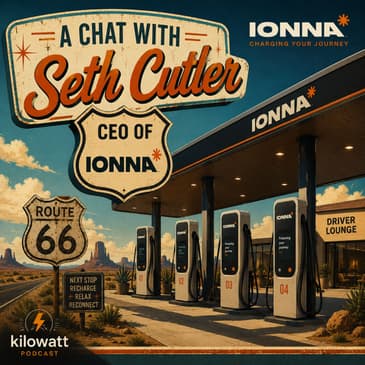
Bodie sits down with IONNA CEO Seth Cutler to talk about what it takes to build an EV charging network around reliability, customer experience, and the places drivers actually want to stop. Seth explains how lessons from his time at GE, Electrify America, and EV Connect have shaped IONNA's approach, from purpose-built Rechargeries and driver lounges to retail partnerships and the company's upcoming Beacon locations. They discuss the work happening behind the scenes to keep chargers and payment systems working, including IONNA's in-house software, proactive maintenance, and use of AI to identify potential problems before drivers encounter them. Seth also breaks down the differences between Rechargeries, Rechargery Relays, and Beacons, and explains why amenities like bathrooms, food, canopies, and even trash cans are part of the charging experience. The conversation also covers IONNA's rapid growth, its relationships with EV clubs and communities, and the challenge of building a profitable charging business without compromising reliability or the driver experience. Finally, Seth discusses IONNA's internal culture, its "driver first" philosophy and "IONNA Speed," and why he hopes EV charging reliability eventually becomes something nobody needs to talk about anymore.
Other Podcasts:
Guest Links:
*Show Art Created By Dall-eHosted by Simplecast, an AdsWizz company. See pcm.adswizz.com for information about our collection and use of personal data for advertising.
[00:00:22] Hello everyone and welcome to Kilowatt, a podcast about electric vehicles, renewable energy, autonomous driving and much, much more. And today we are going to cover the much, much more part of this podcast. I had the opportunity this morning, August 26th, to sit down with Seth Cutler, who is the CEO of charging company IONNA. If you're not familiar, IONNA was formed in 2023.
[00:00:46] It is a joint venture between eight automotive manufacturers. So we have BMW, GM, Honda, Hyundai, Kia, Mercedes-Benz and Stellantis. Well, I guess and Toyota. Initially it was seven and then Toyota came in in 2024. In that relatively short amount of time, their network has grown to be more than 100 locations.
[00:01:13] It's actually quite impressive how quickly IONNA has grown. The main thing, and you'll get this in the interview as well, but it's the customer experience. You're not just driving into a location, getting under your car and plugging in. Like the IONNA rechargeries have things for you to do. They have bathrooms, they have garbage cans. Some of them have little retail spaces and Seth is going to talk about that.
[00:01:41] I do want to let you know, Seth uses an acronym called, he uses QSR and that is quick service restaurant. So basically we're talking like a Starbucks or, you know, just a place you could grab a quick coffee and a drink. So when you hear QSR, that's what that is. And then more about Seth, Seth is a veteran in the EV charging space. So, and that's saying something because the EV charging space hasn't been around for all that long.
[00:02:10] But Seth worked for GE Electrify America and EV Connect. And, you know, like I said, now he is the CEO of IONNA. And in the interview we're going to end, I don't want to spoil too much, but we're going to talk about some of the lessons that he learned along the way and what IONNA is fixing. And, you know, trying to make a good experience, customer experience for everybody out there who owns an EV.
[00:02:39] So before I spoil the entire interview, let's go ahead and welcome Seth to the show. Thanks, Bodie. Great to be here. Thanks for having me. Thanks for coming on, man. This is kind of fun and exciting. First, I have to say, after doing some research, you are very inaccessible. You're an easy CEO to talk to, it seems like. So that kind of says a lot to what you're doing with IONNA.
[00:03:05] When you look at your career, you know, you started with, I believe, GE and then you went to Electrify America and EV Connect. When you look at, you know, charging stations today, what do you see differently because of all the experience that you've had to this point? Yeah, I think, look, I think the, I tell people this all the time, right? The market has gone through these kind of waves or phases.
[00:03:31] And I think that's very natural, especially in a nascent market or nascent industry. And so, you know, where we are now in terms of trajectory is a place where, you know, reliability is getting better. Density of chargers are getting better. Customers have more choice. And so where customers now are looking for is to say, how do I get the best experience at the most affordable price? And that's really where IONNA's focus is making sure that we're not just putting in chargers in the ground. We're putting them where people want to go. We're providing amenities so that there's something to do while they're there.
[00:04:00] And we're finding ways to make sure that the pricing is affordable to drivers as they look to go electric. Yeah. And one of the things, I mean, there's lots of stuff that we'll get into that I find interesting about what IONNA's doing. And the only one in Arizona, the closest one to me is in Wilcox. So that's about 144 miles. I was going to make a pilgrimage to the one in Scottsdale, but it's not open yet as far as your website goes.
[00:04:25] But when you look at an IONNA station, is there something you can point to and say, that's there because I learned this lesson the hard way 10 years ago? For sure. I mean, I think if you look at, you know, and Arizona is a great story, right? Like we have a site opening next month in Tempe where we bought or were leasing a old car dealership that we're converting to a full scale recharger with a driver lounge and bathrooms and vending machines and canopies.
[00:04:56] And to me, you know, when we started the company and really start to build the operations from early on, we said, look, the world has changed in charging. And so we wanted to make sure that the earliest sites we built were ones that had a very differentiated experience to really tell the story of what IONNA was trying to develop. Now, we've filled in the gaps, so to speak, on the network side with sites that are partnered with key high quality retail partners. But if you look at the early sites we built out and you look at the sites we're going live with now, they're really differentiated, right?
[00:05:24] You know, these are converted gas stations, they're converted QSRs, they're converted dealerships. We came in and said, hey, let's go build the amenity from the ground up that's purpose built for EV drivers. I think, you know, if I look at a lot of sites that have been put in the market and I've got my fingerprints on a lot of that in the industry today, there was a lot that was done to get stuff in the ground fast. But maybe not with the best customer experience in mind.
[00:05:47] And I think that's a place that the team is hyper focused on is not just get stuff in the ground, but make sure that it's really delivering for customers bar none from a great experience standpoint. Yeah, I do think it's interesting. So I rented a Chevy. I had to go back to Alaska for a funeral. I rented a Chevy Bolt and Alaska, not known for its charging network, I'm going to be honest. But I was like, you know what, let's do this.
[00:06:13] I had one bad experience with charging networks after another. And I had to drive about 100 and I think it's about 180 miles, 200 miles from Anchorage to Saldana where they had a charging station. And it was just like failed charging experience, failed charging experience, failed charging experience. One, I could barely read the screen on when it actually did work. So I had no idea other than electricity was going into my car. That is something that really stressed me out. And I've been doing this since 2016.
[00:06:43] I've owned an EV for a while. So I'm not like a new EV owner or even new to the world of EVs. In your perfect world, right, you've talked a little bit about the customer experience and things like that. But what do you see as the best interaction between the driver and the charger? Yeah, so I think a couple ways to think about that. And I think the experience you just described is one that I think pains me and the rest of the organization here.
[00:07:11] Because the folks that we've hired and the company we've built culturally is one where we really want to go fix charging in the United States and in North America as a whole. Because if we can do that, I think we can really unlock electrification more broadly in the market. Because today, charging anxiety, to your point, as you just told the story, is a real thing. It's still a thing. And so we're hyper-focused on that quality and making sure that when you come to a site, it works. You can get a charge. I think there are still people, like you just said, that go to a charging site.
[00:07:40] And it's still a bit of a roll of the dice of, am I going to get charged here? That's just not acceptable for someone to say, hey, am I going to really make the investment into a $40,000 or $50,000 or $60,000 vehicle that I may not be able to fuel up but doesn't work? And so then what that looks like is once you can kind of take off the table any misgivings about reliability, then when you start looking at it is how do you make the payment seamless?
[00:08:02] How do you get to a place where you give a variety of options, whether it's credit card or app, and really start to unlock plug and charge or auto charge for customers where they can plug their vehicle in and walk away? Because I think everything that we can do to reduce friction in that system or that machine for drivers, again, just creates a really great experience for them where charging is not a reason not to buy an EV.
[00:08:25] And honestly, if you look at EVs in general, those products today in the market are superior to even internal combustion in terms of speed and handling and acceleration and everything else goes alongside of that. I do think it's funny that we're in a world where credit card processing has been going on for decades.
[00:08:44] And yet the fact that a credit card working, and I know that IANA has done a lot to make this work every time, not just sometimes, but for a payment system to stay up so that it's actually working. Why is that so difficult for the EV charging industry? What magical thing do we have to overcome to make this work everywhere?
[00:09:07] Look, I think EV charging, I think there's two big barriers to EV, or there's two big obstacles, I'll call it, for EV charging that have existed in the market today. One is, you know, you've got these essentially vending machines that are dispensed electrons that are, you know, there's no humans there, they're unmanned. And so you've got, you know, disparate sites across the country, rural, densely populated locations that there typically are not people on site to service those stations. And so you're dealing with somebody who's trying to figure out what's wrong.
[00:09:35] They have to call a call center if there's an issue. There might be cellular connectivity problems driving some of the issues you're seeing. And so that's one facet of it. I think that the second facet of it is that, you know, historically, this has been a nascent industry. So the people that have been designing charging stations, which has been heavily focused on, you know, power conversion, power electronics,
[00:09:56] how do I take AC off the grid, convert to DC, high efficiency put into a vehicle, may not have had experience in terms of the actual integration with credit card readers into the overall software solution. And so when you can start to say, hey, how do I make sure that I've got internet connectivity? How do I make sure that while I may not have people manning every one of these sites, I'm doing health checks on a regular basis to proactively check the locations? And then how do I make sure that we've got the right testing integration with the credit card readers into the software?
[00:10:26] What that starts to do is remove the barriers and the obstacles that have existed to provide that level of ubiquity from a credit card terminal that, to your point, in the year 2026, you'd expect to see in the market that frankly just hasn't been there to date in the EV charging industry. So that kind of leads us to what Iona is doing differently, right? Right.
[00:10:49] When someone plugs their car into a charger and everything works, that's not interesting to anybody unless it doesn't work, right? That's the benefit. We don't want it to be interesting. But I kind of want to know what is happening behind the scenes specifically for Iona in terms of, I know that that's a very difficult thing to make a boring experience possible, you know, in terms of charging.
[00:11:15] I know you have all sorts of other cool things that you're recharging, and we'll talk about those. But in terms of that, I can't imagine the undertaking. How much of the stack does Iona own? Or are we working with a lot of great third-party partners on this? How does that work? Yeah. So I think to your first part, which I think resonates really closely to me, is that to your point, you know, talking about a good charging experience that it worked is not very exciting, honestly, right?
[00:11:44] But there's a lot that goes into making that work. And I always use the analogy of nobody goes to a restaurant and talks about the great meal they had, right? Or the fact that they get food poisoning. They'll talk about the fact that it was a great meal. And I think that's the difference here, or the analogy here is we need to make sure that charging becomes the equivalent of it works every time. Just like when I go to a restaurant, I'm not talking about how I didn't get sick. That's expected at the restaurant. And so to that point, though, there's a lot that goes in to make sure people don't get sick, so to speak, right? Or that they can charge their car.
[00:12:13] And so obviously, you know, we're buying chargers from Alpatronic, which is, I think, a really great charge manufacturer, a great partner in the space. There's a lot of stuff we're buying off the shelf, credit card readers and some software solutions. But we have developed our own software stack in-house that goes across all the disparate systems from internet providers, credit card terminals, backend providers, integration into mobile apps. That allows us to provide all types of alerting, diagnostics, monitoring.
[00:12:42] And we're now starting to work with AI solutions as well to be able to do predictive analytics to find out whether there's an issue before customers find out or may find there's an issue at the sites. That's been very helpful. When you couple all that from a tech stack standpoint into how we operationalize that from a service standpoint and labor standpoint, that's what I think has become a winning formula for the team that in two and a half years has developed what has developed, where we can roll trucks proactively.
[00:13:09] We, you know, we're doing preventative maintenance more often than others and we're biasing towards helping the customer. So if we get a report from a customer on a, you know, from our call center or from a, you know, social media platform that says I had an issue, I think a lot of companies will spend hours, days, weeks determining if it really is a problem. What we do is we roll a truck with parts on hand immediately. And what we find is it may not have been a problem. Maybe there was a customer interaction issue.
[00:13:34] Maybe it required a reset of the, of the software or the firmware, but either way we're on site validating that immediately to make sure that that's not an actual problem. And then we use that data to train our AI model even further to help identify us in terms of, Hey, was that a problem or not a problem? So we can inform ourselves better going forward. Yeah. And for those who don't know, it can be quite expensive to just, to just roll a truck to find out that everything's okay.
[00:13:59] Like, and that's probably a lot of the reason why those other charging companies aren't rolling trucks just because, because doing that across a nationwide network can get quite expensive. It can be very put on cost.
[00:14:11] So I think that's where we've done, I think we're, we're really kind of in this new frontier now with AI models where we can use that data now to really train our models in a different way by using the kind of, I'll call it human capital from a, from a node sample or data node perspective to feedback into that model beyond what we're getting off of the telemetry of the chargers or the credit card readers. So I think there's a lot of interesting things that we're doing right now and really investing to, to really make sure that we can continue to deliver quality at scale as we build the network. Yeah.
[00:14:40] And I mean, I'll, I'll, I'll mention this in the, in the intro, but you, you know, Ion has only been around since 2023 and your, your growth has been pretty significant and your reputation remains very high in the EV community. Um, is, I mean, we're going to kind of talk a little bit about the business here in a minute, but is that something, I mean, obviously that's something you got to be very proud of. Basically, that's not really a question.
[00:15:10] You should be proud of that. Well, I'm part of the team. You know, I think it, it's not the, the, the, I think to your point that the OEMs announced the, the formation of the joint venture back in July of 23. We started operation in February of 24, launched our first site in December of 24. And, you know, here we are a year and a half later, um, with, I think, I think impressive scale and really good quality, but the team has done an amazing job. I think we've hired the best of the best into the organization to do, to do what's, to do what we've done.
[00:15:38] Um, and these are folks that are every day or, you know, run through brick walls, mission driven, because I think a lot of the people that work here have come from the industry before. Uh, and they know the mistakes have been made, the mistakes that we've made, I've made. And then we brought in other folks outside the industry that see the potential, the opportunity. And I think it really resonates, you know, with them of what we're building, right? I think we really are blazing a trail forward to really, you know, reinvent electrification here.
[00:16:05] When, when someone inside your organization has an idea or, and this is, I mean, you don't have to answer this if you don't want to, but how much, um, how much ownership do they get? If they're like, I think we can make this better. How much leeway did they get to run to make that better? Is that, it kind of sounds like your company is pretty open to new ideas being a fairly young, uh, startup. Yeah, absolutely. I mean, I think if you look at, I'll, I'll, I'll pick on, so to speak, our software team.
[00:16:33] I mean, our software team has done amazing things on their own. A lot of times they're coming out and saying, Hey, we developed this thing and look what we can do. And that's, then they're sitting down on their operations team and the operations team is saying, Oh, I didn't know. I didn't even know you guys were working on that. Now all of a sudden it's something that we can go, you know, productize internally. You know, the AI models, an example of that, of what we're doing for service. So, you know, we give everybody, each team gets their own mission in terms of here's the mission you have to go accomplish. You guys come back and tell us how to make it possible, right? Yeah, get sites live. Tell me how we're gonna get sites live, right?
[00:17:01] Does that mean that we, that we do the construction for the utility? Does that mean that we do construction at risk? What are we going to do differently, right? Same thing with when we tell the team, Hey, we have to go deliver reliability and quality. You guys come back and tell me what, what software tools you can develop and diagnostic systems you can put together. Uh, because the truth is, is that we've hired some really talented, really smart people. We need them to help shape the organization and then the outcomes that will deliver real value to, uh, to EV drivers. Yeah.
[00:17:29] And, and if you want to keep those smart people, you got to give them room to run, right? A hundred percent. Yeah. Um, let's talk a little bit about the charging sites themselves. Can you break down what a relay, what a rechargery is and what a beacon is? Yeah, absolutely. So like we've come up with a couple of these, what we call product classes, which I think is a huge differentiator for the business as a whole. And this was done something we did very early on to your point about, Hey, what have we learned from the industry?
[00:17:56] This was one, one thing we learned, which is at the end of the day, excuse me, we're operating retail, retail environments. Some of them look different than each other, but then they're all retail. And so we have a classification of what we call recharger relays, rechargeries and beacons. Rechargeries split into two places. They're full scale rechargeries and they're rechargery ads. So I'll start with that product classification first. A rechargery is something where we've got a high quality retail, uh, partnership, either something that we've done in house by ourselves.
[00:18:26] So this is like, we take over a gas station. We open a convenience store. We put an Amazon just walk out technology. We put in a driver lounge. We've done that now probably half a dozen times more in the pipeline. That's a rechargery. Where we can partner with a high quality retail partner, Wawa, Sheets, Circle K, KC's, Wally's, et cetera.
[00:18:47] They provide that experience for the drivers with bathrooms and a QSR and an experience for that driver to have directly inside of their location. So that's a rechargery. Then you have rechargery relays, which give us an opportunity to co-locate adjacent to, uh, you know, a collection of, of QSRs or other amenities that are within walking distance, but may not be the same experience as you have at a Wawa or a Circle K.
[00:19:13] And those relays give us an opportunity to kind of fill in the network, so to speak, the skeletal structure as we build at scale, right? Cause we're trying to hit across, you know, dozens and dozens of states. And we're trying to go across, you know, multiple different interstates as well. And we can't always build the amenity ourself. And we can't always find a Wawa or, or, or sheets or, or, or a Circle K in those locations. So they, they become your infill to the overall network. Those rechargery relays are though no less than experience.
[00:19:41] You know, some of them have canopy still, they all have trash cans. I'll have windshield wiper cleaners or squeegees. So even though they're not a rechargery, they still provide the same basic, uh, amenities and reliability. And then you have a beacon, which is really a, what I call a rechargery on relays. And this is a place where you've got a much larger footprint. Um, you've got a much larger offering from, from a retail perspective. You have outdoor seating, et cetera. And so our first beacon right now is under construction. I was actually out there yesterday, walking the site with our construction team.
[00:20:11] That site will be 22, uh, high power charging bays. It's a thousand square foot, um, essentially a convenience store with Amazon just walk out. It's got an outdoor patio and games and outdoor seating that's covered. So this is a very large facility, uh, just off the, uh, the 405 interstate in California. And it'll be our first one that we'll experiment with and then see how we scale it across the country from there. One of the things that I do appreciate, and even though I've been experienced it myself,
[00:20:39] but way back when, when I first covered that, uh, you know, seven initially, but eight, uh, automakers were gonna, you know, build a network. You know, sometimes there is, there is like some skepticism there, but it really felt like there was like the, a customer forward type of, of location. You know, even like you said, trash cans, it doesn't seem like that's a big deal, but if you're on a long car trip and you have kids, trash cans are huge.
[00:21:09] Um, but in my other job, I drive a fire truck and every now and again, I have to go down and get maintenance done at the truck center. Right. And they have these driver lounges, which are very similar to what you're talking about. Like you can go to a vending machine, you can get a drink, there's coffee there. There's, uh, you know, recliners and a TV. And it's a, for me, it's a very good experience because otherwise I'd just be sitting in the showroom waiting for my truck to get done. Right. That would not be that.
[00:21:39] That's not, uh, that's not a desired task for me to do in, in, in my day, but because of, you know, the way that they set these, uh, driver's lounges up, it is quite nice. And if I had to choose between, you know, uh, two, two competing, uh, charging stations, the place that I could go and get us that I know that I could get a snack and use the bathroom. And some of these locations even have meeting rooms.
[00:22:06] I would a hundred percent choose IANA over the other places. It makes sense, right? I don't think anybody enjoys filling up their vehicle. Like no, no one enjoys going to the gas station. Right. Um, and I think, I think similarly, we have to make sure that the charging is in the backdrop, right? I charged my car, but let me tell you about what I did while I was charging it. Right. Charging needs to just occur in the background, which I think is something that can really different, really differentiates electrification in that one. Look, 80% of charging happens at home. Right.
[00:22:35] Cause that's, that's one of the beauties of electric cars is you can charge at home if you have availability to that. And if you have to charge in the public, which people still very much, you know, heavily rely on, you want to, you want it to be where they're talking about the experience and the destination and not about the act of charging. Do you, I know that there have been some events at, uh, rechargeries. Do you, are you open to like Tesla clubs or Rivian groups or whatever, you know, other EV
[00:23:03] associations having meetups at, uh, rechargeries? Absolutely. I mean, we, you know, even though we're a joint venture of eight OEMs, we work very closely with the other OEMs out there. So, you know, Lucid Motors has done ride and drive events at our recharger in, uh, in forest park, Georgia, which has been great. We do work with, with Rivian. Uh, we do work with the, uh, the, the F one 50 lightning club all the time across the U S we're talking with Tesla clubs. Um, so, you know, really, you know, I, I, I look at this as, you know, at some point,
[00:23:32] you know, I'll, I'll, I'll find something else to do. I'll retire. I want to look back and say, Hey, listen, if Iana didn't, if we don't see EV sales pick up, then Iana failed. And I think I really mean that. And I think so does the organization. You know, we have this driver first mentality of Iana is meant to be a forcing function to help sell EVs in the U S and to eliminate charging anxiety.
[00:23:56] And if, and I think a huge barometer of success will be, do we see EV sales climb over the next, you know, two to three years because of what we built out across the U S. How, how do you, cause I don't know that you advertise really, right? How do you let people know outside of just things like what we're doing right now? Yeah. I mean, I think we've done, we've done a lot of grassroots efforts, a lot of community driven activities. So we've got a few different things we're doing.
[00:24:22] We have started doing some advertising billboards as an example, very much on brand with us in terms of, you know, old meets new. Um, I think there's still a lot of folks that rely on billboards and when you're driving down the interstate, it plays really well. We are doing online advertising as well, but really where we've been focusing as on really engaging with the community. So, you know, our, our comms team has developed a station hands program where they're, you know, partnering with your point, local car clubs, EV enthusiasts. We'll drop the price for the weekend to 20 cents a kilowatt hour, which is on par with
[00:24:52] almost home charging. We'll do, we'll do a bunch of, you know, giveaway merch and swag to, to drivers. Um, and we'll do it in a way that we're partnering with the community. Um, and then we work very closely with our investors, right? So, so, you know, we're doing our, our labor day promotion, which we've done for the other big holidays. So it'll be 20 cents a kilowatt hour over that four day period starting next Friday. You'll see our OEM partners push out, you know, in app and email communications, um, to their customers as well.
[00:25:18] So I think we've been very clever, I would say, or very intentional about how we try to get the word of mouth out, uh, to, to drivers. And then we've been very strategic in terms of how you work with our investors to be able to, to really, um, you know, kind of inform the community that we're here. But I, but I, I will, I'll also recognize the fact that as a new company, I think we've got a lot of work in front of us to really build the awareness machine out, uh, to let drivers know that Iona exists. There's, there's eight major manufacturers behind Iona.
[00:25:47] Uh, this gives you resources. Most startups aren't going to have, you know, save like electrify America or whatever, where they have a BW group, but for Iona to have a healthy business, what does profitability look like? Because at some point in time they're, they're going to want this to stand on its own. Yeah. So, so I think I get this question a lot, right? Like this is not a, we're not, this is not a, uh, a charity organization.
[00:26:16] This is a for-profit for sure. And I think nothing changes going forward in terms of driving towards, towards that mission about building a sustainable business, both sustainable electrification, but sustainable in terms of something that will stand on its own. And I think, you know, very much our ethos is we believe that if we can take care of the driver, everything else will work itself out. So we run the company very efficiently. It's why, you know, it's, it's how we're able to scale the way we are.
[00:26:43] Um, and so we're very much so trying to make sure that we are delivering a quality of scale product that people want to use. And if they want to use it, that'll, that'll, that'll continue to, to create, you know, self-sufficiency into the future. We, we know that it's, I mean, I've had so many people talking about, you know, standing up, you know, charging stations and we know it's very expensive. What did, what did you find was the biggest opportunity to reduce some of those costs to standing up the station?
[00:27:14] It's a good question. Look, I think, I think we've been very, um, very efficient in terms of how we design our sites and how we think about scale. Um, and then where we, where we spend money to accelerate and where we spend and where we don't spend money because it doesn't make sense from, from a, uh, a site built perspective. So, you know, hyper-focus on the customer experience and design will invest there. Um, but we won't in places that isn't going to help either the driver experience or get sites built faster. And so I think our scale definitely helps, right?
[00:27:42] When you're, when you're trying to build a scale, you can leverage that, um, from a cost position standpoint, and then you can make certain decisions that help you get there as well. And then when you look at, you know, you know, profit and, and the, you know, with the money coming in versus the money going out and you need to make cuts, where won't you make a cut? Like where, when, what, what area of the business were you like, this is kind of, um, this is, this is who we are.
[00:28:11] So we're not going to cut costs necessarily here. Maybe eventually you would have to, but initially what's protected. Yeah. I mean, it's very easy, right? It's quality of scale. So we'll, we'll never compromise on the customer experience. If we have to roll a truck, we roll the truck. If it means that we're going to spend less money on advertisements, we'll spend less money on advertisements. If our software team says they need to develop new features to help reliability and quality, they get what they need, right? Got to protect the driver.
[00:28:38] So very much, you know, we have these cultural tenants that we, that we live by. The first one is safety. Everything has to be safe, right? We're dealing with, you know, construction sites across hundreds of locations right now. We've got, you know, families coming to charge our sites. We have to be safe. The second one we focus on is the driver first. Every decision we make, the driver's at the center of that decision. And then the last, the last, what we call cultural tenant is what we call Iona speed. And really what Iona speed is, it's really this, this, this bias towards action, make
[00:29:07] a decision, drive action forward, move the ball forward. I think a lot of companies, a lot of organizations, they can get stuck in the analysis paralysis and by committee and let's have another meeting and what should we do here? And what's allowed us to move fast and what's allowed us to maintain that quality is, you know, we'll get in a room, what decision needs to be made. We're going to make the decision right now. We don't need to have five more conversations about how to make that decision. We know what matters. Get the site live, deliver the right quality and the right customer experience to drivers.
[00:29:37] Excellent. And I really only have one more question for you, which is when you, I mean, you obviously do a lot of interviews. So what is one thing in terms of EV charging that you hope you never have to talk about again because it's been solved? I mean, that's, that's easy. I get that question a lot, right? And it's reliability. You know, I think on all these podcasts, all these interviews, we get that question a lot still about reliability and quality.
[00:30:06] And I think until the industry, not just I don't know, but until the industry as a whole gets to that place where we don't talk about that anymore. I think, I think charging is a problem in the U S right. It's probably North America. And so I think it behooves all of us, myself and everybody else in this industry about really solving reliability once and for all. So people aren't, you know, it's kind of like the old Verizon commercials where, you know, the guys walking around going, can you hear me now? That's not advertised anymore, anymore. Right. They don't talk about that because that's a, that's, that's, that is a thing of a nascent
[00:30:36] market that really has, has corrected. So I think that's where we have to get to on the charging side as, as a group. Excellent. Well, Seth, thank you very much for coming on. How would people learn more about what IANA is doing? Yeah. Check out our website, IONNA.com, you know, you know, follow us on social media. I know there's a lot of influencers that also follow us. So just, just look us up and, and on your next drive, give us a shot. Excellent. All right, buddy. Thank you so much. Yeah. Thanks so much. Great to be here.
[00:31:07] Okie doke. I want to thank Seth Cutler for coming on the show and being such a great guest. I would also like to thank Sarah for organizing this and putting this whole thing together. That was very helpful. I barely had to do anything, which is always appreciated. So thank you, Sarah. Thank you, Seth. If you want to learn more about IANA, I'll put the link in the show notes as well. I, I should say that I mentioned that their location, their new location is in Scottsdale
[00:31:36] and Seth said it was in Tempe. He is obviously correct because he's the CEO of the company. It's on Scottsdale road. It's actually on Scottsdale in the 202, which is right on the border between Scottsdale and Tempe. So when it opens next month, I'll definitely take a swing by and give their chargers a try. And I'll let you know my customer experience. Oh, oh, oh.
[00:32:02] I should also say if you are somebody that drives a Tesla or if you're somebody that's driving a car that uses a CCS plug, that's totally fine because they offer both. And I believe they offer both at every single location. But if you want to verify that, if you're out doing a road trip, you can go to their website and type in, you know,
[00:32:24] click on find a charger and put in your location and it will give you all that information in terms of how many of each connector they have. So anyway, big thanks to Seth. Big thanks to Sarah. Really appreciate both of you. I'll put all the links in the show notes. If you have questions, you can send them to me. It's Bodie, B-O-D-I-E at 918digital.com.
[00:32:49] You can find me on LinkedIn and you just search my name, Bodie Grimm, B-O-D-I-E G-R-I-M-M. And yeah, I hope you all enjoyed this interview and I'm looking forward to your feedback. All right, everybody, our next episode is going to be all news and that will be Friday or Saturday, probably Friday. We'll see.
[00:33:16] Hope you all are having a great week and I'll talk to you all soon.