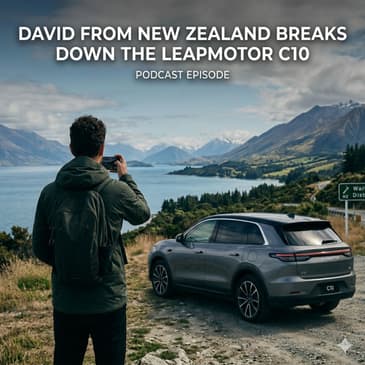
In this episode, host Bodie sits down with David from New Zealand to get an owner's perspective on the Leapmotor C10 electric SUV. David shares his transition from a gas-powered Suzuki Vitara to the C10, highlighting why its exceptional value, rear-wheel-drive dynamics, and spacious layout won him over against competitors like the BYD Atto 3. They dive into real-world range, the local support infrastructure provided by Stellantis’s investment, and how over-the-air updates have tamed early frustrations with the vehicle's driver assistance systems. David also details the unique conveniences of owning a modern software-defined car, from integrated ambient lighting alerts to using vehicle-to-load power capabilities for everyday tasks. Finally, the conversation hits on the realities of road-tripping and public charging infrastructure across New Zealand's scenic highways.
Support the Show https://www.supportkilowatt.com/
Other Podcasts:
Beyond the Post YouTube (https://www.youtube.com/@beyondthepostfm) Beyond the Post Podcast (https://www.beyondthepost.fm/) Shuffle Playlist (https://shows.acast.com/shuffle-playlist) 918Digital Website (https://www.918digital.com/)
News Links:
*Show Art Created By Gemini
Hosted by Simplecast, an AdsWizz company. See pcm.adswizz.com for information about our collection and use of personal data for advertising.
[00:00:22] Hello everyone and welcome to Kilowatt, a podcast about electric vehicles, renewable energy, autonomous driving and much, much more. My name is Bodhi and I am your host and on today's episode we are going to sit down and talk to David from New Zealand about his Leapmotor C10. We have talked quite a bit about Leapmotor recently. It's almost every time we mention Stellantis actually we have to mention that Leapmotor is kicking their behinds in terms of electrification.
[00:00:52] We just, Stellantis is a big investor in Leapmotors. But yeah, we talked to David, he tells us, you know, kind of what his thought process was when he decided to go electric and then what vehicles he looked at prior to buying the Leapmotors, what he owned before owning the C10. And then, you know, we just get a good chat about whether or not he likes it or not.
[00:01:17] One of the questions I asked, which I thought was relevant is did he have any apprehension about buying the Chinese vehicle and I'll let him answer that. But yeah, in all in all, this was a really good chat. So without further ado, let's go ahead and welcome David to the show. David, you live in New Zealand. You have much more many more choices as I found out.
[00:01:47] Living in New Zealand for EVs. You purchased recently a Leapmotor C10. Were there other EVs that you were looking at before you made the choice to go with the C10?
[00:01:58] Really, really, the only EV that we were seriously looking at as an alternative before we tried the C10 was the BYD 803, which is about the same price point. Also much preferred how the C10 drove rear wheel drive versus front wheel drive. The 803 is a bit softer and quite sort of bouncy in its ride.
[00:02:20] But we drove quite a few different variations. The original BZ4X, things like the Kia EV6. Quite like the EV6 to drive, but it's nearly half as much again cost-wise over the C10. And you had to get the GT line spec to get close to the same features that the Chinese were offering.
[00:02:50] So that was, yeah, I guess the value proposition was really why we went with the C10 above all else. My wife particularly liked the look of the C10. We've gone with a colour called Tundra Grey, which is a sort of beige-y colour, which is quite unique. But yeah, no, we did try a few, but really the C10 just seemed to tickle all boxes and also a great price.
[00:03:18] Other than price, what were some of the most important features that we were looking for? Space and comfort. My wife particularly liked the SUV body style, which the C10 is. It's kind of like a station wagon almost, whereas a lot of the small Chinese SUVs are more like glorified hatchbacks. So yeah, space, comfort definitely. I prefer the rear wheel drive as an option. What was the price point?
[00:03:47] So we paid $53,000, which is about US$31,000. I mean, here that's great. Yeah, yeah, exactly. So 803 at the time was pretty much identical pricing. We've now offered a deal that's about $500 cheaper. And it offers the same range. The 803 is a bit more efficient, being smaller. So yeah, 420k's WLTP.
[00:04:16] What are you getting real world, though, with your range? Around town, we would exceed that. On open roads in summer, we're getting 350 to 380. Got down to about 300 in the middle of winter. Around here, we don't get snow. But down to zero degrees Celsius. So freezing. Are you around Auckland or yet?
[00:04:42] We're in Topal, which is roughly halfway between Auckland and Wellington. So halfway between the two largest cities. We did Auckland back last Monday. So it's approximately 600km round trip. Can't take about an hour to recharge while we were shopping and doing things around Auckland. So pretty easy. Torque break on the way back and topped up in more than enough to get home. Absolutely perfect range for our use. What did you drive before you bought a C10?
[00:05:11] We had a Suzuki Vitara. That was a 2017 turbo, front wheel drive. 1.4 liter turbo petrol. In SUV sort of that, but really just a hatchback. Same powertrain as what they put in the Swift Sport. I don't know if you're familiar with the Suzuki Swift Sport at all. I don't even know if Suzuki cars are sold here in the US. I know we have some Mitsubishis. Like one brand. One trim. Right.
[00:05:42] Mitsubishi definitely going out. If it wasn't for the Outlander. And their pickup. They wouldn't exist here either. But it seems like they're doing some interesting things. It sounds like Foxconn are building an EV in Thailand. Or Taiwan, sorry. And it sounds like they might brand that as a Mitsubishi. Oh yeah. The markets, including ours. So yeah.
[00:06:10] It's interesting how different brands do different things. Yeah. No, for sure. When you went from your Suzuki to your Leap Motor C10, what were some of your impressions? Well, I mean, C10 is way bigger. The one. Again, it's similar sort of market positions. Suzuki is sort of sold as a fully budget. But could value a vehicle. And that was one of the reasons we bought it originally.
[00:06:40] And going to the C10 is much the same. So it's sort of the entry-level price. But you get a lot of vehicle, a lot of features for the money. It wasn't anything that Suzuki had that we didn't get with the C10. But obviously, C10 got a whole lot more. The C10, not a performance vehicle by any stretch. But it's slightly quicker than the Vitara. Because it's substantially bigger. And not lose any performance was a thing.
[00:07:06] Did you have any sort of apprehension about buying a Chinese-built vehicle? Did it feel risky? No, not at all. Definitely not risky. I've sort of been following the market generally. Watching international reviews and things of Chinese brands. And yeah, sort of knew of Leap Motor before they came here. But we got in pretty early. I think ours is one of the original shipment into the country.
[00:07:36] The fact that they're backed by Stellantis. Reputationally gives them much of a thing. But it does put some weight behind the brand. And the local distributor has been around for a long time. Lots of different brands. Including a lot of Stellantis products. And they've been around for a long time. They've got a pretty good reputation for how they operate. They felt that even though the Leap Motor brand is Chinese, there was going to be local support for it. And so yeah, going Chinese definitely wasn't really a thing.
[00:08:06] When you look more, I guess a better way to say this is, how does the car feel to you? Does it feel like it's a budget car? Does it feel like it's premium? Is it something in between? Definitely in between. And probably slightly more premium than budget. Very nice sort of interior feel. Very little in the way of sort of hard plastics. And even those feel good, robust.
[00:08:30] No rattles, no sacks, no untoward noises or anything at all in our ownership. Even now it still feels as it did when we bought it. So yeah, and compared to the Suzuki, which was all hard plastics, it feels, yes, I mean premium. And things with features, it's glass, panoramic roof. It's artificial leather, but it's a really soft, supple feeling. Heating and ventilating.
[00:09:00] Front seats. Nice. Headed steering wheel, heated mirrors. Everything's electric, of course. Electric seats. Driver profiles. So wife and I get in, tap our user profile, and adjust the seat and the mirrors to your seating. I know you had a, when you first saw the car, or when your wife first saw the car, she liked how spacious it was inside. But what were some of the other design aspects that kind of attracted you to this car? Sure. It's a big car.
[00:09:31] Proportions are pretty good. 20-inch wheels. Got sort of cool things like a rear light bar. Does sort of animations on power down. So gimmicks, but they're quite attractive looking. Adds a point of difference. Privacy glass on the back. So yeah, it just is a nice looking car, we think. Yeah, and the things like when the car does certain things to shut down, or when you turn it on, and it kind of welcomes you, or any of the things.
[00:10:00] I think that brings, it's not value for the sake of it does something that makes your day any easier, right? But it brings value in that you bought this thing for X amount of dollars. And when you get in, it makes you happy because you're like, oh, that's a cool feature. I like this feature. Yeah, absolutely. And things like ambient lights too. So contribute that. You change the colors. They do different things. They integrate with the reverse sensors. So you get close to an object, the lights go from
[00:10:31] present color to orange to red, or yellow, orange, red, as you get closer to objects and things like that. So it's nice little integrations. Because if you so choose, you can match them to your audio as well, and they can pulse to the music. Oh, nice. Just, again, little gimmicks, but quite cool things. But yeah, just little things that you appreciate over time. So one of the things that I thought Tesla did really well early on is everything that they built into their car,
[00:11:00] there was a lot of purpose built into their car, but there was also a lot of silliness in a wink and a nod that, you know, this is a car. It should be fun to own. It doesn't, not everything has to be, there doesn't need to be a reason for everything to be there, right? We can have karaoke mode in the car or whatever to make it just a little bit more fun. Yeah, absolutely. And again, with anything software-based, software-defined cars, whatever you want to call them,
[00:11:29] and that is so much easier to implement. Do you have any experience with the Neo brand? No, I'm only following them on YouTube and things. We are supposed to be getting their Farfly here this year. Oh, yeah? But I haven't seen a formal announcement yet. Yeah, I love their little assistant. I can't remember what it's called. Numi? Yeah. Yeah, Numi, yeah. Yeah.
[00:11:58] Like, just silly face. It makes silly, it's just, if anybody doesn't know, it's just a little screen that if it rains, it'll start raining. It'll show on the little screen that it's going to start raining. When you get in, it welcomes you. It can, you know, I don't know, there's just lots of little things. Again, provides no value in reality, but it makes you happy that you, you know, spent however much money on this car. I think that's underrated in the auto industry. No, absolutely. And I think in China,
[00:12:29] brands have to differentiate themselves one way. And obviously it's one thing that Neo does that others don't. And it's such a competitive market. And most of the cars have all the features. How do you differentiate? And that's, you know, gimmicks or whatever you want to call it is one way of doing that. No, that's it. That is a really good point. And actually not one that I think I've explored very much. So you've given me something to think about. Okay.
[00:12:59] So we've talked a little bit about the design of the car, the interior. What were your thoughts when it comes to the software? Initially, good. It's a iPad style screen on the dash, like so many of the Chinese are. It's easy to navigate around. It's fast and responsive. I knew going into it that there was no Apple CarPlay or Android Auto. And again, it was a consideration, but not deal breaker for us.
[00:13:29] It sounds like for some people that is a bit of a deal breaker. But it's got Spotify built in. It's got the Bluetooth good quality. And the nav maps work well. Yeah. It all just works. We haven't missed CarPlay at all. So your wife's had a Spotify account. So that's our primary audio source. And it works great. And the sound system is fantastic. But we've had no issues with the software at all.
[00:13:56] We've received four significant other updates since we've had it. And every update adds significant and meaningful changes. One of the biggest criticisms of the C10 in particular was its ADAS system or systems being particularly intrusive. Loud beeps and bongs. If you go over what I thought was of spending it by a kilometer an hour,
[00:14:26] it would start alerting you. The driver's session monitor was overly zealous if it didn't think you were paying attention. But we received an update within a couple months of owning it. And it made those better and new updates since it's just improved on it further. They've now added a shortcut button on the steering wheel that you can customize in the latest update.
[00:14:53] Now it means that you can add ADAS features to that button. So a single tap of that disables most of the ADAS system, which is very nice to have. I enjoy driving. I don't want to have systems that distract you or overly zealous in how they operate. And the lane keep, particularly if you drive what it thinks is too close to either side of the lane, it bings first and then tries to steer you back into the lane.
[00:15:24] Which, it's definitely a lot better, but I still just like to feel I'm in control. And that customization lets you do that. But no, on the whole, the software's great and it's, yeah, it works. My wife's car is really overzealous with her Kia Carnival. And we went in, go ahead, what's that? Yeah, no, it's, yeah, saying it's definitely not an elite motor thing.
[00:15:49] I think the Chinese specifically get bad rap for their ADAS systems, but talking to owners of newer Kias, they too are in the same boat, particularly lane keep and driver awareness things. And from my understanding that those Kias are even more difficult to disable. They are. You are 100% correct.
[00:16:16] We were driving in California on a, on a narrow kind of two lane road. And it was windy and I didn't want to be hugging the center line. I'd much rather hug the outer line. And it kept pushing me back into the middle and I was like, I do not want to be here. I would much rather be a little closer to the, to the right end, right part of the right end to the right side of this road. Then where you're putting me. Not actually, I don't know.
[00:16:45] I don't know if you know New Zealand roads at all, but that, that would, that would define 90% of our roads are that, you know, relatively narrow, two lane oncoming traffic. And yeah, quite windy. So yeah, anything that tries to pull you close to the center of the road is not what you want to do. 100%. With that, how would you compare like a driving it in the city versus doing road trips? Oh, fantastic.
[00:17:13] I mean, my wife drives it to work and back every day. So it's particularly efficient around town. Of course we're, we're in a small town. So, you know, a round trip for who's 10 kilometers, um, you know, six miles. Day to day we were charged once or twice a fortnight. Um, we don't have solar yet. So it's just charging off the grid, but we have an overnight tariff. It works absolutely fantastically for us.
[00:17:39] And road trip, again, it's, it's comfortable, fantastic sound system, enough performance. I think it's good to drive. Watching video reviews is very much, you get the presenter's opinion a lot. And, you know, some people say, oh, it's, it handles great and it drives great. And others say it's, it's rubbish. It's, it's very hard to really know what, what it's like based on reviews. Nothing against reviewers. They've got a job to do. Um, and they're reviewing a lot of cars.
[00:18:08] It would be fantastic if they could sort of add some commentary as to what they're comparing things against. You have to say a car handles badly. What, you know, what are they comparing against? Are they comparing something that costs the same? Something that's in the same market? You know, any SUV is going to handle poorly compared to a sports sedan or something like that. But yeah, it's, it's hard to know when they are saying something that handles badly is in what context. That's yeah. Let's see.
[00:18:37] That is a really good point. Recently, I've had a lot of, oh, not a lot. I've had a few car reviewers on and I would like to have them back on to just maybe three or four of them and just discuss what kind of things are important to you as a reviewer and how are you measuring it? I think that's a, cause everybody, right. Everybody has a different opinion. And some people are really very realistic in what to expect. And some people are like, this is just my bugaboo and I'm going to hit every car that,
[00:19:06] that, you know, tickles that bugaboo. Yes, not very much. And again, with the new vehicles and over the updates, reviews get out of date so quickly. You know, the changes that are noted over there, update can make to a vehicle. Not so much the driving dynamics, but pretty much everything else can be improved or made different with an update.
[00:19:34] So if you're watching a review that's a year old, you know, it can be quite a different car now. You almost need reviewers to go back and do a review of an updated car and see how they think it compares and how it's improved. Agreed. You mentioned that you have a tariff at night. What does that mean to people in like the United States? Does that mean you get a, a, a little relief in terms of what you pay for charging or what does that mean?
[00:20:04] We have a lot of different, uh, energy retailers. There's, we've really only got four major electricity companies come here to generate and then they, you, you, you buy from retailers. There's a few links to the chain, but, um, every retailer, if it sits there, sell price of electricity. Most don't do a time of day or type of use based charges, though there are a couple of now doing that.
[00:20:31] So you can get substantially cheaper rates of peak things. Um, but our, our plan is our overnight rate from 11 PM to 7 AM is, is half our day rate. We, we currently pay the thing. It's just gone up on the first of April, but it's about 40 cents per kilowatt hour during the day. And it's 20 overnight. So a full charge of a car costs about $8. Nice.
[00:21:01] Yeah. We were talking, um, what, what, what'd you say was a $2 a liter right now for gas? Um, it's, it's gone up. Yeah. So it's over $3 now. Yeah. Yeah. So that's, uh, you know, moving that to American dollars. Cause I didn't think it would be this high, but it was like $7 a gallon. Yes. Um, and it was actually more, it was probably like seven 30.
[00:21:29] I don't remember what the number was, but yeah, that's significant. So if you're paying eight for energy, huge savings. It is. And obviously road trips, um, public charging is, is definitely more expensive. Um, New Zealand also has, um, I think we're still the only country with it. In fact, we, we pay a road user charge, um, as a excise effectively on every kilometer we drive.
[00:21:59] Um, so it's another seven, uh, 7.6 cents per kilometer effectively. Now that's, that's paid outside of charging though, right? Absolutely. Yeah. So it's, it's on top of, yeah. So our charging is cheap and if we could do all our driving just on, just on electricity
[00:22:20] costs, um, would be, yeah, save money and our fist, but, um, yeah, EVs here are still semi-cheaper than a petrol or diesel equivalent provided you can charge at home. Um, if you're relying on public charging, um, we pay between sort of 80 and a dollar per kilowatt hour for public charging.
[00:22:44] And when you're then paying road user charges on top of that, um, you know, it's almost cost competitive with, with, uh, uh, efficient petrol. Yeah. Same here. Same here. Unless you, you're charging in very off peak or off busy times at the charger, sometimes you can get better deals, but, uh, sometimes, you know, you can walk away from a charger paying 50 or 60 bucks depending on how big your battery is. Yeah, no, absolutely.
[00:23:14] Yeah. We, we, we drove 600 kilometers, um, a week ago, um, from where we lived to, to Auckland city and back. And obviously had to use public charging to, to recharge, but it costs us $60 New Zealand to do that. It's probably half to a third what it would have cost us to do the same journey in our previous vehicle. But fuel alone, it's a definitely cheaper, um, than adding the road user charges in offsets that a bit, but it's, it's still cheaper.
[00:23:42] Well, you talked a little bit about the public charging. What's the infrastructure look like where you are in New Zealand or do you have to really plan or are you just like, well, I know there's going to be one around somewhere. It's getting better all the time. Um, and if you're following the main routes, definitely you, you don't need to plan so much.
[00:24:08] Um, previous government, as you put in a plan or a previous government put in a plan to put charging infrastructure in. So yeah, every 75 kilometers of the main highway network, there will be a charger. Um, I don't think they went so far as defining what their charger would be. And obviously to begin with, they were sort of 50 kilowatt units. Um, so that sort of plan.
[00:24:35] And so I think that was pretty much, that was met. Um, so yeah, if you're traveling on the main roads, um, which the majority of people here would be doing, um, every 75 kilometers, there would be a charger. Um, and that, that was probably, yeah, four or five years ago that that solar plan was met and it's grown substantially from there.
[00:25:01] Um, we've got a network operator called ChargeNet, which was sort of the first one other than Tesla to roll out a nationwide network. They're all over basically. Um, they're not the cheapest, but they've got a good, consistent, reliable, reliable network, um, a mixture of units from, yeah, 50 kilowatts up to 300 kilowatt units. Um, yeah.
[00:25:30] And, and they're like, like everything they are always growing, adding new units, adding new sites. Are you able to charge on a Tesla network with your C10? We can. Yes. And I have done, um, we choose not to cause they're sort of the dearest, um, operators for non Teslas. Um, and again, if you're doing a lot of trips, you'd probably sign up. So the subscription and get a discounted rate, but because there's so many alternatives, we don't, don't need to.
[00:25:56] Um, we've got two Tesla stations in town where we are. One is Tesla only. It's been, you know, a long time. There was a newer station that's opened everybody. Um, and I have, I've charged there as a test and it works fine, but they're more expensive than everyone else. And then you mentioned that one of the reasons why you felt comfortable buying like Lieb Motors specifically as a brand is Stellantis is a big, uh, backer in the company.
[00:26:27] With that, have you had to have anything in terms of like service done or repairs or any kind of warranty coverage? Not, not warranty. We have had a, a first service and within the first three months of ownership, we had a cracked windscreen, um, which were a replacement. So we had to go back to a dealer for that. And that was an interesting exercise in itself. Um, you first redoubt to your insurance company.
[00:26:56] We, we have a excess free windscreen repair replacement as part of our insurance policy. Of course, talk to them. Yeah, no, we can do that. No worries. Oh, what's this car? We've never heard of this before. They had to go away and find out what the story was. They talked to the distributor and I know we can source a windscreen. So yeah, we can do all that. And then came back and said, oh, no, we can't actually do the job because we can't do the ADAS calibration. Oh, so yeah.
[00:27:27] And then had to get back to the dealer. Um, the day we had it booked in or, you know, once insurance had gone through, it said, yes, go ahead and book the, book the windscreen replacement, um, kind of deal. And, oh, I'm sorry. We've just sold the last screen in the country today. Um, so we then had to wait for a new windscreen to come in, which I think took four weeks in, in total. And it was only a crack. So we were able to keep driving in the meantime.
[00:27:55] So a bit inconvenient, but, um, you know, even if parts aren't in the country, yeah, they're not that far away. Another thing that was a factory we bought, Leap Moto only had three dealers in the country. We're sort of halfway in between two of them. So just something we had to think about if, if something did go wrong, we didn't need to get it to a dealer. Yeah. We're three hours away, but fortunately, don't you touch wood, nothing, nothing other than the windscreen has gone wrong.
[00:28:20] I've had it in for its first service, which was 12 months, 20,000 kilometer service intervals. It was a $280. The first service, um, annoyingly the actual service was $80 and the rest was made up of a cabin filter, which, yeah, I don't know ahead of time. You'd say, well, you know, just some of the cabin filter. I'll fit that myself. Um, but anyway, that's when you, your major service cost is that it's, um, but disappointing.
[00:28:49] I just replaced the HEPA filters and the cabin filters in my car yesterday. And, uh, I'm glad I did it because I wouldn't want to pay somebody. It was already $90 just for the filters. Right. I totally, totally understand where you're coming from. It's like, man. Yeah. Could have done that myself. Yeah. Correct. Yeah.
[00:29:13] Um, if, if you had to pick an area where the car could use some improvement in your opinion, what would you pick? Um, it's only for our use. It's, it's close to perfect. I don't think there's anything that we ourselves would like improved. Um, for other buyers, yeah, CarPlay or Android Auto would, I think, um, make it more appealing to other users.
[00:29:41] You know, I think there's a lot of people that won't even look at it because it doesn't have that. They won't try and, um, see what the system is. They'll, they'll look for another option that does have, does have those features. Charging speed would probably be another area that others might look at. Um, again, for our use, it's, it's, it's perfect. Um, we don't need it to charge faster.
[00:30:07] Um, so we, we get to the major centers from here without having a charge on the way. Um, and, you know, and our charge is in general sufficient to get home. Um, you know, we have a little dog and we need breaks ourselves. So we would need to stop for five, 10 minutes, but that's, you know, plenty of time to top up while we do that. And we're guaranteed to have charged to get home and saying that the peak charge rate
[00:30:36] is only 84 kilowatts, which is not, not great on paper, but, um, it has a really flat curve. So yeah, it's, it'll hold 84 kilowatts from basically from zero through to 85%. Um, and then it sort of tables off to about 25 kilowatts for the rest. So it's a, it's a really good curve if you, if you ignore the peak rate. Yeah, that's true.
[00:31:02] What is the, what is one feature that you think is kind of underrated that maybe is even under reported by reviewers? Yeah, that's a good one. We think it's a good car to drive. It handles well. It's comfortable. Most amount of space, particularly for the rear seats. Yeah. It's a really stretch out. Enjoy it. It has that called guard mode, but it's effectively a pet mode. So you can, you can leave, leave your animals in the car for an hour of time with the aircon
[00:31:30] going and, and I miss it on the screen. Camp modes. Um, you can basically put it in a camp mode and sit in it. Um, vehicle to load. Oh, nice. You run, yeah, run three kilowatts off of it. Priority appliances. Um, I've used it because it's there, just, you know, running vacuum or whatever to clean the car. It's handy not having to run extension leads. You can just plug in where the car's parked. Um, haven't had to use it. Our power's been pretty stable.
[00:32:01] Um, but it's nice to know that if there was an outage, we could run essentials off the car. And again, it's a feature of the Chinese. Most of the Chinese manufacturers here have, have all those features or variations of them. Um, but I think just as a, an all round vehicle, um, we weren't going to buy one, but we sort
[00:32:25] of looked at a RAV4 hybrid, um, before looking at this and on paper there, same sort of market space, similar overall size, similar performance, but to get things like heated seats, ventilated seats, um, those sorts of things you need to get the top end RAV4. Um, which is so many dearer than what we paid for LC10. So, and not electric. Um, yeah, a hundred percent.
[00:32:55] And the vacuum thing, um, I don't, I only have, uh, two outlets in my garage that I can get access to and they're in the ceiling. So, um, it's a little bit of a pain in the, in the rear. I do have an extension cord, like a reel up there on one of them, but man, would it be nice to just vacuum my car where it is without having to get the reel down and move it over and. Absolutely.
[00:33:22] And it's those little things that, um, you don't, don't consider normally buying a car as, as those little conveniences. No, that's a, that's a big convenience in my opinion. Um, well, David, thank you so much for agreeing to come on and chat about your, your experience with the C10. Um, any last parting messages you would like to share before we part ways? No, um, not, not about C10 specifically.
[00:33:52] I don't think, um, I think we've basically covered everything. Um, as I said, I'm sure you, you can tell, um, we, we, we love our C10. We've, um, had a great run. Absolutely recommend anyone looking if they're in a market that it's available. Go and check it out. Take it for a center drive. Like any new vehicle, not, not, not every car is going to suit every buyer, but certainly don't add it to your list. Go and check it out. It's a, it's a great old car. David, thank you so much for agreeing to come on and, uh, I hope you enjoy the rest of your weekend, buddy.
[00:34:22] Yeah. Thank you so much. You too. All right, everybody. I want to thank David for being so generous with his time. And when I say generous with his time, uh, there is a time difference between Arizona and New Zealand. So, you know, it took a little bit of time to, for me, not for David, for me to figure out when the, when we could do this. Cause I, I had to go through and I didn't, you know, I used Allison. And Sheridan's time shifter, uh, uh, tool that she has.
[00:34:51] If just type in pod feet and time shifter, if you're interested to kind of get an idea when, when would be the best time for both of us. Anyway, it worked out. So David, again, thank you so much for coming on the show and chatting with me about your leap motor C10. All right. Uh, that is it for me. I'm going to head to bed cause I've, I'm, I'm exhausted today and I've had a long one. So I hope you all have a wonderful weekend.
[00:35:18] And on Tuesday we will talk about GM's Q one 2026 earnings call. Yeah, I think I'm pretty sure that's what it is on Tuesday. All right, everybody. Thank you so much. I will talk to you soon.