Episode Summary
Welcome to a weekend edition of Kilowatt, where we break down the latest shifts in electric vehicles, autonomous driving, and renewable energy. In this episode, we dive into the details of California's newly structured EV rebate program and explore Norway's staggering, world-leading 98.1% EV registration market share dominated by the Tesla Model Y. We also discuss the impending arrival of affordable Chinese EVs like Dongfeng's Nami Box and Vigo into the Canadian market under reduced tariffs. Turning to Tesla news, we unpack the recent recall of nearly 20,000 older Model 3 and Model Y vehicles due to overly bright low-beam headlights. Additionally, we cover the NTSB's latest findings regarding the tragic FSD crash in Texas, Elon Musk's promises regarding personalized FSD driver preference learning, and Tesla’s plans to build a purpose-built, wheelchair-accessible autonomous vehicle outside Austin.
Support the Show https://www.supportkilowatt.com/
Other Podcasts:
- Beyond the Post YouTube (https://www.youtube.com/@beyondthepostfm)
- Beyond the Post Podcast (https://www.beyondthepost.fm/)
- Shuffle Playlist (https://shows.acast.com/shuffle-playlist)
- 918Digital Website (https://www.918digital.com/)
News Links:
- Elon Musk says your Tesla will start to learn your individual preferences
- Tesla Must Recall 20,000 Vehicles Over Bright Headlights
- EVs At 98.3% Share In Norway — Tesla Model Y Leads
- California's EV Rebate Won't Apply To All Cars. These 13 Automakers Qualify
- Tesla FSD Investigation: NTSB Confirms Driver Pressed Accelerator in House Crash
- Americans Can't Have These Affordable Chinese EVs. But They're Coming To Canada
- Tesla reveals development of wheelchair-accessible autonomous vehicle
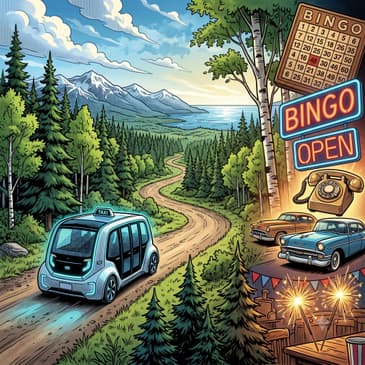
*Show Art Created By Gemini
Hosted by Simplecast, an AdsWizz company. See pcm.adswizz.com for information about our collection and use of personal data for advertising.
[00:00:00] Every team, every topic, everywhere. This is Belief.
[00:00:53] This particular show now starts on Monday. So we'll do a weekly edition starting on Monday and a weekend edition, which would start on Friday. So weekly, Monday to Thursday, weekend, Friday to Sunday. And the reason why we're doing this is because the way that my schedule works, like I work two days on and then I have four days off, but those days rotate.
[00:01:18] And then I have my part time job and I have, you know, just all the other stuff that goes with having a family and two podcasts, active podcasts that I'm doing. It's just really difficult to hit a specific day right now, as you could tell, because I released an episode last week on Sunday, which was our first weekend episode. And then I released that episode on Monday, which was our first weekly episode.
[00:01:46] But they were like one day and there was a Sunday and a Monday episode. And then there hasn't been one since. I'm going to try not to do that without going into too much detail. It is imperative that if you own a home that's over 40 years old or any home, really, but especially one that's over 40 years old, that you have handy people on speed dial.
[00:02:09] Somebody that can handle problems that happen in your house, whether, you know, it doesn't really matter what the problem is. But reliable people that make enough money to feed their family, but aren't overcharging you and do good work. Key like we have a couple of folks now that we call on a regular basis, semi-regular basis to do things like we had somebody come and build our deck and they did an amazing job. Super well-built deck.
[00:02:38] You know, we've got people for painting and people for drywall and all that stuff now. But man, can I tell you that it is so much easier just having somebody that you can text and say, hey, we got a problem. And they're like, we'll come in tomorrow and take a peek and give you a price. And then they fix it the next day. Craziness. So, yeah. Anyway, without, again, going into all the details. It's just nice to have people who can fix things.
[00:03:08] I can fix some things, but I do not feel comfortable fixing everything. So, but if the price is so extravagant, I will learn for a certain price. You know what I mean? Anyway, we have a new Patreon supporter and that Patreon supporter is Stacy. And Stacy did not become a patron to hear me jibber jabber about my own stupid house stuff.
[00:03:36] So, what Stacy did pay for is for Tesla news, EV news, and interviews. And we got a couple of really cool interviews coming up. I don't know quite when I'm going to release them. And we haven't recorded them yet. I'm recording one tomorrow, but yeah, got some high quality guests lined up for the show, which has always surprises me. This show gets way better guests than I think it deserves. I mean, I'm always appreciative.
[00:04:06] Don't get me wrong. But man, there are some smart people out there who agree to come on the show. And I'm always very confused by it. But we have one coming up tomorrow, which I'm sure you'll hear that interview soon. But anyway, super cool. All right, let's go ahead and dive into our email. Oh, you know what? Before we do that, we should give Stacy a proper thank you for going to supportkilowatt.com and signing up and becoming a patron. Stacy, thank you so much.
[00:04:32] If you have any questions or need anything, please don't hesitate to reach out to me. My email is Bodhi at 918digital.com. And again, thank you so much for becoming a patron. None of the Patreon money goes to my home repairs. Just so you know, all the money goes back into the show. All right, let's go ahead and start the EV news. We recently talked about an EV rebate program in California.
[00:04:58] And what I neglected to talk about when we were talking about that EV program was how much those rebates were. So if a California resident buys a new EV under $50,000, and there's an asterisk there, and we'll talk about that in just a second, just in case you don't know what the asterisk is. But if you buy a new EV under $50,000, then you will get a $3,500 rebate.
[00:05:23] And it's pretty open to anybody, as far as I understand, that will get that $3,500 rebate. If you buy a EV that is under $25,000, then that's cut in half. You get a $1,750 rebate. If you buy a Rivian or Lucid, there is no price cap because Rivian and Lucid are based in California.
[00:05:50] Even though they don't have manufacturing in California, the companies are based there in California. So, yes, $3,500 and $1,750 are the rebates you'll get if you buy an EV in California. All right. If you had to guess, and this is a genuine question.
[00:06:16] If you had to guess, what percentage of vehicles registered in Norway during Q2-2026, what percentage of those vehicles were battery electric vehicles, what would your guess be? And I want you to remember, and I'm going to give you a hint here, Norway leads in EV registrations. It leads the world. So, you know this number is going to be high. All right. Take a second. What's your guess?
[00:06:44] The number is, and let me know if you got this dead on, but the number is 97.4% of the new vehicles registered in Norway during the second quarter of 2026 were EVs. So that's pure battery electric vehicles.
[00:07:02] If you add in the plug-in hybrids, that number goes up by 0.6% for a total of 98.1%, if you're rounding up, of total EV registrations during that time. And as far as the most popular EV registered during that time, hands down, it was Model Y.
[00:07:28] They registered a total of 5,686 Model Ys during that time period. Moving on to our final EV story, and I honestly thought I had more EV news than this. It felt like I had a lot when I was writing it. Moving on to our final EV story is about Canada. As we know, Canada is allowing 49,000 Chinese-made cars into the country. Most of those are going to be EVs, if not all, for a reduced tariff.
[00:07:57] Right now, in 2026, the tariff is sitting at 100% on Chinese-made cars. For the 49,000, that tariff will be reduced to 6.1% tariff. So a pretty significant drop on the Chinese-made cars. Obviously, a lot of Chinese companies are looking to move into North America, and this is a great way for them to do that. They're also working in Canada.
[00:08:26] BYD has quite a few cars that they sell in Canada. I see often the BYD Shark. That's probably the most common Chinese EV that I see in Arizona right now is the Shark. And actually, now that I think about it, it might be the only one that I've seen to this point or recognize that it was a Chinese EV is the BYD Shark.
[00:08:54] And that is obviously not pure battery electric. That's an E-Rev. But yeah, that's the closest thing I see here in the U.S. And man, every time I see that truck, I'm like, that is a nice-looking truck. And to be fair, I do think it looks a little bit like Toyota's pickup trucks, but I think Toyota's pickup trucks are also very nice-looking. So anyway, moving on to the actual story. Dong Feng is one of the Chinese automakers that is looking to enter the Canadian market.
[00:09:23] And they are currently going through homologation, which is, you know, getting the car ready to meet all of Canada's regulations. They're going through that homologation process with two of their models. The first one is the NAMI box. Or if you go to Dong Feng's website or their Canadian website, it's the Box 01. And the Vigo. And they're selling two different trims of the Vigo.
[00:09:53] It seems like the Vigo might be further along in homologation than the box. Simply because there's more information on there that feels like concrete. We still don't have all of the details because this process hasn't quite finished yet. But as far as the Dong Feng website goes, the box will be a small car. Think like the Chevy Bolt or Mini Cooper.
[00:10:18] It looks like on the interior is pretty basic, but they kind of have this nice quilted, padded, I guess, quilted material that's on the dash. Like a small instrument cluster behind the steering wheel. An infotainment screen in the middle, like most cars do now. In terms of specs, the box will be front-wheel drive. Starting off with a 42.3 kilowatt-hour battery. It'll fast charge. It just says fast charge to 80%.
[00:10:48] It doesn't say from where or from what in about 30 minutes, which is probably a little bit slow. Range up to 430 kilometers, which is about 267 miles. We don't have a price, and we'll talk about that here in just a second. But we don't have a price just yet.
[00:11:08] But, you know, we can assume that it's going to be decently priced, let's say, compared to some of the other options in Canada when it comes to EVs. The next vehicle they had was the Vigo, which is a front-wheel drive SUV. This is going to be smaller than an Equinox, but around, you know, in that general size for the Equinox.
[00:11:31] So if you don't have an Equinox in your area, to compare, like the Chevy Equinox, you would probably have a Kia EV3, which is actually closer to the size of the Vigo. There is going to be two different trims. You're going to have the Air, which will come with a 44.94 kilowatt-hour battery, which will get you a range around 401 kilometers or 250 miles.
[00:11:56] If you go with the Pro, you get a little bit bigger battery, 51.87 kilowatt-hours, which will get you 480 kilometers or 298 miles. In terms of the interior of this car, you know, similar in a lot of ways. It's a basic budget model, nothing terribly fancy. It does look nice on the outside, I think, the Vigo. I think, actually, the Box 01 is a super cute-looking car.
[00:12:27] In terms of shared specs, you know, front-wheel drive, both of them, that kind of thing. But 10, let's see, a charge to 80% in 18 to 30 minutes, depending on the model. We can assume that the Pro is probably going to charge a little bit faster than the Air. Like I said, in terms of prices, we don't know what the prices of these vehicles are going to be. Well, I should be clear. We don't know what the prices are going to be in Canada.
[00:12:53] We do know the starting price of both of these vehicles in China, which they're always going to have the more favorable price. But these two vehicles start around $13,000 US, which is around $18,000 Canadian. The article I was reading said, and I agree with this, that both of these vehicles will likely start under $35,000 Canadian, which is about $25,000 US.
[00:13:21] So I would tend to agree with that. I don't think... I mean, Dongfeng might decide they're going to just make a terrific deal and suck all the oxygen out of the room. But other Chinese companies are coming to do the same. So I don't know. Maybe we'll get a price war on Chinese automakers outside of China. Who knows? All right.
[00:13:48] Let's go ahead and move on to our Tesla news. And I noticed I started a sentence and did not finish it. And I don't know where I was going with that. So we'll move on to the next story because I just put the first MIA, M-E-A, and that's all it's got. So let's move on to the second story.
[00:14:12] Tesla is recalling around 20,000 vehicles because the headlights on those vehicles are too bright. And the total number is actually 19,900, which seems oddly round for this. But these are going to be older Model 3s and Model Ys anywhere between 2017 and 2023 in terms of model year. And the problem is that the low beams exceed federal regulatory limits.
[00:14:40] And Tesla said, well, no, this isn't a problem. And the Fed said, it is recall. And so Tesla's doing a recall. So, you know, okay. If you are an owner of a vehicle in that model year, it doesn't necessarily mean you're affected. There's only 19,900 that are being recalled.
[00:15:01] So it may be that, you know, those are just a certain amount of cars that use this one specific bulb that Tesla put in. Because they sold way more cars during that time period than 19,900. I'm not sure how many of you follow whole Mars or whole Mars catalog on X. I do. Omar and I follow each other. Although we don't know each other to my knowledge of ever interacted.
[00:15:30] But we do follow each other. But Omar went on X or whole Mars went on X to talk about, you know, how sometimes full self-driving will disobey the settings that he set up in the full self-driving settings panel, you know. And Elon jumped on because, you know, whole Mars has Elon's ear for sure.
[00:15:54] And he says, the car will start to remember your specific interventions and match each person's individual preferences. So, you know, whole Mars went on, said, I don't understand why this is happening. Or, you know, I'm paraphrasing. It's weird that this happens sometimes, however you said it. And Elon said, well, you know, eventually the car is going to start to remember your specific interventions and match your personal driving preferences. Which is cool.
[00:16:23] And this isn't the first time Elon said this, actually. He's said this a couple times since I've been doing the podcast. And don't get me wrong. This kind of thing would be great as long as the habits that it's copying are good habits and not bad habits. And we all have bad habits for sure. You know, we all have things that maybe we're better at than other people in our life. And then things that we're not so great at when it compares.
[00:16:50] So hopefully it's taking all of the good habits and not the bad habits. But having said that, even though Elon said this, and again, I think this is great. And I think it would be really cool if the car was able to learn from you and get better based on how you like to do things. It doesn't really answer the question as to why. It doesn't address why the car will sometimes not follow the settings a user selected in that particular FSD menu.
[00:17:20] I do understand that it can be difficult to adhere to certain rules when operating in the real world. There you go, Steve. They can clip that one. Real world. That's hard. I can't imagine how difficult it would be to program something that took every single possibility into account. And obviously that's impossible. They can't do that. And we're seeing that, that they can't do that.
[00:17:50] But there are just so many variables as to what could happen in every situation, even if it's super similar. I feel like I'm seeing a lot of S's right now. But anyway, even if they're similar, you're still going to have different situations that the car is not going to be able to account for. And maybe this is why it'll sometimes do things that you told it not to do in the settings. Maybe. I don't know.
[00:18:20] I mean, I can't imagine that Omar is talking about these specific situations. I would imagine that it's probably just more something more common where the car is doing something that he's like, I don't know why you're doing this. I explicitly told you not to do it, but the car is doing it anyway. That's what I would imagine he's talking about. I'm not talking about maybe edge cases that are just super weird.
[00:18:44] But anyway, on one side, I do think it's cool that the car is going to learn from you. I don't think Elon really addressed the underlying situation with that comment. But also, I recognize that it's hard. So I told you that story so I can sound wishy-washy on my opinions. It's complicated.
[00:19:08] Speaking of complicated, a few weeks ago, we discussed a really sad incident where a Model 3 operating in full self-driving mode crashed into a home in Katy, Texas, killing a 76-year-old woman. The National Traffic Safety Board has determined that the Model 3 was operating in full self-driving mode, but the driver pressed down on the accelerator completely, like 100% pressed down.
[00:19:35] So if you're not familiar, FSD does disengage. Like if you tug on the steering wheel one direction or another, it'll disengage. If you tap on the brake, it'll disengage. But if you push on the accelerator, it assumes that you just want to go faster and it will set the speed at whatever that happens to be.
[00:19:55] In this case, I believe the car was traveling like over 70 miles an hour, if not 90 miles an hour at some point in time, but over 70 for sure. So we know now that the driver did step on the accelerator, push on it all the way down to the 100%. We don't know why. We don't know.
[00:20:19] Maybe he thought it was the brake, which would be kind of weird because when you're accelerating like that, you know that you're not decelerating. So I don't know why he would think it was the brake. Maybe initially he thought it was the brake. Maybe he had a medical emergency. I do believe he said that he passed out briefly. So maybe that was a cause. The investigators did find that the driver did some Google searches on his phone.
[00:20:49] And it was kind of some of the Google searches. Were formed in a complaint about full self-driving being too timid and not aggressive enough. So, you know, all of this information, investigators will put together a case and it'll go to court and we'll find out, you know, what the courts decide. When we first covered this story, I mentioned that Elon and Ashok Eliswamy, they announced, you know, the results.
[00:21:19] They said, no, no, this wasn't a problem with FSD. This was a problem because he stepped on the accelerator and went from, you know, whatever percent to 100%. And at the time, I did not think that information was wrong because Tesla has. They get all that telemetry, right? They get all that information. So I don't think that they were wrong.
[00:21:40] But I did mention that I wish they had waited until after the investigation was completed to share the results. And some of you wrote in and agreed with me and some of you didn't. And some of you were kind of in the middle and you could see some things that were appropriate on one side, but not appropriate on another. Some of you didn't bother to write in. So I don't know what your opinions were on that.
[00:22:04] But my particular view of this situation, this particular Tesla story, I guess, was, I don't know, somebody died. So I don't think within, we'll say, charitably 48 hours, somebody dying and you say, well, not our fault, not it. I don't think that's particularly a mature way to handle this kind of a thing.
[00:22:34] There certainly could have been posts from Elon or a shock where it said, you know, our condolences to the lady who lost her life. And here's what we found. I didn't see any of that stuff. Maybe it was there, but I didn't. I certainly didn't see it. So I felt like it was a little distasteful, to be honest with you, to announce it like that.
[00:22:58] I do think, and I'm not saying Tesla's doing this, but I do think there is a risk of being seen as if you are trying to put your thumb on the scale, either a public opinion or some sort of, you know, getting out in front of something that may go to court later and taint a jury by announcing it this early.
[00:23:20] And again, I'm not saying Tesla's doing that because I honestly don't know if they are doing it, but when other companies do this kind of thing, I do feel the same way. So I'm not picking on Tesla just in general. I'm just saying that we have a way to investigate this stuff and find fault. And just because this gentleman looks like he's probably a majority fault, Tesla's not at some fault in the eyes of the law.
[00:23:49] You can say, well, no, that's not the case. And that's great. That's your opinion. You can have your opinion, but the law assigns fault in different ways than what you and I do. So with that, um, I just, I, I really want to come away with this is, you know, just think just because a company says something doesn't mean that's true. I understand that Tesla wants to, you know, um, they have a brand to protect.
[00:24:17] I do understand all that stuff, but if somebody hated Tesla, they're going to have the same opinion, no matter if Tesla put this out, uh, this information out or not. If somebody loved Tesla, same thing, they're going to have an opinion, whether Tesla put this information out or not. Um, and then everybody else is kind of going to form their opinions based on, you know, their own biases and what the information that they are able to consume. Um, I don't like Tesla's a big company.
[00:24:46] I don't think they're going to have, like, if you compare, uh, last year to Elon's, uh, uh, attempt at government efficiency. If you compared to the damage that that had on the company compared to this, uh, them, you know, getting out ahead of a tragic accident, not, not really comparable. So, you know, they've gone through worse is what I'm saying in terms of brand damage.
[00:25:13] So, um, sometimes you just kind of have to grin and bear it as a company, as a small podcaster. There are times when I do not necessarily agree with someone and maybe they call me out publicly or maybe they call me out privately. Not always do I have to, I mean, I can still state my opinion, but I just have to kind of grin and bear it. And then you'll never hear about it because I could come on here and I could complain about a lot of different things.
[00:25:40] But, uh, I don't because I don't, I don't really see the point. Like someone shared their opinion, whether publicly or privately. Um, I don't get this very often by the way. And if you're thinking, oh, I went too far. I'm one of these people. You're not. If you regularly email me or if you put in, uh, if you disagree with me, but you have the best intentions, I'm not talking about you. There are way other, way more people out there who, who will just randomly email me stuff.
[00:26:10] So I'm not talking about you anyway. Um, the point is that, you know, I would rather see some empathy or sympathy for the family that lost, uh, a grandmother, a mother or a wife. And you're, you're, if you know that the information is true, that the driver pushed on the accelerator all the way down to the ground. Right.
[00:26:38] And cause the accident, even though FSD was engaged. If, if you're a company and you know that that's the case, you know, those facts are going to come out. Maybe you don't have to be within, like I said, 48 hours, but I think it was much less than that saying this isn't our fault. It's the driver's fault. Uh, or maybe that's, maybe that's unfair. Maybe you just don't need to call out the driver in this situation. Just give it some time and let the investigation unfold. This was only a couple of weeks ago, like mid June.
[00:27:07] And we already have this information coming out mid July. So, uh, you wouldn't have to wait very long. All right, moving on. Um, oh, you know what? Before we go to moving on, this article points out that having, uh, telemetry data for this kind of investigation is key. And I just want to point out here that there are the telemetry data has been available for a really long time.
[00:27:37] Like cars have had black boxes for decades. And that black box tells a lot of what Tesla is giving, you know, investigators in terms of telemetry data. The thing is, you know, like in my 24 year career as a firefighter, there's been a few times, I think three that I've been called three that I can think of that I've been called out. And asked to use like the spreaders and the cutters or jaws of life.
[00:28:01] If, if, if, you know, you don't know what I'm talking about to just kind of gently pull back the car so that they can get to the black box so that they can plug their machine in and download the data. Right. It doesn't happen a lot. Um, obviously if I'm only can remember three times, but, uh, that data has always been available.
[00:28:21] It's just been harder to get to, uh, if, if it isn't, if it isn't, uh, uh, you know, uh, if the car accident isn't so bad that they can't get the date, get access to the black box, you know, then they have to call like somebody like me out and we have to open it up so that they can get access to it. It may just be that they have enough data that they don't need the black box, but this stuff has always been available is really what I'm trying to say.
[00:28:47] It just relied on the investigators to go out to either the crash site or the wrecking yard and actually pull the data. Whereas now they can just send an email or I'm assuming it's probably not an email. They probably go through some sort of portal and they can request the information. Okay. Um, oh, we're going to end on some good news here. And I want to kind of commend Tesla for this.
[00:29:11] And especially if they follow through with it, Tesla is building a new factory outside of Austin, Texas. And this factory will be used to build their autonomous taxis. And one of the built, one of the vehicles they're going to be building in this factory is a purpose built wheelchair accessible autonomous vehicle.
[00:29:34] Now we don't know if it's going to be the robo van or not, although that would make a lot of sense that they'd be able to, uh, you know, the robo van, the way that it works with the, you know, the elevator doors and being able to just kind of move right in. And if you're in a wheelchair, um, that would be great, but it might be something completely different that Tesla hasn't announced yet. So, but they are building a purpose built wheelchair accessible vehicle.
[00:29:59] This is where to me, autonomous driving is the game changer as a 51 year old man that has only so many years left where I can drive a car myself safely without the risk of hurting myself or somebody else. And the ability to still remain mobile is huge for me.
[00:30:21] And I've, I've said this many times before, um, my grandparents on my dad's side, they really, in my opinion, growing up or my memory, they really didn't. Oh, sorry. Dropping stuff. They really didn't go out a lot. Like my grandpa went to the VA to get drunk and my grandma went to bingo to get poor. Um, but that was the kind of their, their fun thing.
[00:30:48] That was the, really the only thing that I remember them doing on any sort of regular basis. They didn't seem to go very many places unless it was involving a doctor's appointment. You know, they'd go up to, from Saldatna to Anchorage because my grandma had a doctor's appointment and the VA was up there or my grandpa did, but that was about it. You know, um, they would take a couple of vacations when my grandma's sisters would come and visit.
[00:31:12] I was always so surprised because they were very, very full of life and, you know, acted much younger than my grandma did. And I don't know what their age differences were. Maybe they were much younger than my grandma was, but it's just my grandparents on my dad's side just always seemed to be very stationary and just kind of waiting to die. Now, if you take my grandparents on the other side who were younger, like my mom's parents were much younger than my, my grandparents on my dad's side.
[00:31:41] But if you take those folks, they were, um, also, uh, very, uh, they, they, they enjoyed their alcoholic beverages and cigarettes and stuff, but they were also, they were like always active and just, just amazing. Like how many things that they did, whether it was organizing softball games in the fields or, you know, having parties with literally hundreds of people.
[00:32:09] My grandparents would have a 4th of July party and there would be hundreds of people there. Like they were, my grandparents 4th of July parties were so well known. And man, I grew up in a very small community in Nikiski, Alaska. So, you know, so well known isn't like, isn't like growing up in Chicago. Right. But like the fire department knew that there was probably going to be a fire on my grandparents land somewhere.
[00:32:35] Like they, this, I was told this when I became a volunteer firefighter with, for the Nikiski fire department way back when. So like they were epic parties. My grandma, my grandma and grandpa, my mom's side just lived life to the fullest. And that's kind of how, without, without the drinking and the smoking, that's how I kind of wanted to live my life as well. You know, there's, there's lots of brain disease in my family, especially on my mom's side. There's diabetes and heart disease on my dad's side.
[00:33:04] But being able to, for me, being able to know that when I get older, that is not going to take away my ability to be mobile. So other things might, but that ability to be mobile, but being, to be able to get into a robo taxi and still go out and do things and live life is super important. And now I know I've kind of gone on for a little bit, so I'm going to end it here. But I do think a lot of people identify with this, especially if you're of a certain age. So I don't know.
[00:33:34] I mean, we only get one life and to waste it just sitting inside and, and not experiencing what's available to us in a different country or a different city or a different, even, even the next town over. Those little experiences that we have with other people's strangers, even kind of make life worth living. So anyway, I opined a lot in this episode.
[00:33:59] So I apologize if I opined, if I over opined, but I hope you all had, uh, and I hope you enjoyed it. And, uh, this week we are going to cover Tesla's Q2 2026 earnings call. And like I said, I've got some good interviews lined up for you or I'm lining them up at the moment. I got one lined up for you and I'm lining some other ones up at the moment, but I appreciate each and every one of you.
[00:34:23] And I hope y'all have a wonderful week and you, you enjoyed this weekend edition of kilowatt. And I will talk to you all soon. Oh, and before we believe a real big thank you to Stacy for becoming a Patreon supporter. Thank you very much, Stacy.