Bodie Grimm is the host of the Kilowatt podcast, where he dives into everything electric, from electric vehicles, renewable energy, and autonomous driving. You may have heard him on the Daily Tech News Show or the NosillaCast podcasts.
Episode Summary:
In this episode, Jeremy Michalek, a professor at Carnegie Mellon University, joins the show to discuss the economic and environmental trade-offs of electric vehicles (EVs). He explores the comparative benefits of hybrids, plug-in hybrids, and full battery EVs, emphasizing that the optimal choice often depends on individual driving habits and regional electricity sources. Jeremy also delves into the limitations of current EV subsidies and policies, suggesting more efficient alternatives. Additionally, he touches on the lifecycle impacts of EVs, including battery production and grid emissions, and offers insights into the role of public transit and autonomous vehicles in future mobility. This conversation provides a nuanced perspective on electrification and sustainable transport policy.
Support the Show
Other Podcasts:
Guest Links:
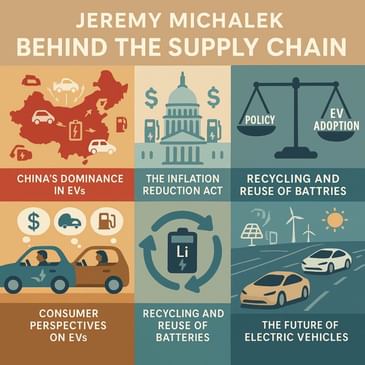
*ART PROVIDED BY DALL-e
Support this show http://supporter.acast.com/kilowatt.
Hosted on Acast. See acast.com/privacy for more information.
[00:00:02] A new day on the love island. It's been switched, flirted, I'm just rich, I'm just rich with love, I've been talking to you and got fired. The party can go! The Violent VIP is back, finally! Donnerstag, 20.15 Uhr, on RTL2 and on RTL Plus stream.
[00:00:56] I had an opportunity to sit down with Jeremy Michalek, who is a professor of engineering and public policy, as well as mechanical engineering at Carnegie Mellon University. He directs the Design Decisions Laboratory, as well as co-directing the Vehicle Electrification Group, where his research spans vehicle electrification, life cycle assessment, consumer behavior and public policy.
[00:01:22] His work has been featured in outlets like the New York Times, and he's presented policy briefs on Capitol Hill. He's received numerous national awards for his contributions to sustainable mobility and design. And he kind of slummed it a little bit by coming on the Kilowatt Podcast, but I appreciate that for sure. I was actually a little intimidated to interview Jeremy, but turns out he's a heck of a nice guy and super easy to talk to.
[00:01:51] Our conversation today is going to cover a wide variety of topics as it comes to EVs. I'm talking, you know, we start off by talking about China, and then we talk a little bit about battery materials, and then we get into public policy. And I do want to say, for anybody out there who wants to turn public policy into something that's political, we're not talking about politics. We're actually discussing policy.
[00:02:19] So please don't email me about politics, because all we're doing is discussing the policy. Okie doke. Let's go ahead and jump into our conversation with Jeremy Mahalik. Jeremy, welcome to the show. It's great to be here. I am really looking forward to this conversation. And we are going to, I think we have a theme for the conversation that we're about to have.
[00:02:46] We're going to kind of start sort of at the beginning of EVs in terms of recent history with China, and then we're going to kind of work our way down to recycling and reuse. So starting with that, how did we end up in the current situation that we're in? You know, like in the 80s, Japan, just their auto industry just kind of folded into the United States and Europe, and they became very dominant.
[00:03:12] And now we're seeing the same thing happen with China and, to a lesser extent, Korean automakers as well. How did we get here? Yeah, the way I think of this is that as China was rising, it really wanted to break in and become one of the big auto producing nations. I mean, really, it was the US, EU and Japan were the big ones, and China was really interested in breaking in. So they had a bunch of strategies.
[00:03:40] And one of them was, if you want to sell vehicles in China, you have to form a joint venture with a Chinese firm so that the Chinese firm can learn about all that's involved in actually producing viable vehicles and managing the design and production process and all that stuff. So China did that, but it was really hard to catch up. I mean, we've got 100 years of figuring out how to make internal combustion engines work, all the tolerances on the pieces and the controls and everything. There's a lot of engineering.
[00:04:10] So what changed is that battery prices really came down and China saw an opening, hey, if battery prices get cheap enough, electric vehicles can become real competition for gasoline vehicles, not just in these little niche areas, but across the board. And so the thing about electric vehicles, they're just a lot simpler to engineer. Battery, motor, a little controller and some thermal management, and you've got a vehicle.
[00:04:36] So China invested very heavily, did a lot of experimentation, a lot of incentives, both at nation level and local level to produce batteries and vehicles just as their market was taking off. And all these first-time car buyers were becoming auto owners. So they really positioned themselves well for this transition.
[00:05:04] And then once battery prices came down, as we started to learn how to make batteries better and cheaper, we're sort of the transitions now underway and they're in a very good spot in terms of how much they control. Do you know what the incentives are now? Because I know early on, the Chinese government would give either really low interest loans or just give them money to build a factory.
[00:05:30] Give them like they could lease the land for like a dollar for 30 or 40 years. Do you know what the incentives are now? Because we're seeing BYD and Xpeng and, you know, NIO is a little bit different because they're more luxury brand. But we're seeing all these companies from China come in and they're still able to sell a car at 12,000 US dollars, which is insane. And it's a decent car. It's not, it's not, you know, a car. It's a car that you could be okay driving.
[00:06:00] Yeah, the incentives are, they're still large incentives in China. They're not as large as they used to be, as you mentioned. And it's not only in China. China has done a Chinese firm, some of them state owned firms have done a lot of investment in the supply chain. So in other countries like say Indonesia, where a lot of the nickel is produced, there's a lot of Chinese involvement in or in the Democratic Republic of Congo, where a lot of cobalt is produced. There's a lot of Chinese firms that dominate parts of that supply chain.
[00:06:29] And then the minerals go to China for refining and processing into batteries. So I think there's been a lot of investment and some would say over capacity. Many would say, I think, over capacity that there's actually more capacity to build than what we need. And that drops prices, which makes it hard for a lot of people to compete.
[00:06:49] So if you have the state kind of backing this in the meantime, taking the hit on prices in the meantime, you can engineer this dominance that's happened. Yeah. Like when I first looked into why China was so dominant in the EV space, one is they have a lot of the natural resources you need. Two is the ones that they didn't have. They made those contracts and went out and made those steps to get those materials very early on, like you said.
[00:07:20] What happens? Like I talked to the are you familiar with the organization Lead the Charge? No, tell me about it. Okay. They do this great kind of report card on automakers every year. Like how well you in terms of indigenous population, in terms of like environmental impact. And they just do this big report card. And at the moment I'm blanking on a lot of what's in there, but I talked to them every year.
[00:07:47] And we know, I mean, just from the news and everything, but the the the the Democratic Republic of Congo has a lot of human rights violations just in general, just getting the materials that we need out for batteries, not just for EVs for all batteries. We know, you know, Russia is currently at war with with Ukraine, but not all of the nickel comes out of Russia. But I think it's like the second most amount of nickel comes out of Russia.
[00:08:14] So when we're looking at potential disruption vulnerabilities, kind of kind of got the same thing going with South Africa with with the manganese. How does that affect the supply chain? Yeah, it's a really big deal that so much of the supply chain hinges on what a single country is doing. So when it comes to the kinds of rare Earths that we put into electric motors, that's where China actually has a lot of them in the ground.
[00:08:44] I mean, there are rare Earths across the globe, but China has this like cost effective, you know, way of not necessarily environmentally great, but way of extracting lots of rare Earths. And so they do have special deposits, you know, in their own soil. I think when it comes to the other the materials that are used more in batteries instead of the motors, those are things like nickel, lithium, cobalt and manganese.
[00:09:33] And so it's not like it's all in the ground in China. It's that, as you said, China has invested in having Chinese companies be part of those extraction operations. And then once extracted, the materials are shipped to China and they get refined in China. And so then China becomes the dominant supply of those refined materials that are needed to make batteries.
[00:09:58] They make the most batteries, they make the most electric vehicles, and they've got the largest auto market in the world now. So it kind of makes sense that they play a large role. But when it's almost really difficult to make, it is really difficult to make an electric vehicle without China at all. And so that means that what happens in China affects the entire industry in a pretty heavy way. So, I mean, there's a wide variety of things that could happen that would lead to vulnerabilities.
[00:10:28] You know, what if there's an actual disaster? What if there's another pandemic? What if there's a political collapse or the geopolitical strategy? You know, China decides as part of the part of the way of playing a geopolitics game that they're going to restrict supply. All of those things, there's a lot of impact that happens if there's a restriction of supply from China. Yeah.
[00:10:58] And then that kind of leads us into... So with... How do I put this? The Inflation Reduction Act, it just went away, right? Or it's going away in 13 days from the time we're recording this. The... That was kind of help setting up the US to be a player in this industry.
[00:11:23] Not just for EVs in particular, but like there's just a lot of critical things that we're doing with manganese and lithium and there's military stuff. And for... I don't know. It might even have started in the Trump administration. They were looking at ways to onshore that here to the US. How is it changed now with the one big beautiful bill? Yeah. So the Inflation Reduction Act, I mean, that's a huge bill. It was the biggest climate bill in history. But on...
[00:11:53] We should also say... And I'm sorry. We should also say, horribly misnamed. Yeah. It was a climate bill. They should have just called it a climate bill. But go ahead. Sorry. Well, that's the political side. But on the substance, the... Yeah. For electric vehicles, it did create incentives for producing and selling electric vehicles. Those are on the same magnitude that they were in previous administrations.
[00:12:21] Just kind of continuing and changing those incentives. But maybe one of the big things is that it made those incentives contingent, the biggest of those incentives, contingent on figuring out a way to make batteries without China. And so you got both some of the incentives. You had to have industry or a healthy portion of the supply chain from the United States and from allies. And the largest incentives, as soon as you touch something from China, you don't qualify at all.
[00:12:49] So the idea was that there's these large incentives if you're able to, like, build up this alternative industry to diversify the supply chain, that you have access to these incentives and that can help drive the industry. So there were hundreds of new facility investments in the United States for battery manufacturing and materials processing and such that investments that started after the Inflation Reduction Act was passed.
[00:13:19] And what changed with the One Big Beautiful Bill Act is that it eliminated most, not all, but most of the incentives from the Inflation Reduction Act. And if you look at investments in that industry, they just totally collapsed. And it's a clear, like, up and then back down if you look at the graph over time.
[00:13:42] So in the short term, there'll probably be more reliance on gasoline vehicles, which means that we won't have as much of the supply vulnerabilities from battery material supply chains. We'll have it from oil supply chains instead, as we've had for many decades. But what I worry about is in the long run, you know, oil just can't be the long run solution. We run out of, we'll run out of the cheap oil at some point. It's a finite resource.
[00:14:12] And maybe 10 years ago, you could say electric vehicles might, you know, always remain a niche type of competitor. But batteries have just changed. I mean, they're just so much cheaper now that you can get a 300 mile range vehicle at, you know, competitive lifetime costs today, even without subsidies. And so that, that means that that's transitions, you know, well underway without, you know, the
[00:14:40] government necessarily being the single thing that's driving it. And so, you know, if that transition is going to happen, the question is what role does the United States want to play? Are we going to kind of sit it out and then later have to figure out how to buy materials from the supply chain that's dominated by adversaries? You know, or are we going to, you know, what are the appropriate policies to try to position ourselves well for the future technology?
[00:15:08] And I mean, there's real debate about what the appropriate policies are, but there's been a pretty big change between the Inflation Reduction Act and the One Big Beautiful Bill Act. I have mixed feelings on subsidies because sometimes it feels like very much like we're picking winners and losers. And I don't really love that. But if, if you were able to do the impossible and hit all of the metrics that you had to hit for a battery, right?
[00:15:34] Isn't it, it's something like you would actually get more money back than it costs to make the battery pack. If, if, if you were able to hit all the metrics that the government had set or maybe someone close to that. That's right. So the, in the subsidies in the Inflation Reduction Act were quite large. And if you could qualify for all of them, which I don't think any automaker was able to do. I mean, it's very difficult to qualify simultaneously for all of them.
[00:16:00] But if you did, you could get more in subsidies than the cost of actually making those batteries. So that might sound excessive. I mean, certainly if those were long-term subsidies, you'd say, why, why is, why are taxpayers paying for those, the production? But I think the goal was that if those incentives are large enough over this transition period to get
[00:16:24] the industry started, then you'll have the infrastructure built, the jobs, the positioning and the, you know, competitiveness in the global market to be able to continue to play and compete in the global ED market. I mean, I've heard colleagues say that the American automobile industry is at real risk
[00:16:47] of becoming a small regional player, you know, because of this kind of shift, if there's not enough, you know, competition with where the global market is going. And so I don't think that's really in the best interests. So I think totally fair to say, you know, where should taxpayers, you know, be paying for this transition? I mean, some people might say not at all. Some people might say we have to be smart about it and we can differ about, you know,
[00:17:16] exactly what the best policies are. But I think the rationale is if we don't do anything and then our adversary is doing a lot of investments, we can end up kind of stuck as the technology transitions and we're sort of dependent on a supply chain that we didn't invest enough to be part of. Yeah. And it's not apples to apples comparison, but I think Europe is a little bit of in a little
[00:17:43] bit of that same situation in terms of, you know, the Chinese or the EV market in general, I think just kind of took legacy automakers off guard and not to say that they didn't see it coming. I think they were all overly confident that they would be able to achieve some of the same success that Tesla did because they've been making cars for a hundred years. And they're like, well, we've been making cars for a hundred years. We'll have 20 cars out by 2020. And they didn't.
[00:18:11] They had two, like Ford had two cars out in 2023. Well, three, if you want to include a commercial van, that's not, it's not really killing it, you know, they're great cars. I think the Mustang Mach-E and the Lightning are amazing, but it's not going to be enough to make a difference. And those cars are kind of expensive. Yeah, certainly early in the transition, automakers are losing money on the electric vehicles and they're still more expensive to buy than gasoline vehicles.
[00:18:40] So, you know, in the short run, it's not, doesn't sound like a great strategy. And the question is looking forward and seeing where things are going. And, you know, what's the, what should you be selling today to position yourself for the future market? And, you know, I don't think we're going, you know, with or without government intervention, we're not going to a hundred percent electric vehicles, you know, really soon because there's an awful lot of people that it just doesn't fit their needs yet.
[00:19:07] I mean, they live in an apartment, they don't have regular charging. The charging infrastructure is not built out for them to rely on it every day. And until recently there just weren't electric vehicles even available in all segments. I mean, it's only, only what last year that we started to get electric pickup trucks. So, you know, it's not for everybody yet, but I think what has really changed is with the
[00:19:33] cost of batteries coming down so much that for most households, it's a real alternative to consider. It's not this crazy thing. You have to be a super enthusiast or, you know, always want the latest technology or status symbol to, you know, to buy. It's, it's, you know, it's become something that makes sense for a lot of households. I don't know anybody that likes paying high gas prices, period. You know, I, I don't know anybody.
[00:20:01] And this is, this is a funny thing to me because I kind of consider myself, I'm not apolitical, but I have these, I can understand, I have views from both points of view. Right. And then, then other ones that don't match at all, which is also another lonely feeling when you're at a party. But it, they, like, I have friends that will say I'm a conservationalist and those are my more conservative friends. Right. And then I have friends that are more on the environmentalist side.
[00:20:31] To me, these are two, these are pretty much just different sides of the same coin. You know, there, there doesn't seem to be that much different when we're looking at things like what, you know, the, the Trump administration's looking at revoking the endangerment finding. What is that going to do for us, whether you're a conservationalist or more environmentalist minded? What, what, what, what are the impacts of that?
[00:21:01] Right. So the endangerment finding is the, the finding by the Supreme Court that the, well, it's finding by the EPA that was, that was approved by the Supreme Court that a greenhouse gas emissions are air pollutants under the Clean Air Act. And that, and if they're air pollutants, then EPA has a duty to regulate them. Um, and so it's under that basis that they developed their greenhouse gas emission standards
[00:21:31] for cars and trucks. And, uh, it's, that's both cars and light trucks, like all the vehicles we drive around. And it's also medium and heavy duty trucks like used for freight. And, um, and so we've had those standards under the previous several administrations. The stringency of the standard has generally in increased under the Obama administration
[00:21:57] and loosened under the Trump administration and increased again under the Biden administration. So the stringency has varied, but what's happening differently now is that, uh, their EPA has proposed to revoke that finding. And, uh, if, since that's the basis for regulating greenhouse gas emissions, if the finding is successfully revoked, they just won't have a legal authority to regulate greenhouse gas emissions at all, including
[00:22:26] for vehicles. And so go ahead. Go ahead. Yeah. So, I mean, that's a, that's a big deal, not only in terms of the question about powertrain technology, like, are we going to transition to electric vehicles and how quickly, but also even within the gasoline vehicles that we already have, those standards are a big part of the reason that, uh, we've been improving vehicle efficiency and reducing emissions over time.
[00:22:54] And if they, um, you know, if those standards are revoked entirely, then that would, um, then, then, then, then that point of pressure for like, you know, trying to make vehicles more efficient over time would be lost. And also could create kind of a chaotic situation because, uh, state governments like the California state government has their own standards and that's been challenged by the federal government this year.
[00:23:21] Um, but they have their own efforts to create a cleaner vehicle fleet in that state. And it's very difficult for automakers when they have different standards and different states and the federal versus the state level. So prior administrations had this effort to like commonize everything and have a kind of a single set of standards that is a compromise kind of works for everybody. Uh, this would really change that. And it's, then it becomes harder to predict, you know, what things are going to look like
[00:23:49] at the federal and the state level in the coming years. Is the, is this, uh, endangerment finding, is this the same thing that, cause the government recently, um, reduced the penalties down to zero for auto manufacturers that didn't meet certain standards. Does that fall underneath that, the endangerment finding, or is that something completely different? That is related, but different. So there are actually two agencies that, that regulate almost the same thing.
[00:24:16] The, the NHTSA, the National Highway Traffic Safety Administration, they regulate vehicle efficiency, fuel efficiency. They have that authority from the, uh, what is it? The policy or the policy conservation act, uh, from the 1970s, uh, which was a response to, uh, the oil crisis. So when OPEC, uh, turned off the tap and, uh, restricted supply and oil prices shot up, people
[00:24:46] were waiting in line at gas stations to try to fill up their vehicles and lawnmowers and such. Um, the U S said, wow, this is a real national security problem. We have to have a policy in place to avoid being so dependent on oil. And so part of that was let's make vehicles more efficient. And so that policy has been in effects, um, you know, for, for decades. Uh, that's the one that the penalty for violating that policy, uh, was dropped, was zeroed out.
[00:25:16] Um, there's a parallel policy that's under the clean air act. And that's the one that endangerment, the endangerment finding, which I think was from 2008, um, said that under the clean air acts, EPA should regulate greenhouse gas emissions as air pollutants. And so they created a set of standards to do that. And the reason it's a little confusing is because, uh, under the Obama administration, there was an executive order that said, Hey, you've got one agency regulating greenhouse
[00:25:45] gas emissions from vehicles, another agency regulating efficiency of vehicles. They're kind of one-to-one every gallon of gas you burn emits a known amount of carbon dioxide. So there was an order that said, you guys have to coordinate and make your policies consistent with one another. And so they kind of were thought of as one thing. Uh, but since then they've become separated again as the administrations have changed.
[00:26:13] And so that's why there's two different policies that each regulate vehicles in related, but somewhat different ways. Gotcha. So looking at where we are and kind of where we would like to be, what kind of policies would you like to see or, uh, you know, what kind of policies do you think would make sense? I should say, um, when it comes to governing emissions and EVs and air quality and that kind of thing.
[00:26:41] Yeah, I think, well, from economists generally, when they look at this, the question is when public inter when policy intervention is justified is when the market fails to deliver, uh, what society wants. So markets are great. They often deliver, they manage supply and demand automatically. They often deliver a lot of things that society wants, but there are known conditions where
[00:27:07] markets can fail to do that and deliver the things that society doesn't want. And so that's where there's justification for policy intervention. And one of those is when there's pollution because, you know, if you're selling a vehicle and I'm buying the vehicle and I drive it around, I'm getting the benefits. But the emissions from my tailpipe, I mean, only a small fraction of them are, are affecting my health. They're also affecting all my neighbor's health as well. And my neighbor didn't have any say in that transaction.
[00:27:35] So that's one of the places where markets fail or when people make transactions and those transactions affect other people who didn't have any say in the transaction. So the standard way to, or kind of the best way to fix that is to, um, is to figure out how much damage you're causing to those neighbors and then price that in. And so ideally we'd have some policies that priced in the costs that we're causing to other people when we emit these pollutants.
[00:28:03] Um, sometimes we're able to do that or something like that. Sometimes we have other policy mechanisms, but we can kind of tune them to like how strong the policy should be is related to how much damage we're causing to other people. Cardiovascular and respiratory disease when we emit standard air pollutants, uh, climate change related, you know, effects to health and the environment, human health and such, uh, when we emit greenhouse gas emissions.
[00:28:31] So I guess ideally we're not just randomly making up policies to say, I like electric vehicles or I don't like electric vehicles. What we're trying to do is let the market do things the market does well and look for the places where the market's failing to deliver what society actually wants and do some corrections there. I think that's kind of the main answer.
[00:28:55] The thing that complicates that is at the same time, we're trying to compete with adversaries like China who are strategically investing in, uh, you know, gaining power on industries that they see as being dominant in the future. And so there's some, maybe some additional policies that are needed to encourage diversification and onshoring a part of that industry so that, uh, we're not so vulnerable in the future.
[00:29:23] Every, every quarter I do earnings calls and it does seem, uh, for, for electric vehicles. And it does seem like companies like legacy automakers are a little more risk adverse at taking those big swings because obviously they have, uh, shareholders to answer to, they have their employees to answer to,
[00:29:41] they have customers to answer to, and they don't want to lose money. Right. Um, how do we encourage industry to make those swings without necessarily, uh, going bankrupt? Right. I mean, one of the nice things about the greenhouse gas standards that are currently being challenged by this endangerment finding, uh, revocation, um,
[00:30:04] um, one of the nice things about them is that they are technology neutral. So they don't, uh, require automakers to make any particular technology like greenhouse, like, uh, electric vehicles. They just say, overall, your fleet has to get better on how much greenhouse gas emissions it's producing. In fact, it even has allowances for if you sell mostly pickup trucks, you're allowed to emit more, um, pickup trucks generally emit more, whether it's, you know, electricity charging from the grid or,
[00:30:34] or gasoline or diesel. Um, and it allows for that. It says you don't have to force people into smaller cars or that, you know, that might not fit their needs. It's just within every category of vehicles, you've got to find a way to reduce your emissions over time. And it lets automakers decide which way is going to be most competitive for the kinds of vehicles that they sell.
[00:30:56] So those kinds of policies that have flexibility built in can be really efficient at achieving the goal while allowing industry to figure out the best way to achieve the goal. Okay. I like that. Uh, when it comes to end of life for the battery packs, if we can get back onto EVs here, when it comes to their end of life, I'm a big proponent of, of the recycling, right?
[00:31:20] Like, uh, a lot of this stuff can be recycled and reused into another battery. It's already battery grade. Maybe it can't go into an EV for whatever reason. Maybe it's got to go to something else, but it's still can be a battery. Uh, it can still be useful. It's just not going to go into a landfill. Um, that that's one way to really reduce our reliance on other countries. Can you talk about that a little bit? Like what have studies shown when it comes to recycling and reuse of the batteries?
[00:31:49] Sure. Sure. Absolutely. So I want to contrast this with what we do today, which is we import oil. I mean, we make our own oil as well. Um, in fact, a lot of it, uh, today, but still oil is sold on the global market. So their price is determined by sort of global supply and demand. Um, and so with the vulnerability is still there that if oil, uh, supply drops, prices will rise, whether we're making the oil or we're buying the oil from, from importers.
[00:32:18] So the thing that's tricky about oil imports is that if you want to drive your vehicle tomorrow, you've got to buy more oil tomorrow. I mean, the, the, what we're importing or what we're producing is the fuel. So that means, uh, as soon as there's a supply disruption, the entire economy gets hit because you can't operate tomorrow without fuel. You've got to need more fuel every day to keep operating.
[00:32:40] What's different about battery supply chain vulnerabilities is we're not importing the fuel. You're importing the, uh, materials that are used in producing the vehicle battery. And so once you've got the vehicle, the materials are in it. You don't need to keep buying more materials to, to operate the vehicle. You can keep moving with the vehicles you already have.
[00:33:00] So if there's a supply disruption for lithium or cobalt or nickel or something like this, uh, it may affect our ability to build more electric vehicles and make more batteries, but the whole economy can keep driving the vehicles we have in the meantime, while we're working to resolve that disruption. So I think the potential for disruption is somewhat smaller. Um, so that was background. Now I think I've lost track of your question. Can you ask me?
[00:33:26] Well, I don't remember what are the, what are the, like looking forward to recycling and reuse, what have your studies shown on like the benefits of it? And maybe even some, cause I'm a big, uh, like, I don't think, even though I do an EV podcast, renewable energy podcast, I think it's just as important to point out where we're
[00:33:47] failing. Like I'm going to do a story, uh, in a week or two about, uh, the EV chargers and it's, it's actually kicking up dust because of the fans and causing more air pollutants around the EV chargers. So like, I'm a big proponent of, of talking about the positives and the negatives. Uh, what are some of the positives and negatives of recycling and reuse? Right. Thank you. So, so the neat thing about the recycling is it's not an option you have with oil where you, once you burn it, it's gone.
[00:34:15] The neat thing about the, uh, battery materials is that they're still there in the, in the battery. And so if you recover those materials at the end of life, then you still have them. You can put them into a new battery. And so that gives us an additional way to reduce those vulnerabilities. And so really there are two things that you can do, um, or at least two major things you can do with the batteries, uh, at the end of life. You can either, uh, recycle them or you can find a second use for them.
[00:34:43] And what makes sense to do depends on what kind of lithium ion battery you have. So the three main types of lithium ion batteries that we use in electric vehicles today are lithium iron phosphate, LFP, lithium manganese cobalt, NMC, and lithium cobalt aluminum, NCA.
[00:35:03] And so with, you know, different automakers focus on different, uh, combinations of those battery chemistries, but, um, but they differ in what kind of minerals you need to make them. And they differ in the economics of what you can do with them at the end of life. So, so the first one, lithium iron phosphate that's used in standard range Teslas today. And, uh, it's the cheapest one to make. Uh, you can only pack so much energy into a car because it doesn't have as much energy density.
[00:35:33] Uh, but it just lasts forever. Uh, we've done studies where we subject those batteries to fast charging, uh, all the time, charge, abusing them, really charging them from zero to a hundred percent on, you know, high powered charging. And they just keep going there. I think of them as the energizer bunny of the lithium ion batteries. And they don't have much value in them for recycling of some, but it's not like really valuable materials you can get back out of them. But what they do have is because they last forever, you can reuse them when they're done in a vehicle.
[00:36:03] You can make stationary storage for the power grid, uh, or for your home for a backup power in a, in a blackout, um, or to help manage solar power on your roof. So you can reuse them and they're competitive with new batteries. Um, so that's, that's for, uh, LFP on the other, under, under the spectrum is NCA. Those are used in the long range Teslas, the nickel cobalt aluminum, and they've got nickel and cobalt in them.
[00:36:31] So they're much better for recycling because selling that nickel and cobalt pays for the recycling operations. Uh, whereas they're less good for reuse because they die so quickly that they just don't have as much left life left on them. So for those, you can see recycling them and having an alternative way to get nickel and cobalt that doesn't rely on that global supply chain. And that can, uh, mitigate some of those vulnerabilities.
[00:37:00] Have you, have you had a chance to look at the manganese rich batteries, the chemistry? It's not out quite yet. Uh, I'm, I'm not sure. I don't know if I know which one you're talking about. Uh, LMR is, or manganese rich there. Chevy and Ford are making big investments and it's still a couple of years away. They say, you know, 20, 28, I say 31, 32.
[00:37:25] But, uh, uh, I, I think that's a really interesting technology because it, not a chemistry, not technology. Because it, it does away with a lot of the nickel in the cobalt. Some of those chemistries might have that still in there, but it's mostly manganese. But I was just curious because I'd like to learn a little bit more about that, that chemistry just as a general rule. But if you have, if you're not familiar with it, we can move on. Yeah, I would just say that nickel and cobalt are some of the more expensive materials they put in batteries.
[00:37:55] And when you can make batteries without them, uh, you know, you get that real benefit of less expensive or with, without, or with less nickel and cobalt. Then that's a real benefit. And if there weren't trade-offs, everybody would be doing it, right? There's some trade-offs. And, but we're doing a lot of, uh, engineering and research to figure out, can I coat those particles? You know, make them last longer? Can I, you know, change the microstructure? Can I introduce different variations of chemistry?
[00:38:21] Um, so there's just an active area of trying to figure out how to improve those batteries, um, continuously. Yeah. Yeah. Uh, the, the, the dopants and coatings, that, that whole thing is interesting to me. Like how it's basically like, do you put ketchup on your food or do you put salt in your, or, uh, MSG in your food? You know, it's like, it's, it's that whole concept. Oh, when I learned about that, I was like, oh man, that's, that's, I didn't even think. Would have never thought of it.
[00:38:50] This was why I'm not a battery engineer. Yeah. A lot of those are focused on the mechanisms of like, why do batteries degrade? Why do they get worse over time and over use? And can you figure out how to mitigate the, like stop those mechanisms from happening or slow them down so the battery lasts longer? Yeah. And, or you can get a little bit faster charge or there's just so many different little, little sprinkles that you can put into a battery chemistry to, or into the coating the cathode
[00:39:17] or whatever to, to make it just a much better experience for the, for the customer. And they never know. Um, so when, when it comes to where we're at with, with EVs, like I, I can tell you from, from early on, like in right around 2004, maybe 2000, no, it was before that 2002, 2003, I was super into hydrogen powered cars. Obviously that didn't really happen at any great scale.
[00:39:47] Um, and then Elon came, uh, Tesla came out with a roadster. Um, and I was like, Oh, now, now here we go. We're hydrogens off to the side. We're going to go with, with EVs. Um, really, I think we're just now starting to see EVs take off. My friends who were telling me that they would never own an EV or there would never be an EV pickup truck or whatever. They are now either, they either, they own an EV or they own a hybrid or they're open to buying one.
[00:40:16] Where, where are we with consumers and EVs? Like I will say my friends are probably some of the dumbest people they ever meet, but they, they are open to trying new things. So where are we in charge of consumer and where are we in terms of consumers just in general? Yeah. So we've looked at this a bunch.
[00:40:40] So one of the things we did is, uh, did some controlled experiments in surveys eight years apart. Um, actually the first one run, we were trying to compare us to China, us consumers to Chinese consumers. And then eight years later we said, why don't we redo that us survey and figure out if us consumers have changed. Um, and what we do in these surveys is we give people options between different vehicle profiles like, okay, you've got this gasoline vehicle costs this much.
[00:41:08] It, you know, it costs, it gets X amount of fuel economy and, or you could buy this electric vehicle. It's got a certain range, it's got certain costs. And, you know, which would you prefer? And then we vary all those parameters, the range, the costs, et cetera, to see what drives consumers to choose one versus the other. And what we found is that consumers really haven't changed over that eight year period, that things they want and the things that are willing to pay for are pretty much the same.
[00:41:36] What's really changed is what electric vehicles offer. So during those eight years, electric vehicles have been able to offer primarily more range at lower cost. And those, you know, the same people with the same preferences are more willing to buy electric vehicles as they, as their offerings improve. Now there's diversity in that. For example, in the pickup truck market, we did a study specifically on the pickup truck market.
[00:42:04] And we found that about a quarter of pickup truck buyers are like, no way. I mean, it kind of doesn't matter what the electric vehicle's offering them in terms of range or hauling capacity or they just are not interested in electric vehicles. But that leaves three quarters who, if the technology is able to offer enough, they're open.
[00:42:27] And so I think getting, you know, to 100% adoption is a lot harder than that first, you know, because there's people who are just permanently resistant. There's applications where electric vehicles just aren't as competitive. Um, but, but, but still a lot of growth from where we are now is definitely possible as the technology improves. Uh, internal combustion engines have had, you know, a century to improve and we're kind
[00:42:57] of leveled off in how much improvement we can get. Electric vehicles are still really early on that curve. And so you can expect a lot of continued improvements and prices and range and power and other things that they offer. And so I would expect that technology innovation to continue to drive increased adoption, even if the government, you know, stops, uh, policy entirely. Is it mostly, okay.
[00:43:23] So I have a lot of friends that are in trades and they, uh, their truck is important to them. Either they're towing a trailer with all their equipment behind it, or they've got ladders hanging off the trucks or whatever. It's really important that they are able to get from place to place to place in a very quick amount of time. It is something, and your survey may have, may not have touched on this, it about the range extended pickup trucks that are coming out like the, uh, Scout Terra or the Ram charger
[00:43:52] that, uh, uh, I guess Ram, cause it's not dodging anymore. Ram is putting out is, has, are people more open to it in those situations? That's a great question. We didn't, because we did that survey last year. We didn't, uh, we focused more on the battery electrics. So I don't know the answer to that, but that's a great question. I would say that electric vehicles, including the extended range ones do offer some benefits that some pickup truck owners really like.
[00:44:21] And that includes the ability to power a house during a blackout. Um, it includes because you've got all that extra energy on board. There's some services you could use like for tailgating where you've got, you know, an energy source that you could use for, to, to run like a, you know, electric, uh, equipment and for the tailgating and such. So there are just some of these sort of lifestyle convenience things that the electric versions do offer that gasoline and diesel don't. But that said, gasoline and diesel certainly have their advantages.
[00:44:51] And I not expecting the pickup truck market to, you know, turn over all that quickly, but it matters that those electric vehicles are being offered across all those markets. Pickup trucks were the last market to electrify, at least in modern electric vehicles. And so, uh, the fact that there are options available means for those people where it makes sense that they have the option. All right. And I have one last question and I, this is probably going to seem like a very simple,
[00:45:19] uh, uh, obvious, simple question, but where, when you put out the surveys, where, how important was price? Very important. So when we're thinking about these surveys, um, we're not doing like the consumer report sort of thing where we ask consumers like what's most important to you price or range or acceleration, because if we're talking about a difference in price of a hundred dollars,
[00:45:46] well, then price isn't as important to me as, you know, something like range. But if we're talking about a difference in price of $20,000, well, then price is really important to me compared to range. Right. So really the magnitude matters. And so what we do in these surveys is we, because we vary the prices we're offering people, the, uh, range that we're offering, the, the acceleration performance, uh, and other attributes, we're able to see how much of a variation in those, uh, you know, how much
[00:46:14] more would people be able to pay in order to get those other attributes by varying them. Um, and so that's why it's not a super clean answer, but I think the price and range, I'd say we're two of the most important attributes determining a person's interest in owning an electric vehicle over a gasoline. Yeah. With, with the, uh, IRA credits going away, I'm really curious to see what happens with the Chevy Equinox, the, the, the, um, more affordable tier that it's still got over 300 miles of range.
[00:46:43] And I have every reason to expect that the, uh, the new Chevy Bolt is going to have amazing range and be under $30,000. How much under, I don't know, but I'm sure it'll be under 30. And then you have the Nissan Leaf that's also got pretty decent range and sitting right around $30,000 in the slate pickup truck. I think there are all these cars that are kind of inching their way towards that price point. Um, and hopefully, you know, they make it to the finish line.
[00:47:12] Um, but yeah, I'm kind of curious as to, to how that will change the dynamics because I didn't set out when I bought my car, I did not set out to spend 50 plus thousand dollars with tax and all the fees and stuff on a vehicle. Yeah. Um, and I don't think many people set out to, to spend as much money as possible to get, you know, the minimum of what they, what they would like or what they need. So I, I, I love that automakers are doing that.
[00:47:39] Do you have anything else that you would like to add that I have not, uh, covered in this chat? No, I think it's been a great conversation. I mean, the neat thing is that we're at a point in the technology where people have real options and, um, you know, an electric vehicle. I mean, some of my family members, something would just like, I'm not buying an electric vehicle. I don't want to have to deal with the range and the charging and such. And maybe it's not the right choice for them. But the fact that it's available across these different market segments means that households
[00:48:08] get to make a choice and they can decide, they can look at way the options decide. Um, I, Wall Street Journal asked me one time to do a comparison between, uh, the owning and a gasoline and electric vehicle. And earlier, I think it was earlier this year. And so I just looked again at the, what if I bought a model three versus what if I bought the top, uh, gasoline, uh, car, which I think at the time was the, uh, Corolla. Uh, maybe it was a city. I think it was a Corolla.
[00:48:36] And so I was just comparing the two and yeah, on the day you purchase, you pay more for the electric vehicle, but it was already, uh, you know, you could, it already paid for itself over the life of the vehicle. Even if you account for the fact that money in the future is not worth as much to me as money today, uh, it's still paid for itself already. So it just means that for a lot of households, it may be a decent option, especially if you own a few vehicles, maybe one of them will be electric and you'll still have the gasoline for the long trips or for the pickup truck.
[00:49:06] Um, so I just think we're in a good place where consumers kind of get to weigh the options and make decisions that make sense for their household. Yeah, I'll agree. Uh, Jeremy, where would people find you if they want to catch up with what you're doing? Yeah, I'm a professor at Carnegie Mellon University. And, um, very Googleable that my group is called the, uh, vehicle electrification group. And we put all of our studies online and I try to, on the front page, put a very accessible headline style.
[00:49:36] Like what's the bottom line of what we know from our research about electric vehicles, the good and the bad, you know, the benefits and the costs. I think it's a nice place to go if you are just excited about electric vehicles and want to know more about, you know, that try to get a kind of a neutral perspective. Yeah. Yeah. And your articles go back for quite a few years. So if somebody wants to, to do research and, and see what life was like in, you know, 2000, I think 2015 was, what was the earliest one on there? I can't remember. Yeah, I think we founded the group in 2009.
[00:50:06] So. Okay. So yeah, if you wanted to go back as far back as 2009, just kind of look at the difference. Uh, I think that's an interesting study. Jeremy, thank you so much for joining us. Thanks buddy. It was nice talking to you. Okie doke. I want to thank Jeremy for coming on and being so kind and gracious with his time. I also want to thank Millie and Patricia for taking the time to set this whole thing up behind the scenes. There's a lot of moving pieces when it comes to setting up an interview.
[00:50:34] So it was really nice of them to, to do all the hard work and let me do all the easy work. If you want to check out everything that Jeremy's doing, I'll put links in the show notes. You can also Google him. His last name is spelled M I C H A L E K. And he is right. He's easy to Google. All of his stuff comes up or a lot of it does. I don't know if it's all of it. All right, everybody. That is it for me this episode.
[00:51:00] If you want to email me Bodie, B O D I E at 918 digital.com, you can also find me on X at 918 digital and you can follow me on LinkedIn, which is Bodie, B O D I E Grimm, G R I M M. And that is it for me. I hope you all had a wonderful week and I hope you have a wonderful weekend on our next episode.
[00:51:27] I sat down with Efret Avnet Steinberg, who is the co-founder of Inner. Inner is using CT scans to scan batteries and predict battery failures. So it's kind of a, it's a cool nerdy conversation. I think you're going to enjoy it. All right, everybody. I will talk to you on Tuesday.