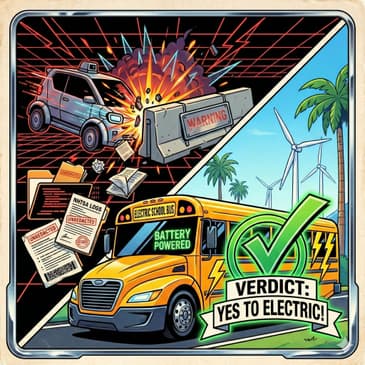
Description:
In this episode of Kilowatt, we dive into the EV news, starting with Aptera’s massive milestone of assembling its first five production-intent validation models to prove the solar EV movement is very real. We also explore the newly live Rivian R2 configurator, breaking down the diverse trim options, initial pricing structures, and the agonizing wait for the brand's best colors. Tesla dominates much of our discussion as we dissect the unredacted NHTSA logs detailing 17 "Robotaxi" crashes, exposing what really happens behind the scenes with teleoperator interventions and minor collision data. Additionally, we analyze driver feedback on the controversial Tesla FSD 14.3.2 update to see if the system's performance is truly taking a step backward. Finally, we take a look at a massive Cybercab car wash being erected under the lights of Las Vegas, and share an inspiring story from an electric school bus driver who vows never to return to diesel.
Support the Show https://www.supportkilowatt.com/
Other Podcasts:
News Links:
- Wooshn YouTube Channel: Really How Bad Is Tesla's FSD 14.3.2 Update?
- InsideEVs: The Rivian R2 Configurator Is Live. But You'll Have To Wait Until 2027 For The Best Color
- Electrek: Rivian opens R2 configurator: here are all the options and pricing
- Electrek: Tesla finally reveals what happened in 17 ‘Robotaxi’ crashes
- CleanTechnica: Electric School Bus Driver Will Not Go Back To Diesel
- Teslarati: Tesla is building a massive Cybercab car wash in Las Vegas
- Ars Technica Cars: Vaporware or not? Aptera assembles its first five validation models.
*Show Art Created By Gemini
Hosted by Simplecast, an AdsWizz company. See pcm.adswizz.com for information about our collection and use of personal data for advertising.
[00:00:21] Hello everyone and welcome to Kilowatt, a podcast about electric vehicles, renewable energy, autonomous driving, technical problems, and much, much more. My name is Bodhi and I am your host. And putting this show together, while putting the articles together has not been a challenge at all, putting the show together for a lot of technical reasons that I'm not going to get into, some of which involve logic and some other things, it's been a problem.
[00:00:50] Like my internet went out for a decent part of the morning and all these things just are all piling up. And every time I go to record, there's one problem here and one problem there and just trying to work through each of those, another one pops up. So I say all that to say this.
[00:01:08] We're going to talk about news today. So, um, a little bit later in the show, I am going to mention FSD and FSD supervised 14.3.2. And I just want to let you know that there is an article, not an article, there is a YouTube video by Kerry Murphy. Kerry was on the show not that long ago. Uh, he is the host of the
[00:01:37] final lap podcast. And he's also the host of the Wushen, Wushen YouTube channel. And Kerry actually did a really good breakdown of FSD 14.3. The video is about 30 minutes long, but I would highly suggest a 14.3.2, but I would highly suggest that you go and take a look, uh, because what we're going to talk about today is in that video. So I'll put a link in the show notes.
[00:02:04] Let's go ahead and jump right into our news. Aptera has assembled five validation vehicles. Now, this is a big deal because Aptera has been on the precipice of production for years, um, which is to say that they haven't really been on the precipice of production, but they're getting closer with these validation vehicles.
[00:02:31] If you don't know, if you don't know, if you don't know, if you don't know, Aptera builds this really cool looking car, it looks like an airplane without wings. And, um, it's a three wheel vehicle. I think technically it's still considered a motorcycle, but they started development of this car in 2006. So we are 20 years of ups and downs for this company.
[00:02:53] Um, in 2012, the founders actually sold the company to a Chinese OEM and they bought the intellectual property. They actually announced a gasoline powered version of this electric car, which I thought was funny. And then, you know, in 2014 or so everything went dormant with Aptera. The founders bought the company back in 2019.
[00:03:16] And, you know, over the last seven years, they've been trying to get this car out. Um, in 2025, interestingly enough, a really dumb podcaster while begging an interview at CES asked the CEO, uh, what exactly do you, do, do you do here? And he says, well, I'm the CEO.
[00:03:35] And I was like, oh, the dumb podcaster was like, oh, that's interesting. I should have known that by your shiny orange suit. I don't know if it was orange in my head. It was orange, but anyway, uh, yeah, uh, I got an interview with the CEO and did not know who he was.
[00:03:53] And then on top of that, it was on the day that they announced their partnership with Panasonic. Fortunately, in the middle of the interview, uh, it had to be cut short, probably three minutes in had to be cut short because, uh, the CEO already had a scheduled interview with Kyle Connor and Kyle was ready. So honestly, even though, uh, I've seen Kyle around, I've never actually met him face to face. Uh, he saved me that day because that interview was not going as well as it could.
[00:04:20] Anyway, uh, this is a big step forward for Aptera and hopefully they can get this car over the finish line. By the way, this podcast actually exists largely because of Aptera. Now, a lot of people who've been listening to this show for a while already know this, but for the new folks, um, I saw an early video of this car and the promise of an affordable vehicle.
[00:04:46] Like we're talking like sub $40,000 when we say affordable at one point in time, Aptera was saying, you know, the car would cost in the mid twenties. I don't, I haven't looked to see what they're actual saying, what the saying, what the car will cost now, but you know, affordable. Um, I think if my memory serves me, I saw it on a J Lino's garage in like 2012 or 2014. Um, I don't think my kids were born yet, but I think they were close.
[00:05:13] That's why I'm putting those date ranges out there, but the video also could have been, uh, another video that Aptera put together. But I just remember the car driving through a neighborhood. That's a lot of what I remember. And I thought, this is so cool. Two seater car, three wheels looks really unique and will be affordable. And, you know, 2012, that's around the time the Model S was coming out at, you know, an affordable $70,000, $80,000.
[00:05:43] So, um, something sub $40,000 really caught my eye. All right. Uh, we talked a little bit about Aptera getting their car over the finish line. It looks like Rivian's getting the R2 over the finish line because you can now officially configure the Rivian R2. So I'm going to break down the trims for you. So starting at $49,000, you get the standard package.
[00:06:11] That gets you 345 miles of range. It's rear wheel drive. Although you can get an all-wheel drive version if you add another $3,500 onto the price tag. Um, but your range will drop down to 330 miles. 19-inch wheels are standard, but for a little extra, you can get 20-inch wheels. You have a choice of five different paint colors.
[00:06:36] The Esker Silver is free, and then the other colors cost between $1,000 and $2,000. You only get the option for a black interior, and this car will ship in 2027. So, you know, you want the more affordable version. You're going to wait a little bit. But then it gets to the premium, premium, the premium model, which starts at $54,000. And you'll get 330 miles of range. It is all-wheel drive.
[00:07:03] There are six paint colors with the same, you know, price range between free for the Esker Silver in $1,000 and $2,000. Standard wheels are 20-inch, but if you want a 21-inch wheel, that'll cost you an extra $2,000. You do get an option for a white or black interior, which is great. The white is an extra grand. And you have the option to add a tow package, which is $950.
[00:07:31] You do not get this option in the standard version. Oh, by the way, on all of the cars, you can pay an extra $2,500 for the Autonomy Plus package, which is, you know, we'll say roughly equivalent, we haven't really seen it in real life yet, to Tesla's unsupervised FSD. So $2,500 is downright reasonable.
[00:07:55] And then if you wanted a spare tire, you could pay an extra $755 for a compact spare tire, which is too much money. That is entirely too much money. This is a cool-looking vehicle, Rivian. You should have just included the spare tire on the back, like every other off-road vehicle has that big tire on the back. And it looks super cool. But yeah, that $755 for a spare tire. I realize there's other things they have to do to the car, but come on.
[00:08:24] That's a lot. All right, so that leads us... Oh, that car will come out later in 2026, the premium version. And that leads us to the Performance, which starts at $58,000. Gets you 330 miles of range. It is an all-wheel drive vehicle, so that's great. Eight different paint colors to choose from.
[00:08:51] Two are coming later this year, including Borealis, which is that kind of cool purple. The black interior comes standard, but they have a really cool coastal cloud, which is kind of a dual-color interior. I don't remember if it's black or gray, but... Anyway, I thought it looked really nice. But that's not coming out until later this year, so... That's an extra $1,000. This trim comes standard with 21-inch all-season tires.
[00:09:18] However, if you want all-terrain tires, you can get the 20-inch all-terrain tires for another $1,000. Now, here is where I think the value comes in. With the launch package that comes with the $58,000 that you're buying the car for, you get Autonomy Plus included. You get the tow package included. You get the option. You don't have to take it, but you get the option for the launch green paint, which is that really cool ravine green.
[00:09:48] I'm sure there's a difference, but it still, to me, looks the same. And then you get a launch key fob, which I don't know if that's all that important to many people. But you get all that included in the $58,000 price, which I think is pretty reasonable. And then on top of that, it'll be available in spring of 2026. Just so you know, spring ends and summer begins at the end of June. So they don't have a whole lot of time to deliver their first car.
[00:10:18] But we'll see. But yeah, Rivian is definitely making a step in the right direction. We'll kind of see how it goes and what people think of this particular vehicle. I hope that it's a hit, honestly, because I think what Rivian's doing is really unique. It may be too much of an off-road type vehicle to appeal to a lot of people, but I don't think so.
[00:10:46] I think this is going to appeal to so many people that will never take this car even on a dirt road, much less off-road. But yeah, it appeals to me, and I am in that category. I would not take it off-road, but I might take it on a dirt road. We'll see how adventurous I am. Not many dirt roads in my area. All right.
[00:11:11] In our final EV story, or our final story in the EV segment, we're going to talk about electric school buses. So there are plenty of arguments against electric school buses. You know, the high upfront cost. You have battery limitations that come in the form of just range limitations, but also in hot and cold environments, that's going to affect the battery range. And then over time, we have battery degradation.
[00:11:40] I think we all could agree, or at least the folks who listen to this show and who are in this community can agree that those are legitimate arguments. But if you really understand how EVs work and how, you know, bus routes work, in most cases, it's not a big deal. Now, if you have a bus route that falls outside of that, and maybe it's kind of far out into the country or whatever.
[00:12:09] Like, it used to take me an hour to get to school when I was in elementary or in middle school. I lived in a community called Nikiski, and we had to drive all the way into Kenai to go to middle school. So it was about an hour ride, sometimes even more than that when the weather was bad. So I am fully aware of what these bus routes look like. In those cases, you just use a diesel bus.
[00:12:36] It's not to say that you can't ever use diesel buses, but when it's appropriate, use an electric bus, and when it's appropriate, use a diesel bus. At least we're not burning diesel all the time. And that's kind of, you know, the kind of goal of this show is makes incremental improvements where it makes sense. Now, on the other side of things for this show, I don't tend to put a lot of emphasis on climate change.
[00:13:06] I like to, climate change is very political. I don't think it should be political, but it is a very political argument. And even if I agree, even if I'm sitting next to somebody or across from somebody who agrees on climate change, agrees with me on it, there is still a lot of things to argue about when it comes to climate change. And I find myself trying to avoid those conversations.
[00:13:33] But what I do like to talk about is air pollution. Because air pollution is something that all of my friends with widely varying political beliefs, this is something we can all kind of come together on. Because air pollution, nobody thinks that air pollution is good. Nobody that I know of anyway. And we know that things like smog and the soot in the air,
[00:14:03] that increases, you know, risks of asthma attacks and heart attacks. And you can have cognitive issues later. In my family, we have lots of cognitive issues as we get older. So this is something that's important to me. And they've even found evidence of air pollution in umbilical cords that has crossed through the placenta into the umbilical cord. So, you know, this is something that starts very early on in life.
[00:14:31] Well, by the way, they also found microplastics and all these other things. I don't know how we get away from it, but here we are. And then, you know, recently we talked to Kim Lundgren, which was episode 700 of Kilowatt. And she mentioned that they developed a plan to put these filters. I can't remember exactly what they were, but they were basically putting like filters on school buses so they weren't polluting so much. Because we have, you know, all these little kids standing out by the bus at the tailpipe level.
[00:15:01] And we want to avoid exposing them to this air pollution if possible, right? When possible. And we want to, when it's not possible to avoid it, we want to mitigate it as much as we can. So I like to kind of highlight stories that are a little bit different when it comes to this kind of segment of the podcast. You know, something that's a little more different.
[00:15:28] Like there's lots of stories that we could discuss that are backed in science. But today we're going to talk about a story that is backed in someone's personal experience, like their lived experience. So all of that leads to this. A school bus driver, her name is Nicole Trone. She wrote a letter to the editor in the Salt Lake Tribune, or the Salt Lake Tribune published it. And I don't, they called it something different than letter to the editor,
[00:15:58] but it was kind of like one of those things. And she is a school bus driver who moved from a diesel bus to an electric bus. And she has no desire to go back to a diesel bus. So she's worked in the Salt Lake City School District since 2021. She's logged over 100,000 driving miles, which is nuts.
[00:16:24] Initially, she was assigned the standard diesel bus that a lot of us are familiar with. She now drives one of the district's 12 electric school buses in the Salt Lake City School District. Excuse me. So here are some of her takeaways from driving an electric bus. And from my experience being on the bus, I remember it was just utter chaos. Kids jumping from seat to seat. But I'm sure it's very different now.
[00:16:53] And when I say that, I'm sure it's not different at all now. But what she notices when it comes to the electric buses is the buses are quieter. So in turn, the students are keeping their voices down. One of those reasons is because she can hear them. And I don't know if she can overhear their conversations. Or when they talk to her, she can hear them without them having to yell over the noise. But anyway, by reducing that noise, it reduces the chaos on the bus.
[00:17:23] And again, sometimes I was a good kid, but sometimes I was the chaos on the bus. So I can completely understand why having a quieter ride environment would make it better for the students, but also better for Nicole. And in fact, in her words, she says, my days are more comfortable, which I'm going to take that to mean less based on the article that I read, less stress.
[00:17:47] And that, but honestly, even if the kids are being good, the constant buzz of people in the background, for me at least is exhausting. Just that constant noise. Because yesterday, I had eight 13-year-old girls at my house and my son. They were all getting ready for a dance. My son actually just, you know, got dressed and watched Star Wars.
[00:18:12] But there was a whole, like, getting ready thing in my living room with all of the girls and some of their moms. And there was even a dad there. And it was fine. Like, all the kids were great. But with, these are good kids. They're 13. But the noise in my house is, was louder than normal. And in general, they were only here for about two hours. So not a big deal.
[00:18:37] But if I was driving and I had to deal with that kind of noise in the background, over time, that's going to be very stressful for me. But in this situation, all the kids were great. No issues. Everybody did a really good job. And they were able to go to their eighth grade dance and have a good time, which is great. The other thing is, Nicole says, is there are no tailpipe emissions. So the interior of the bus is more pleasant to be in.
[00:19:06] Notice, you know, she's not talking about air pollution. She's not talking about, you know, climate change or health issues. She just says it's more pleasant because there are no emissions in the bus. And I can attest to that as a kid. You know, I definitely remember that diesel smell and how, especially in my communities, because I could just open the bus window. And, you know, when you're sitting and idling and you have the bus window open, the exhaust is going somewhere and it's inside the bus.
[00:19:36] I don't know if you can do that anymore on the bus. During the winter, she can keep the bus warm waiting for the students without burning dead dinosaurs. That's great. She did mention that driving the buses in colder temperatures did require some extra planning and consideration when it came to, like, charging and routes and things like that. But her route is assigned.
[00:20:02] But anyway, you had to have a little bit of extra thought in there and extra planning. But really, she said it didn't really affect her daily route. So I thought this was just a really good thing to share in terms of her perspective. And it's not one I think we hear from often. But this is, you know, this is a good reason to have electric buses.
[00:20:29] Again, if it meant that we had to have electric buses, but they had to charge halfway through their route, then that doesn't work. But overall, I just thought this was really interesting. And I'd like to do some more stories that are like this. All right, everybody. That is it for our EV news.
[00:20:51] Before we move on to our Tesla news, I just want to let you know that you can go to supportkilowatt.com and you can sign up to become a patron. And you can either support the show on Supercast or Patreon, whichever floats your boat, whichever one you want. And all of the money goes back into the show. None of the money that comes from the Patreon goes into my own pocket. And you get an ad-free experience and you can support the show for as much as you want.
[00:21:19] But really, for a dollar, everybody gets the same experience. So if you want to support, and we certainly have people who support a $5 and $10 sometimes, that's great. But that's not necessary. You could definitely support for just a dollar. All right, here we go with our Tesla news. Tesla is building a huge car wash for the Cyber Cab in Las Vegas. This is going to be, as advertised, a 36,000 square foot car wash.
[00:21:48] It's going to also include some minor maintenance like paint scratches. And I'm sure, you know, somebody vomits in the back of the Cyber Cab. It's going to be some cleaning in that regard as well. So I think this is great. You know, Tesla has that big supercharger location in Mesa, Arizona, that is simply for Cyber Cabs. It's not for any other Tesla vehicles.
[00:22:16] I wonder if Tesla is testing this stuff out to see kind of what works before they deploy it to other markets. So Arizona gets the Cyber Cab. Vegas gets the, you know, the car wash. And I don't know what's in Austin. But, you know, over time as they roll these out, I'm sure they're testing this stuff out to see what works and what doesn't so they can deploy it to other markets in a thoughtful way. So I thought that was pretty cool.
[00:22:41] And then they have FSD 14.3.2. This is FSD supervised. I mentioned that Carrie Murphy has a really good video on this. But the thing that I want to talk about is when using FSD supervised 14.3.2, drivers will now need to provide feedback each time they intervene. So what happens is if you intervene with the FSD when it's turned on,
[00:23:11] a prompt will come up on the screen and you'll be giving choices as to why you intervened. And in the past, that prompt would go away on its own after a few seconds. Now it stays up until you either touch on the screen what was the reason why you intervened, or you create a voice note by pushing on the button on the steering wheel on the right button. You can create a voice note for that. And then it will go away after you have actually said why.
[00:23:42] Again, Carrie's video shows a really good example of this. So I would highly encourage you to go to the Wushin, and I'll put a link in the show notes, to the Wushin YouTube channel and watch the video. It's really good. And say hi to Carrie in the comments. That would be cool. All right. Now, this is our final Tesla story here.
[00:24:06] We finally have some details on those RoboTaxi crashes that the Tesla leadership team, at least at the conference call, the last conference call, seemed like they were saying that there weren't any accidents, but, you know, they were being very sly, let's say, in how they were presenting this information. But we knew at that time that the National Highway Traffic Safety Administration had at least 17 incidents that were redacted.
[00:24:36] So there was the incident, and then the narrative just read, redacted may contain confidential business information. Okay. I was very... My opinion hasn't changed. I do think when you're testing these vehicles in public, you owe it to the public to explain why or what happened so that we have transparency, so we know what's going on,
[00:25:04] because you are in some way endangering the public's life by having this software or this technology that hasn't been fully tested yet. And in the trade-off, you have to be transparent about what's going on. And what's going on is that most of the 17 accidents that, you know, Tesla had to report were not the fault of Tesla or CyberCab,
[00:25:34] which honestly shouldn't surprise all of you. You know, most were very, very dumb, just small accidents. And I'm going to give you some examples. I'm not going to go through all 17. Actually, Tesla's fault. But none of these accidents were all that big of a deal, to be honest with you. So here are just a couple that I just kind of pulled randomly, for example. So the first one is,
[00:26:01] the Tesla ADS stopped on the right side of the street. The safety monitor requested support because the ADS wasn't proceeding forward. The teleoperator took over and drove the car left up a curb and into a metal fence. No passengers were in the vehicle. And I started with that one for a reason, but I'm going to save my opinion until I read the rest of these. So the next one, the Tesla ADS was stopped at a light at an intersection.
[00:26:31] An SUV that had been stopped behind the ADS crept forward and rear-ended it. The passengers were not in the vehicle. So this was not Tesla's fault. Here's another one. The Tesla ADS was in a right-turn-only slip lane with a yield sign yielding for cross-traffic. The ADS was stopped, then crept forward at two miles per hour while continuing to yield
[00:26:59] and was rear-ended by an SUV behind it. The safety monitor later reported pain and sought some medical evaluation. So again, is this Tesla's fault? Well, legally, probably not because the SUV hit it from behind. But was it acting in this scenario like a regular person would? I don't know. But in reality, the accident wasn't caused by Tesla.
[00:27:27] It might've been helped by Tesla, but there shouldn't be a fault for this. They got rear-ended. That's in America. That's typically always the person in the back or the person who rear-ended them. So the next one is, the Tesla ADS was proceeding straight in a center lane approaching a green light when a dog ran into the intersection from the right. So the ADS reduced speed and steered left.
[00:27:55] So I don't know if it was 27 miles per hour is what they were going, and then they reduced speed, or if the car was going 27 miles an hour at reduced speed when it hit the dog. The dog ran towards the Tesla, made contact with the bottom of the front right bumper, pushing it into the path of the van, but the dog was later seen running away. So seemingly, maybe the dog was embarrassed, and maybe they had some bumps and bruises, but hopefully nothing that was long-term.
[00:28:25] This next one is a property damage only. The Tesla ADS was stopped at a red light. A pedicab approaching. A pedicab is, you know, somebody with a bicycle, and they have a little carriage in the back that people sit in. So the pedicab was approaching from behind, and the bike lane clipped, approaching from behind in the bike lane, and it clipped the right side of the Tesla mirror as it rode past. So no big deal.
[00:28:53] This is actually pretty common, the mirror thing. There was a couple of them where a mirror had been clipped or hit something. The next one is a Tesla ADS made a left turn onto a residential street. As it passed the house, the ADS's side mirror made contact with a dump trailer's gooseneck hitch sticking out into the street. So there's another example. And then we have, we only have three more here,
[00:29:23] just in case these aren't interesting to you. I found them to be very interesting. I would have done all 17, honestly, but I'm trying to keep in mind that not everybody thinks this is as cool as I do. The next one is the Tesla ADS was stopped behind traffic at a red light. A person on a motor scooter approached from behind, moved into the gap behind the ADS, steered right, and made contact with the rear end.
[00:29:52] The scooter driver then hopped the curb and continued onto the sidewalk. So again, not Tesla's fault. The two more. The Tesla ADS was reversing into an empty parking space when the right rear tire made contact with the corner of the curb. I can totally see why Tesla wouldn't want us to know any of this. Like these are so heinous.
[00:30:22] That's actually not true. I think this is, I think this next one and the first one are the reason why Tesla didn't want to report this. This is the last one. The safety driver requested navigation help. The teller operator took over the ADS when stopped and drove straight into a temporary construction barricade, scraping the front end of the fender and tire. So I started with the first one on purpose because in that same situation,
[00:30:51] the safety monitor requested help and then the person, the teller operator took control and drove it up onto a curb into a metal fence. And in this one, when, you know, the safety operator, or excuse me, the teller operator put it into a construction barricade. Now, were these big accidents? No, but clearly the teller operators, I don't know if you need more training
[00:31:20] or if it's something that Tesla needs to do on their side in terms of making that a safer operation for the teller operators. But yeah, I mean, if that was for me, the concern wouldn't be when the car is driving around without being unsupervised. The concern is more that the teller operator is, you know, doing something that through controls,
[00:31:50] different controls may be unsafe. And I don't know how it works on the teller operator side. I don't know what they're doing. You know, nobody's ever really seen this as far as I know. So that would be that would be my concern. Is that something's going on when the teller operator takes over? That is increasing the risk of an accident happening. Now, is that a significant increase? I don't think we have the data for that. Is that, you know,
[00:32:19] based on these 17 different accidents? Yeah, I think that that is something that should be investigated a little bit further to see why this is happening with the teller operators. Also, you know, Tesla made such a big deal about having no safety monitors in the vehicles when it first started the robo taxi or right before it started robo taxiing. And it turns out they had to have at least a safety monitor, but they were in the passenger seat,
[00:32:49] not in the driver's seat. And I think this is mostly for optics. It would be just as easy to put the safety monitor in the driver's seat and have the teleoperator operate the vehicle. But when it's unsafe, the safety monitor who's in the driver's seat can override that and slam on the brakes. Whereas in these two situations, I'm sure the safety operator was not pleased when, you know, they jump a curb and hit a metal fence
[00:33:19] or get run into a barricade. That's probably not a great feeling from them. These are minor, minor problems, you know, but it's not. Minor problems can lead to big problems. I have driven in the Waymos multiple times. I had, at one point in time, access to the Chevy Cruze, one of the VPs at Cruze or GM Cruze. One of the VPs at Cruze gave me access, which was really nice of them,
[00:33:49] but I could only drive or ride in the car between like 10 p.m. and 5 a.m. or something like that. And honestly, man, I'm up a little bit later tonight. It's 11 o'clock at night, but typically I am in bed before 10 p.m. and I don't want to go anywhere at 10 p.m. So I never, I should have, I was waiting for them to get more realistic hours for me to test this. I should have tested it when I could, but yeah,
[00:34:18] so that's pretty much my experience is Waymos. Hopefully, this next time I get to Vegas, I'm going to ride a couple of Zooks, but for right now, that's where I'm at. But I am pro autonomous vehicles and they don't, they don't scare me. You know, I told, said recently I took a Waymo on the freeway. It, it was interesting for about eight minutes and then the rest of the time I just zoomed out on my phone or zoned out on my phone
[00:34:49] and didn't worry about it because there was nothing I was going to do about it anyway. So I might as well be blissfully unaware of the dangers that might be coming my way. So, yeah, anyway, Tesla, this is, none of these are that big of a deal. I don't, I don't even think like one comment from Elon is way more, one more comment from, or one comment from a, a frustrated
[00:35:19] or froggy Elon is way more brand damage than this. Like, this is nothing to worry about. There are definitely some things that maybe they need to look into, like I said, with the teleoperator stuff, maybe move that safety monitor behind this, behind the wheel, which I think would be smarter. Uh, if I'm being honest, it, I think it's more of an optics thing. Like, look, we don't really have to have somebody there, but maybe you should just so that they can hit the brakes
[00:35:48] when the teleoperator is, is, you know, unable to control the car like they would control it if they were sitting in the driver's seat. So, all right, um, that's it for me. I hope you all enjoyed this episode. I certainly enjoyed recording it. I am recording this on Saturday night, but I am going to bed. So, I will release this on Sunday morning. I hope you all had a wonderful weekend, and I will talk to you soon.