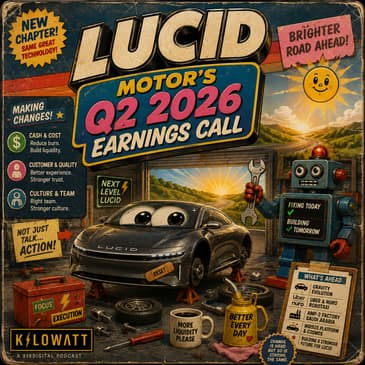
In this episode, we cover Lucid Group’s second quarter 2026 earnings call and the company’s new direction under CEO Silvio Napoli. Napoli lays out three priorities for Lucid—cash and cost, customer and quality, and culture and team—as the company works to reduce cash burn, improve liquidity, and better align production with demand. We look at the workforce reductions and changes at Lucid’s Arizona factory, along with efforts to improve the ownership experience through expanded service support, mobile service capacity, and tighter software and quality controls. The call also provides updates on Gravity and several of Lucid’s major projects, including the Uber and Nuro robotaxi program, the AMP-2 factory in Saudi Arabia, and the midsize platform and Cosmos prototype. Lucid isn’t providing formal guidance yet, but the company expects second-half production to be below Q2 levels while deliveries should exceed production as it works through existing inventory. We also hear Napoli’s broader assessment of where Lucid has fallen short and what needs to change if the company is going to turn its technology and products into more consistent execution.
Other Podcasts:
Publications: News Links: *Show Art Created By Dall-eHosted by Simplecast, an AdsWizz company. See pcm.adswizz.com for information about our collection and use of personal data for advertising.
[00:00:00] Good day, and welcome to Lucid Group's second quarter 2026 Earnings Call. At this time, all participants are in a listen-only mode. After the speaker presentation, there will be a question and answer session. To ask a question during the session, you will need to press star 11 on your telephone. You will then hear an automated message advising your hand is raised. To withdraw your question, press star 11 again. Please be advised that today's conference is being recorded.
[00:00:26] I would now like to hand the conference over to your speaker, Nick Twerk, Chief Communications Officer. Please go ahead. Thank you and welcome. Joining me today are Silvio Napoli, our CEO, and Tawfiq Housaid, our CFO. Before handing the call over to Silvio, let me remind you that some of the statements on this call include forward-looking statements under federal securities laws. These include, without limitation, statements regarding the future financial performance of the company, production and delivery volumes,
[00:00:56] vehicles and products, studios and service networks, financial and operating outlook, timeline and guidance, liquidity position, capital expenditures, macroeconomic, geopolitical, policy and industry trends, tariffs and trade policy, company initiatives and plans, leadership changes, and other future events. These statements are based on various assumptions, whether or not identified in this communication, and on the predictions and expectations of our management as of today.
[00:01:24] Actual events or results are difficult or impossible to predict and may differ due to a number of risks and uncertainties. We refer you to the cautionary language and the risk factors in our annual report on Form 10-K for the year ended December 31, 2025, subsequent quarterly reports on Form 10-Q, current reports on Form 8-K and other SEC filings,
[00:01:45] and the forward-looking statements on Form 10-K for the year ended December 31, 2020, and the forward-looking statements on page 2 of our quarterly earnings presentation available on the Investor Relations section of our website at IR.LucidMotors.com. We undertake no obligation to revise or update publicly any forward-looking statement for any reason except as required by law. In addition, management will make references to non-GAAP financial measures during this call.
[00:02:08] A discussion of why we use non-GAAP financial measures and information regarding reconciliation of our GAAP versus non-GAAP results is available in our earnings press release issued earlier this afternoon, as well as in the earnings presentation.
[00:02:37] Hello, everyone, and welcome to Kilowatt, a podcast about electric vehicles, renewable energy, autonomous driving, and much, much more. My name is Bodhi, and I am your host, and in today's episode, we are going to cover Lucid's Q2 2026 earnings call. We talked about this a little bit over the last couple weeks.
[00:02:58] It came out that Lucid hired this firm that allegedly, not allegedly, typically what they do is help with restructuring for bankruptcy. So it came out that Lucid was going to go bankrupt. We talked a little bit about this with Tom Appel of the Car Stuff podcast. Lucid came out and said, no, no, no, that's not true. Don't believe that. Whether it's true or not, you know, that remains to be seen.
[00:03:27] They are certainly not doing well financially, so they may be doing this preemptively to avoid bankruptcy, for sure. Kind of a last ditch effort before they have to claim bankruptcy. But that was kind of one of those moments where it's hard for me as a podcaster to be like, do I report? Do we talk about this on the show or do we just kind of mention it and move on?
[00:03:54] And I decided to mention it and move on because we don't, we really don't know. You know, all we have is some vague reporting. Not to say that that's not true. Like they did hire the firm and they did, they did do quite a bit of restructuring. But, you know, it's kind of one of those things is, for me, is it worth mentioning?
[00:04:21] And I decided it wasn't worth making a big deal out of because right now they're not bankrupt and they're not claiming to be bankrupt. So I was like, okay, well, we'll just leave it as it is. But in this particular earnings call, Silvio Napoli, who is the new CEO, this is his first earnings call as a CEO.
[00:04:44] He is going to address a lot of this, a lot of the things that Lucid is doing to become hopefully one day solvent and, you know, can start returning money to investors. So we're going to listen to his entire opening remarks. I will jump in every now and again. I've already listened to them, so I already know what he's going to say.
[00:05:08] And honestly, the reason why I listened first, because I was like, is this even worth listening to, depending on what he says? Because you had Mark Winterhoff, which I believe that's his name. He was the interim CEO. And then before that, he had Peter Rawlinson. And I can't really put much blame on Mark Winterhoff. I'm going to make sure that's his name. Lucid.
[00:05:36] Yes, I can't put much blame on him just because he was an interim CEO. Although I'm looking at, I typed his name into Google and the, and I put, you know, Mark Winterhoff, Lucid. And his name comes up. And the first, the first entry is strategic advisor and investor for LinkedIn.
[00:06:04] So his LinkedIn profile is the first one that comes up. The second one is worst from Yahoo Finance. Worst CEOs of the year. So I don't know where he falls on this list. It looks like number one. So it says, Mark Winterhoff of Lucid Group Inc. Is a candidate for worst CEO of the year.
[00:06:30] So I don't necessarily know if I believe that. He used to be the chief operating officer. He, honestly, he kind of inherited a lot of bad stuff. A lot of missteps that I would point squarely at Peter Rawlinson, who is, was the original CEO. And I believe he might have been founder. But yeah, Peter Rawlinson made a ton of missteps.
[00:07:00] And most of those missteps involved thinking that, you know, people with money would want to buy his car. And, and some of them did. However, I think he overestimated how much those people wanted, how many of those people would actually want to buy his car. Because it wasn't as many as he thought, you know, when the air came out, he was quite upset that people didn't realize that there's a very affordable version of the Lucid Air.
[00:07:29] And that would be a version that started about $79,000. So I'm not sure he knows what affordable means. Or maybe we just have, you know, very different definitions of affordable. But then also, you know, when the Gravity was set to be released, he said, you know, it's, we're going to, it's going to go like gangbusters. And that didn't end up happening either.
[00:07:59] I've said this before. I've met Peter Rawlinson, found him to be a very charming guy. I know no issues other than, you know, mistakes were made. And I'm not saying I'd have done a better job because I probably wouldn't have. But, yeah, we're going to hear a lot of the, we're going to hear a lot of talk from Silvio about mistakes that were made in the past.
[00:08:28] And I, I'm not sure that, you know, Mark Winterhoff doesn't deserve some of that ire or, you know, being called out on that. But really, I think most of this falls onto Peter Rawlinson's lap. And not to say, because again, when I met him, I liked him. Not to say that Peter Rawlinson is, you know, some kind of monster. It's just, I don't think the CEO might have been the right fit for him.
[00:08:58] Chief technology officer for sure. Like, he is, he knows his stuff. You know, if you even watch some of the lucid technology videos that they produced, he, he is fantastic. He knows a lot of stuff. But, uh, yeah, that, uh, anyway, I don't know how to say this without sounding insulting.
[00:09:19] I'm just, I'm just saying, uh, he's, Silvio is going to throw some shade and it's squarely going to land on the former CEOs. So we'll see what, what happens, uh, in the future. But anyway, having said all that, because I've now talked for about 10 minutes, let's go ahead and start with Silvio's opening remarks. And then I'll jump in where it makes sense.
[00:09:45] Oh, and, and Tofiq, I can't remember his last name, but Tofiq is the CT, no, CFO, chief financial officer. I cut all of his stuff out only because it was very, uh, financial forward. And we don't talk about finance stuff on the show. We talked about the technology, the cars and that kind of thing. Um, but it was interesting. So if you want to go back and listen, I would highly encourage you to do that. And I'll put a link in the show notes. All right, let's go ahead and jump into Silvio's opening remarks.
[00:10:15] As promised today, I'll share my initial assessment, our midterm priorities, and the actions already underway. In my first two months as CEO with the company, I spend much of my time with the people who do the work. You know, factories, studios, service centers, engineering labs, and technology centers. My approach is simple.
[00:10:41] Listen first, understand what is happening on the ground, and act with urgency. Over more than 30 years, I've led complex technology-driven manufacturing and service businesses through many of the same fundamental challenges Lucid faces today. That experience is directly relevant to the work ahead, and is one of the reasons I came to Lucid.
[00:11:07] And what I've seen so far gives me confidence in Lucid's inherent value and potential. We have leading technology, compelling, award-winning products, and deeply committed people. But potential is not performance, and effort is not the same as results. I agree with all this. And hopefully this much intention and the ideology of like, you know, we can have the best intentions,
[00:11:36] but if we don't have results, that's problematic. Hopefully that stays with Silvio. I've never heard of him before he took over Lucid, so I honestly could not tell you what kind of a person he is. But he sounds very intentional, very thoughtful, and very serious. I would like to see a couple of, you know, hang out with him after he's had a couple of glasses of wine and see how that conversation goes.
[00:12:05] But very, very, his demeanor is very serious throughout the earnings call. And yeah, so let's go ahead and continue listening. Now, before discussing our priorities, I want to be very direct about our situation. I came to Lucid with a mandate from the board to do what is necessary to fix the business.
[00:12:31] My acceptance of this exciting challenge is based on the clear understanding that financial support is needed to provide the runway to make the company profitable and successful. Together with the board, we are confident in our resolve, and that confidence is supported by the financial and operational measures that I will discuss today, which we expect will provide sufficient liquidity runway well into 2027.
[00:13:02] But let me be direct. The way we operate has to change. While there is no question that Lucid brought leading innovations and outstanding products to the market, we have disappointed on several fronts, and for far too long. We have not executed consistently. We miss commitments, launched products before they were ready, underinvested in service, responded too slowly to quality issues,
[00:13:31] and allowed complexity to slow decisions down. Accountability has too often been diffused rather than clearly owned, and we have not operated as one team. The consequence is clear. We are strained trust. Trust with our customers, trust with our employees, trust with our suppliers, and ultimately, trust with you, our investors.
[00:13:58] And I'm here because I'm convinced we can rebuild this trust. We will fix the business because the underlying causes are operational and largely within a control. But to get there, we must go back to basics. All our work must be focused on three fundamentals and four must-win deliverables. We define our three fundamentals as our three C's.
[00:14:28] Cash and cost, customer and quality, and culture and team. The four must-win projects are, first, our plan to deliver 1.4 billion of cash flow improvement by IRN. Second, the Uber Neuro Robotaxi project. Third, the completion of our AM2 factory in Saudi Arabia. And fourth, our mid-sized platform. All right. So he's going to dig into the three C's a little bit more, and then he's going to talk about their priorities.
[00:14:58] Obviously, the Uber partnership is kind of a big deal for them. In terms of, it sounds like there's some sort of revenue share there between Uber, Neuro, and Lucid, right? Because Tawfiq will talk about that during his opening remarks. And again, I cut his part out only because it was mostly financial-y stuff.
[00:15:25] But he does talk about that that's an area where they expect to see revenue in the near future. And, I mean, that's great. I don't know how much it would necessarily be. But on the other side, you know, it sounds like Uber made a big investment into Lucid when they, not just sounds like they did, Uber made a big investment when they first announced the partnership. And then Uber is going to be buying these cars from Lucid.
[00:15:55] So there's revenue on that side of things. And, you know, the kingdom of Saudi Arabia has decided they're going to buy like 4,000 EVs from Lucid a year until like 2032. So when you consider they only deliver, you know, less than 15,000 cars, 4,000 is a pretty significant percentage of their deliverables. And then however many Uber takes.
[00:16:21] So not a lot of cars going out just to regular folks, just in general. And then you take, let's say, I don't know, 4,500 cars a year out. That's pretty significant percentage of their delivered vehicles. But, you know, the priority is there. Like Lucid has to get in the RoboTaxi game.
[00:16:49] That's where all these other companies are going. And that's their plan. And it makes sense that Lucid needs to be a part of that. Lucid has a lot of great technology software that's a little buggy, fiddly, as Alison Sheridan would say. But nevertheless, you know, that is a direction that I think all car companies need to head if they want to stick around.
[00:17:15] You know, there will be a world where people maybe own one car and then the rest is RoboTaxis. And whether that will happen before I die, I couldn't tell you. But I can definitely see a world where we just don't need cars. And, you know, we have a subscription service or whatever. We, you know, more pay as you go to get your car, to have your car take you from place to place. But anyway, he talks about that.
[00:17:43] The Cosmos, the affordable midsize, that was like number four or five on his list, right? That was not to say that it's not important. It's just not the highest priority on their list. Like the AMP2 facility in Saudi Arabia became, is higher than the Cosmos. But as you'll learn later, and there's rumors to this. I don't know that Lucid's confirmed it to this point. But there's been rumors that the Cosmos will be built first in Saudi Arabia.
[00:18:10] And then it'll come to the rest of the world after that, which makes sense. It's simply because Saudi Arabia is a smaller market than, let's say, the United States. So if they're able to build the car and keep up with demand easier, if it's going to be built in Saudi Arabia, because they can start in Saudi Arabia and then they can expand out to regions around Saudi Arabia as it makes sense.
[00:18:39] Versus starting in the United States, where you can have a huge number of reservations in a very short amount of time. It's a little bit more managed in Saudi Arabia, especially since, you know, the kingdom is planning on buying 4,000-ish cars a year. Anyway, all right, let's go ahead and get to the first C, which is cost and something else, culture, something like that. Let's go and listen.
[00:19:04] Let me first provide some color on the three Cs, starting with cash and cost. During my first month as CEO, we reduced our U.S. force force by one-fifth and eliminated the second shift at an Arizona factory. These two measures combined generated $158 million in projected annualized savings.
[00:19:33] The decision to separate ourselves from hard-working team members was not taken lightly. And in fact, I would like to take this opportunity to thank them again for their contribution to make Lucid what it is today. But that decision was necessary, and it was only the first step in our cost-reduction efforts. We need to be direct about the scale of the challenge.
[00:20:02] Lucid continues to consume a significant amount of cash each quarter, as we invest simultaneously in a manufacturing footprint, vehicle production, and future programs. That level of cash burn is not sustainable, and bringing it down is an immediate priority. We are therefore reviewing every major cost, each individual investment, and every single program across the company.
[00:20:31] Our objective is to reduce cash burn with urgency while protecting the initiatives that are most critical to Lucid's long-term value. We have already identified approximately $1.4 billion of cash for improvement in 2026, across operating costs, capital spending, and working capital. We deliberately reduced production by eliminating a second shift,
[00:20:56] because building vehicles faster than we could deliver them was consuming cash and increasing inventory. Today, our priority is to convert inventory into deliveries and cash, aligning production with demand to improve work and capital. We will continue to selectively use incentive programs, but we will not buy volume at the expense of cash or vehicle economics.
[00:21:23] Here, I also want to address the speculation surrounding our work with Alex Partners. Their engagement has been focused solely on supporting our cost savings plan and streamlining our operations. We will be wrapping up their assignment once that work is complete, which we expect at the end of this month.
[00:21:48] So that reference right there that he just made was to the company that Lucid hired to kind of help them restructure, and people thought it was, you know, a sign that they were going to go into bankruptcy. So we've already discussed that, so there's really nothing to add there. But, you know, in the situation that Lucid is in at the moment, if you can't raise revenue, the only way forward is to reduce costs.
[00:22:17] And, you know, I'm pretty sure you all know my stance on labor. I am pro-labor. I'm pro-union. Lucid doesn't have a union. Lucid workers aren't part of a union, I should say. But they are labor, and I hate to see anybody lose their job. However, I would rather see some people lose their job than everybody lose their job. This is not a...
[00:22:45] I'm sure this isn't a decision made lightly. Like, there might be some psychopaths out there that could literally make this decision and be able to sleep at night. But if I had to make this decision, it would eat a hole in my stomach, and I probably would never get over it. Because that is... To take away somebody's livelihood is not an easy decision, for sure. All right, let's move to the second of the three Cs.
[00:23:12] And since I didn't know what the first of the three Cs was, I'm not going to pretend to know what the second of the three Cs is. But let's hear Silvio tell us what it is. Moving on to the second C, customer and quality. Frankly, this is not optional, but a must for every business, including ours.
[00:23:35] Let's be honest, we have exceptional vehicles, but the ownership experience has too often come short of the promise of the product. That's why we created the chief customer officer position and hired Billy Hayes, a highly respected automotive industry leader, with a unique understanding of the customer experience in our sector. With him, we're assigning clear ownership to each major customer pain point and creating a closed loop from customer feedback to corrective action.
[00:24:06] We're making significant investments in service. By the end of the year, we plan to increase the number of technicians and dedicated staff supporting our customers by 35% and mobile service capacity by more than 20%. Together with improvements in parts availability, service operations, and capacity, we expect these actions to reduce wait times by more than 30%.
[00:24:31] Our objective is to make the full experience of buying and owning a Lucid match the strength of the vehicle. We will continue to invest in innovation and bring outstanding products to the market, but only after passing rigorous quality gates. We created a chief technology officer position and hired Raja Macha, a proven technology leader and accomplished scientist with extensive industrial experience,
[00:25:00] including the automotive sector, to take our innovation to the next level and enable the quality our customers expect. Even prior to Raja's joining, we knew that software was a common root cause for customer dissatisfaction. To address this pain point, we immediately deployed measures to strengthen a software rollout process. And we're already seeing progress. During the quarter,
[00:25:28] software quality improved across gravity and air with work focused on infotainment stability, access control, and OTA reliability. We strengthened our validation and release processes, reduce software-related customer issues, and establish more rigorous quality disciplines. At the same time, we continue to bring innovations to the market. Our latest software release, Gravity UX 3.6,
[00:25:57] added hand-free drive assist in combination with other customer features and stability improvements. And I'm excited to share that in a few days, a Monterey Car Week, we will unveil a new, sportier version of the Lucid Gravity. You know, I don't have much to add on this. It's very easy to say that we're going to improve the customer experience. It's much harder to act on it.
[00:26:25] So I'm going to give them the benefit of the doubt because they're putting this process, that, you know, they're putting these processes in place to make it a better customer experience. And hopefully they do fix some of the software issues. You know, Tom Appel was on the show a couple of weeks ago, and he was talking about how he got an alert that the frunk was open and it really wasn't. So he had to go slam down on the hood. He was in traffic. So, you know, those aren't great customer experiences. You know, if you go to YouTube,
[00:26:54] you can find people who like, basically got their Lucid's lemon lod and bought back. So, not a good look for the company. I do think that Lucid is, does pretty good technology. I'm not knocking them. I'm just saying they definitely have these issues. And to correct them, we'll see where it goes. Hopefully they're able to do it. That's kind of the big thing. All right.
[00:27:23] Let's go ahead and move on to the third C. Coming to the third of our C's, culture and talent. Without the right team and the right culture, no plan can succeed. That's why culture and team must be one of our top priorities. Last July 2nd, in my second month on the job, we introduced a new, simplified organizational structure
[00:27:51] which halved the number of direct CEO reports. To enforce accountability and foster transparency, we introduced a true C-suite to lead the company. To accelerate decision-making, we're greatly reducing the number of committees, except for legally mandatory ones. In just a few weeks, we began a major transformation of Lucid as a company and as a team. To keep the momentum going,
[00:28:21] we created a chief transformation officer role and appointed Hugo Martino, a proven leader with deep expertise in driving organizational change across global businesses. We will establish the Lucid business process function led by Hugo to enforce process discipline across everything we do. Lucid needs leaders who are fully present and working side-by-side with their teams. That is why we asked a new leadership team
[00:28:50] to work in person from one of our main locations close to our customers and teams in manufacturing, supply chain, and engineering. My expectation is straightforward. Tough medicine first, clear ownership, fast action, and unity of effort. The people closest to the world will diagnose their problems and design solutions. Leadership sets priorities, removes obstacles,
[00:29:19] and holds individuals accountable, starting with me and our executive team. I love the accountability. I'm a big proponent of you can't live or run an organization off of committee alone. Otherwise, no decisions get made. There are just too many people with an opinion. And it's not to say you shouldn't listen to people with opinions, but when a decision needs to be made, somebody needs to make that decision. So,
[00:29:49] yeah, I mean, I'm liking all the things that I'm hearing, is what I'm saying. All right, let's go on to the priorities. And I can't remember if it was four or five, but there's, you mentioned four or five priorities. We'll dig into that. Alongside this fundamental reset, we identified four must-win deliverables that will shape Lucid's future. I've already addressed the first one, a spending reduction plan which delivers approximately $1.4 billion
[00:30:19] in cash for improvement in 2026. The second one is a robotaxi project with Uber and Euro. A top priority and indeed a must-win project for Lucid. Lucid's capabilities are recognized not only through independent awards for our products, but also through partners choosing a platform for their own strategic platforms. The world between Uber, Neuro, and Lucid
[00:30:48] is one example and demonstrates the potential of our technology beyond privately-owned vehicles. Brand recognition and committed sales aside, this project applies our technology in a new, fast-growing sector. Independent estimates project that 2.5 million robotaxis will be operating globally in 2035. That is less than 10 years from now. And the total
[00:31:18] addressable market for robotaxi vehicles will grow to $600 billion by 2040. I'm going to stop right here because when I first heard this the first time I was listening through, I was like, man, 2040, that's so far away. It's 14 years away. 2040 is 14 years away and it's really, you know, 13 and a little less than half a year. 13 and a half years away. 2040,
[00:31:47] that is nutty to me. I mean, absolutely nutty. Man, it's just, it does not feel like we should be in the mid, should not be like we're close to 2040. Makes me amazed and fairly sad all at the same time. All right. Anyway, I had to break in there for that. If you feel sad to email me bodie, B-O-D-I-E
[00:32:15] at 918digital.com and then just type in sad about 2040 in your, your subject line. All right, let's go ahead and continue on. Given Lucid differentiated technology, the Robotaxi ecosystem also creates opportunities beyond vehicle sales, including recording software services and mobility revenue. Over time, Lucid has the potential to participate across a broader
[00:32:45] share of the Robotaxi value chain, which some industry estimates value at approximately $1 trillion. These exponential growth prospects are not the only feature that makes the Robotaxi market so attractive. Equally compelling, if not more so, is the profit potential with projected margins vassily exceeding those of the traditional retail model.
[00:33:14] As a native software-defined vehicle company, Lucid is ideally positioned to capture a large share of this rapidly emerging market. Lucid's technology platform, combined with our vehicle space, efficiency, and lower operating costs, provides a clear advantage over legacy car makers. The success of the Uber Neuro project will demonstrate the value of our platform at scale.
[00:33:43] Our program is deep into the testing and validation phase with an active engineering fleet of nearly 100 vehicles across the San Francisco Bay Area and Houston. Last month, we began delivering to Uber and Nuro production validation vehicles assembled at a facility in Coolidge, Arizona. So, you might know that Lucid builds their cars in Casa Grande, Arizona. The facility in Coolidge,
[00:34:13] they bought that when Nicola Motors went out of business. So, it sounds like they're putting it to good use. This will be followed by regular vehicle production in Q4, which, in turn, will be followed by a launch in late 2026. While we progress towards this milestone, the robotaxi industry is at a pivotal juncture. And Lucid is resolved to fully capture
[00:34:43] this historic opportunity. That's why we're creating Lucid Technologies, a new business unit with its leader, Kai Stepper, reporting directly to me and driving our efforts in robotaxis and other high potential technology opportunities. Lucid Technologies brings together AI, ADAS, and a broader digital functions under one single structure to improve resource and capital allocation. Kai previously led our ADAS and autonomy
[00:35:12] organization and now serves as president of Lucid Technologies and chief digital officer. With more than 25 years of experience spanning autonomous driving, advanced vehicle technologies, product development, and strategic partnerships, Kai is ideally positioned to help Lucid capitalize on this emerging opportunity. Moving on to our third mustering project, Amp2. Amp2, our
[00:35:42] new factory in Saudi Arabia, is steadily transitioning from construction to industrialization. Last April, in my second week with Lucid, I traveled to Jeddah to see the factory firsthand and get a sense of construction progress and factory readiness. process. And I was impressed by the progress achieved despite the geopolitical situation. All buildings are functional and manufacturing systems installation and equipment testing is happening across stamping,
[00:36:12] body, paint, and final assembly in preparation for production trials. These pictures also attest to the heroic effort by the Lucid team and our supportive Saudi government partners will continue to work to meet the project milestones. And due to return to the kingdom this month, and I look forward to seeing the continued progress over there, it is important to
[00:36:41] clarify that there are two distinct components to a readiness plan. The first is the factory itself, which is within our control. Based on the work underway today, we expect Amp2 to be ready for production in early 2027 and ready to run mid-sized production in the second half of the year. The second component is the surrounding supplier base and supporting infrastructure required to enable a sustained production ramp.
[00:37:11] We are closely working with the salary authorities, suppliers, and other partners to ensure that this ecosystem is ready to support a planned ramp. The salary authorities continue to be a strong partner, helping to advance the road, water, electrical, and telecom infrastructure. We are also evaluating supply localization timelines and identifying actions to mitigate potential delays. Importantly, this does not change our commitment to the kingdom,
[00:37:41] to the local supply chain networks, and to our broader industrial strategy. We look forward to updating you as the work proceeds. Speaking of progress, I had the opportunity to drive our latest Cosmos prototype at Arizona Test Track last week, and I have to say, I came away extremely impressed. This new model delivers everything you would expect from a Lucid.
[00:38:10] The acceleration is remarkable, the handling is precise, and it remains unmistakably true to the Lucid DNA. Really? I can't wait for you to experience it yourselves. Cosmos will be the first vehicle produced at a new AMP2 factory, and the first model from our mid-sized platform. And this mid-sized platform remains an essential element of Lucid's strategic plan. That's why it must be one of our
[00:38:39] must-wins. While the EV market is experiencing near-term demand uncertainty, we remain confident in the long-term transition to electric vehicles. EV adoption continues to expand globally, and we believe the mid-sized segment represents the largest opportunity for Lucid to bring our technology to a broader EV customer base. And I'm encouraged by the progress across the program. Atlas drive units and prototype vehicles are already in advanced
[00:39:09] stages of testing. We work underway across chassis, drive units, battery pack manufacturing, and on-road and test track validation. We're also carrying out crash testing, aerodynamic refinement, and durability testing with cold weather evaluation in New Zealand. Okay, so this is a little bit of marketing and generating hype for the Cosmos
[00:39:38] and a little bit of an update. It's kind of both. And I've debated whether or not I should keep it in, but I do think kind of knowing where they are in terms of developing this because it was supposed to be announced later this year or at least introduced later this year so we could see it and that was kicked down the road to next year. So having this update I do think there's some value to it. So let's go ahead and continue on with the update
[00:40:08] but I just wanted to kind of jump in just in case you're wondering why I left this in because I think it's valuable. The next major phases of the program include additional prototype and quality launch builds, completion of the regulatory and homologation activities, expanded manufacturing validation, and preparation for a start of production. To lead the process and coordinate actions across functions we have promoted Christian Apple to VP of
[00:40:38] Program Management. Based around P1 Factory in Arizona, Christian is responsible for the program while ensuring discipline coordination across the company to deliver top quality. With a strengthened team and additional resources, he and his team are performing a comprehensive review of the program and will implement any changes needed to ensure a successful launch. Our objective is clear.
[00:41:08] Midsize will launch only when every process and quality requirement have been met. We will not repeat the mistakes of the past by bringing a product to market before it is ready. Once more, we remain confident in midsize as a core enabler to scale, improve unit economics, and ultimately profitability. Finally, moving on to outlook.
[00:41:38] Today, I have provided an update on my ongoing assessment on near-term priorities and several of the actions already underway. As you will understand, we are not yet in the position to provide detailed guidance. We will set formal guidance once a leadership team has completed the strategic planning process. In the meantime, we want nonetheless to offer some directional context. In particular,
[00:42:08] I want to stress how current consensus estimates for production and deliveries are based on operating models that no longer reflect the figures we anticipate today. Consequently, based on our ongoing assessment, production and delivery figures are expected to come in below current consensus estimates. Specifically, production in Q3 and Q4 is expected to be below Q2 levels,
[00:42:38] reflecting AMP 1 transition from two shifts to a single-shift configuration through year-end. On the other hand, given the availability of existing inventory, delivery should be above the deliberate reduction in production. Deliveries in the second half should benefit from recent product and service enhancements and reflect sequential growth broadly consistent with a typical seasonal increase from Q2 to Q3.
[00:43:08] We expect growth to be more moderate than in the prior year period, which at the time also benefited from a pull forward of demand and the ramp of the gravity model. When we are ready to provide formal guidance, it will be grounded in market-calibrated demand, lower inventory, and disciplined cash management. Above all, it will reflect commitments we are confident
[00:43:37] Lucid can deliver. For now, our business review remains underway, and Alexander DeBoc, our incoming chief financial officer who joins us this week, will play a leading role in completing that network. So, what can you expect from us over the next two quarters in terms of further updates? In November, at our Q3 results, we will provide
[00:44:05] details on the progress of our 1.4 billion cash improvement for 2026, including a liquidity update. We will also provide a progress update on the Nuro Uber Robotaxi project, and on the latest advancements of our M2 factory readiness. Next, at our year-end results, we will provide guidance for 2027, as well as mid-term plan
[00:44:35] and targets. To wrap up, the work ahead is substantial, and rebuilding trust will take time. With a clear understanding of the key issues, these issues are operational in nature, and we are fixing them. A deep transformation is in motion at Lucid, with a new team in place with clear priorities. The direction is clear. Focus on the fundamentals,
[00:45:04] execute the most-win projects, act with discipline, and demonstrate progress through results. Lucid has the technology, products, and people to succeed. Our responsibility now is to build a disciplined operating model that converts those strengths into consistent performance. We expect to be judged by the results. What an ominous way to end.
[00:45:35] We expect to be judged by the results. I'm not making fun of the way he talks, I'm just saying, very serious, very serious. I mean, overall, and I'm curious to hear what everybody else thinks on this, but overall, I thought this was pretty good in terms of opening remarks. He did talk for a long time, but everything was very organized and thought out, and like I said before, very
[00:46:04] intentional. And for me, it kind of makes me feel better about Lucid and where they're going. Not to say that, you know, let's just put it this way. Lucid could not continue down the same path that they were before, period. period. They just couldn't. They would eventually get either get purchased by Saudi Arabia entirely, and you know, Saudis are going to do what they want with it, or they're going to go away.
[00:46:35] And that's just kind of the way it is. So, hopefully, Silvio and the team will be able to turn the ship around. And I mean, truly, I hope that that will be the case. All right, let's start on our analyst questions. There was some retail investor questions. I think there was three, and I really didn't feel like they were worth adding into
[00:47:04] the mix. One person did ask about energy storage systems, whether Lucid would jump into that or not. And at one point in time, way back when, Lucid, that was something that they were looking into. I think right before they introduced the gravity or maybe around the same time they introduced the gravity, not released it, but introduced it as this is something that's coming. I believe they had a round table and they were talking about solar and
[00:47:34] energy and things like that. And then that just kind of fell away. Honestly, if they would have stayed with that, it might have been a better move business wise for them. But ultimately that just kind of fell away. And the question was, is this something that Lucid would look into? And Silvio basically said, hey, we have so many problems we need to fix. Let's not start adding more problems onto the problems we need to fix. Let's fix these problems and then once we're in a better place, we can start looking at these things, which I think
[00:48:04] was a good answer. All right, let's jump into our analyst questions. Thank you. One moment for our next question. That will come from the line of Alex Perry with Bank of America. Your line is open. Hi, thanks for taking our questions here. I guess first, I just wanted to ask, what milestones should investors be monitoring to measure progress in RoboTaxi? Maybe talk through some of the key
[00:48:33] learnings from your testing and validation in San Francisco and Houston. Thanks. Thank you. Alex, thank you for this question. Clearly, there are two elements. It's a three-part partnership. I can comment on the learnings on the engineering EV supplier side. I will refrain from comments concerning the software and platform side,
[00:49:03] which are with our partners. Clearly, Houston and Bay Area. The idea is we have a vehicle that is software defined. So, the challenge of integrating that to the new firmware and the software is, in fact, facilitated by the way vehicles are conceived. It is really essentially about how to make sure that all the checks and balances, all the redundancies, which are very much safety-related, function through operations. As you can imagine,
[00:49:33] you probably read about this, RoboTaxi certification. It's all about miles accumulated, and there are miles on the road, miles virtually, and now the whole system, which is now three, so the software, the firmware, and the vehicle, respond to that. So, that is, there are a number, and I personally, by the way, every two weeks, review the state of the projects, projects with my counterpart, and Neuro. And in parallel, there is a number of certifications that have been dealt with by Neuro in terms of openness. It's passing all those
[00:50:03] certifications, making sure enough miles are accumulated that then paves the way for the final launch. This is what we're following. So far, there is honestly no red flag in terms of the engineering aspect, but again, there is new systems coming through. I was last week, as I mentioned, in Arizona, and I saw how the prototype vehicles are being assembled and shipped to our partners, and I am very excited to see them on the road, and how they
[00:50:32] perform will be the next stage of validation of the project. I think this was a good question, and I think the answer was good. We're not going to get a lot of detail, especially when he starts off with, I can only talk about one piece of this triangle that we have between Neuro, Uber, and Lucid. The technology is provided by Neuro, mostly. Some of the software, I think,
[00:51:02] is Lucid, but in reality, this is a partnership, and we'll kind of see how it all plays out over time, but I just don't think, I don't know, I think this is a very early on process. So I would not expect to get a lot of data or a lot of information from them, is guess what I'm trying to say. So good question, good answer. I wouldn't expect to get much more than that. All right, let's continue on with
[00:51:31] the questions. And then maybe just one question on manufacturing strategy. Obviously, right now, running AMP 1 at a pretty low utilization rate, and you're still kind of ramping AMP 2 here. So I'm just kind of curious what your philosophy or your strategy is in terms of potentially consolidating mid-sized production into AMP 1 and maybe mothballing AMP 2, or just
[00:52:01] what are your thoughts in general about trying to be a little bit more capital efficient and running a higher utilization rate to optimize that fixed cost structure while demand is relatively de minimis in the near Andrew, thank you for the question. I mean, in essence, this is part of what we're looking at now as part of our strategic planning. But to be clear, I asked the same question coming in, but the fact is today, the AMP 1 factory is meant to design to produce
[00:52:31] air and especially gravity. The way the factory is designed introducing a new line will create inefficiencies on the other model. That's where the decision was taken to put this factory with a new platform in Saudi Arabia, we'd have to. So, going forward, our job is to make sure we ramp it up with quality on both sides. Let's not forget that now we have a new source of volume, which is the robotaxi. So, our plan is to optimize capacity utilization
[00:53:00] by also looking at these volumes and others that may come going forward, first of all, by traditional business, but also by others that lucid technologies might generate. For now, that's all we can say, but I think it's a very understandable question and one that is we cannot answer now, but really key to our profitability going forward. So, I skipped past a couple questions that we're talking about, you know, like deliveries
[00:53:30] and how much inventory they had, and lucid really wasn't answering those questions. They were basically staying on message and saying, you know, we told you we weren't going to give you guidance on this. One of the things they did say is that, you know, if you look at the inventories that we have and, you know, you kind of look at the order book and blah, blah, blah. Basically, they said, if you were able to parse this out, you could see that
[00:53:59] we have a lot more lucid gravities than we do errors in inventory waiting to be sold. So, not a lot of information in terms of that. I do think how they're looking at AMP1, which is in Arizona, and AMP2, which is in Saudi Arabia, like, listen, if you're only building 12,000 to 15,000 cars a year, do you really need two car plants? No, you don't.
[00:54:29] So, if you were looking to save money, would you want to run two factories? Probably not, but I do think in the way of, you know, Saudi Arabia being an investor, owning, you know, 60% of the company, not one particular fund doesn't own 60% of the company, but Saudi interests, they own, you know, 60% of the company.
[00:55:01] If they said build a factory here, you're probably going to build a factory there. Let's just put it that way. So, even if it's only for the 4,000 cars a year that Saudi Arabia is supposed to buy until 2032, you just do it, even if it doesn't make financial sense because they want you to do it. Hopefully, the Cosmos turns out to be everything that Lucid wants it to be and everything that people think it's going to be. And in turn, it sells well. I mean,
[00:55:31] that would be fantastic. I think that Lucid would like that quite a bit, you know, even if they could sell 50,000 cars in 2028 by 2028, or I guess in 2028, that would be a huge jump for the company. So, fingers crossed. To summarize, if they have to run a plant in Saudi Arabia and a plant in Arizona, they're going to do it because they were told to, basically. Not because it makes good
[00:56:01] financial sense, because they were told to. I would imagine that if they were going to shut one of those plants down, it would be the Arizona plant and not the Saudi Arabia plant. But I could be wrong. It sounds like for now they're planning on running both. And then Lucid Gravity, they have a lot of those in inventory at the moment. All right, let's move on to the next question. Our next question will come from the line of Stephen Gingaro with Stiefel. Your line is open. Thanks, and thanks for taking the question.
[00:56:30] And thanks for all the details. Two things for me. The first is, and I know you're maybe not ready to give a whole lot of detail, but when you think about sort of the next couple years, is the underlying business plan changing as far as willingness to license the technology as one thing I'm thinking of or just and also just kind of the focus and importance of the midsize? Is there anything material changing in the underlying plan? Is it all sort of financial and cost related?
[00:57:03] Stephen, thank you for the question. The line is not ideal, but I do think your question related to the idea of licensing. I think as we look at our business planning, licensing absolutely is an option, and Lucy technologies will be to license or sell components into either automotive, EV, but possibly also to other industries. So that is very much something we're looking actively at. At the same time, allow me to come back.
[00:57:33] this will only be possible when we stabilize the business. So our priority now is really a three season, a four must win, because then we're going to have the sustainable business model to take us forward. So all I think what I understood you mentioned is still very much possible and actively looked at, but we're also very conscious of our priorities, which are at the moment is to stabilize our
[00:58:04] technology as it is today. I think a lot of companies are interested in their technology, but as far as I know, Aston Martin is the only company that they have licensed their tech to. too. But I do think it's important to get your house in order, fix the
[00:58:34] software problems, they have great hardware, great efficiencies, and then start licensing that technology to more companies if they want to be involved with Lucid. And there's reasons why you would and there's reasons why you wouldn't, which I won't go into here because we're running long. But yeah, I don't see a downside to licensing the technology for a company the size of Lucid. Maybe in the future that might not be something they're interested in doing. All right, let's move on to our next
[00:59:04] question. As a reminder, if you have a question, please press star one one. Our next question will come from the line of Michael Ward with Citigroup. Your line is open. Thank you. Good afternoon, everybody. When I look at page 23, and you talk about 1.4 billion in cash savings by the end of the year, are those annualized savings, cash savings, or run rate? Is it all going to occur in the second half? Hi, Mike. Thanks for
[00:59:34] the question. So the 1.4 billion is what we're expecting to save this year between now and year end. So that's a 2026 impact that will be reflected in our results. So now part of it, obviously, as you can imagine, we will make it sustainable and part of it will be impacting as well
[01:00:04] the baseline for next year. So we're trying to do things from a structural standpoint, removing some of the cash, but there are also part of the savings and optimizations which are leveraging phasing. So some spent will be potentially pushed to next year. So when you read the 1.4, read it as an impact in 2026. perfect. And so then, so it sounds like some of the capex are deferred,
[01:00:34] so they're not eliminated. But it sounds like the inventory, it looks like to get back to the December 2025 level, it's like $300 million, so there's more there. And that sounds like it's more of a structural change. Is that the right way to read it? Getting more efficient with the inventory care? That's absolutely the right point. So I mean, as we refer to it in the prepared remarks, it's really about how we accelerate the conversion cycle.
[01:01:04] So reducing the timing between the moment where we receive the raw materials for our products into converting them into whip and finished goods, that's something that we're working on from a structural standpoint. And it's really about carrying the lowest level of working capital and translating this working capital revenues as soon as possible. And this obviously touches receivables, payables, so it's really an end-to-end approach and structural change to your point
[01:01:33] that we're implementing currently. And it leads to a lower inventory write-down, correct? That's right. I don't really have anything to add on this other than a lot of the things that I skipped were just kind of covered in this question and answer, so I felt like it didn't hurt to leave it in. So let's move on to our final question and this one's about the Cosmos and where it's being built currently, where the test versions are being built. We'll see
[01:02:03] how much the answer, we already know that if he drove it an example of the Cosmos at the Arizona test track, we already know that they're here, so they're probably being built in Coolidge if I had to guess, but anyway, we get a question anyway. Okay, and the second thing is on the Cosmos, where are those prototypes being built? It sounds like you have some out there being tested and certified already, and where are those being put together? Amp1?
[01:02:34] Amp1, today it's assembled in Coolidge, we have a factory next to Amp1, which is considered a part of it, which is still in Arizona, and so today we have the pilot lines in Coolidge, in a facility which is just a few miles away from Casa Grande, this is where we also have a test track, and that's how we drive our prototypes, and make them ready. So there is actually an interesting technology transfer that we're going to do from
[01:03:04] Coolidge into Saudi Arabia, in fact we have a whole line testing everything before we can be transferring it to Amp2 in Saudi Arabia. And when will the prototypes begin coming off Amp2? That, as I said before, they will become a prototype that will be starting in early 27, and the full amount of production will be in the second part. Okay. Okay. Thank you very much. Really appreciate it.
[01:03:33] All right. So, how informative do you think this earnings call was? I don't, if I had to rank it in terms of being informative, I wouldn't rank it very high. But if I had to rank it in terms of improving sentiment about the company, I would rank it high. Information lacking. Maybe gaining some confidence in the leadership structure that they currently
[01:04:02] have? I am optimistic for sure. What are your thoughts? You can email me, Bode, B-O-D-I-E at 918digital.com. All right, everybody, that is it for me. I do want to say, you know, there's a podcast out there called Autotown, which is fantastic. You should go check it out. If you like to learn more about the auto industry, just in general, it's a great podcast. I don't know the host, but,
[01:04:32] you know, he's been on the Car Stuff podcast with Jilson Manello and Tom Appel. And, I don't know, I mean, my two, my Tuesday or Wednesday, it kind of depends. Generally, I listen to the Car Stuff podcast and then immediately after Autotown. It really, they pair very well together. So, I'll try to remember to put links in the show notes to both of those shows. But,
[01:05:02] yeah, just, I learned so much more, just in general, because Autotown, you have a journalist talking to industry experts and other journalists, and then you have that same thing that happens on the Car Stuff podcast, but it is, let's just say it really rounds out my auto industry education. put it that way. I feel like it's made
[01:05:31] me better at doing this show for sure. All right, everybody, that is it for me. If you want to support this show, you can go to support kilowatt.com and you can get an ad free feed and all of the money goes back into this show. And yeah, that's it. I can't think of anything else. You can go to 918 Digital if you want to go to my website and see everything we're doing there. I feel like I'm missing something, but we've been on the call for
[01:06:01] over an hour or so. Or on the call. I've been recording for over an hour, so we'll just kind of let it go here. Thank you everybody. This is a weekend edition. I'm actually recording this on Friday and it's not 11 o'clock at night. It's ending right now. It's at 8. I will talk to you all soon.
[01:06:25] Showing no further questions in the queue, I'd like to turn the call back over to Silvio for any closing remarks. Thank you. So as we come to a close here,
[01:06:55] I'd like to thank you all for joining us today, for your engagement, and for your questions. Our priorities are clear. Reduce cash burn, improve quality and the customer experience, build a high premium team and culture, simplify the company, and deliver a must twin projects. We know that rebuilding credibility will take time, and we intend to earn it through consistent results. Thanks again, and I look forward to seeing you again soon
[01:07:24] and continuing our conversation. Bye-bye. This concludes today's program. Thank you all for participating. You may now disconnect.