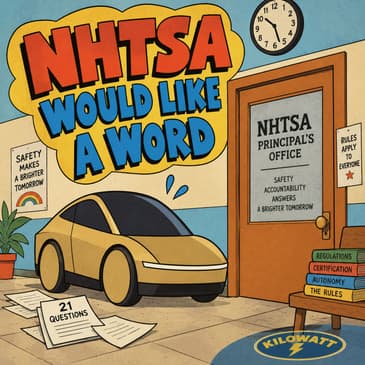
Kia is offering substantial discounts on the 2026 EV9, including $10,000 in customer cash and even larger discounts at some dealers. CATL unveiled its TECTRANS II commercial vehicle battery platform, designed to make heavy-duty electric trucks easier to integrate while offering up to 621 miles of claimed range, megawatt charging, and a long service life. GM is showing off a new infotainment interface on upcoming gas-powered Sierra and Silverado models that puts Apple CarPlay or Android Auto alongside vehicle controls, raising the possibility that the setup could eventually make its way to GM’s EVs. Tesla has added insurance estimates to its vehicle order page, including a comparison of estimated rates with and without FSD usage. Tesla is also trying to speed up Supercharger construction with its new pre-assembled “Accordion” Supercharger system, which arrives at the site largely wired and ready to unfold into place. Finally, NHTSA has escalated its inquiry into the Cybercab with a Special Order requiring Tesla to explain how the vehicle was certified despite lacking traditional controls such as a steering wheel and pedals.
Other Podcasts:
Publications: News Links:- Kia offers big EV9 discounts with over $15,000 off at some dealers
- CATL launches 170 Wh/kg battery platform for heavy-duty transport with 621-mile range
- CATL's New Electric Truck Battery Is Coming For Diesel's Biggest Advantage
- Tesla Adds Insurance Estimates to Order Page, Highlighting FSD Savings
- Tesla's new 'Accordion' Supercharger could speed up its slow buildout
- NHTSA just escalated its Tesla Cybercab investigation in a big way
- *Show Art Created By Dall-e
Hosted by Simplecast, an AdsWizz company. See pcm.adswizz.com for information about our collection and use of personal data for advertising.
[00:00:22] Hello everyone and welcome to Kilowatt, a podcast about electric vehicles, renewable energy, autonomous driving, and much, much more. My name is Bodhi and I am your host and I'm re-recording the intro to this episode because I sounded like such a dope. I'm recording this on Thursday at now 824, so it's a little bit later in the evening. But this has been a nutty week, like it's been busy at work, we've been spending a lot of time outside at work,
[00:00:50] I've been spending a lot of my own personal time outside, it's hot, it's humid, and I am at my end. I am just zapped. Like I've been going to bed early. I haven't been going to sleep necessarily, but I've been going to bed super early just because I am trashed. I cannot even, you know, hold my body up. I've been so tired. And it's just busy days, you know, all good things, all good things, but very busy.
[00:01:19] So my intro to this was just an absolute mess. So I'm going to try to start all over again. I had quite a few emails this week, so that's cool. So I'm going to share some of those with you at the get-go here. Starting off, I talked about how the U.S. had 73 EV models that were being sold in the U.S., I guess.
[00:01:46] And I said, I pointed out that the R1S and the R1T were technically one, but those should be separated out. And David wrote in and said, well, if the R1S and R1T should be separated out, so should the Hummer pickup and the Hummer SUV. So if we do that, we have a total of 75 U.S. models or EV models in the U.S., which is pretty cool. But then David casually slipped in that New Zealand has 92, which is where David lives.
[00:02:14] He lives in New Zealand. So, yeah, I mean, awesome. Giving us one more, David. Also awesome. The little like, well, we have 92. And then Dale wrote in about the Snoozoom mattress review. A lot of people had really positive things to say about the review, so thank you very much to that. That's awesome. I really appreciate the feedback. But Dale was wondering, you know, getting in and out of the car with the mattress inflated.
[00:02:45] And I didn't talk about this. So when the mattress is fully inflated, I have to get in through the back hatch. I could technically get in through one of the back doors, but it would, because the mattress is sitting at a little bit of an incline, that would be a little bit of a challenge. So more than I would want to do. So it's just easier to enter through the rear hatch. Once you're in there with the mattress fully inflated, it feels very roomy. It doesn't feel claustrophobic at all.
[00:03:15] You know, I'm not a little guy and I was in there and I felt fine. You know, my wife could be in there as well and I would feel just as roomy, I think. I don't think it would be a challenge to sleep in there with two people. My kids are adult size, so the four of us couldn't fit in there. But two could fit in and be pretty comfortable. So that's positive.
[00:03:42] In terms of, I think I mentioned this in the review, but in terms of the front seats, you have to push all of the front seats, the front seats all the way forward in order to be able to get the mattress to fit. So if you needed to go somewhere, you would have to deflate the mattress a little bit, fold the feet over, and then pull the mattress back so that you can, you know, push the front seats back so you could go somewhere. That's not that big of a deal because it's pretty fast to inflate, pretty fast to deflate.
[00:04:11] But you would have to do that. So, Dale, thank you very much for writing in. And then in terms of the Cybertruck and its integration with Gateway 3 and Powerwall 3, OB, which is, we're going to have a new segment, monthly segment. It's going to be OB's EV tech tips. We actually recorded three of those segments today. And the first one will probably be sometime in October.
[00:04:40] But OB is an EV technician, mechanic, however you want to say it. So he has a lot of really great tips for us. And like I said, we already recorded three. I think you're going to enjoy them. Really good information. And they're quick little bits of information as well. So OB wrote in and said the Cybertruck has had power share with Gateway 3, but without the Powerwall.
[00:05:09] So if the Powerwall wasn't involved in the system, you could share your car power with the house. The stumbling block was if you had a Powerwall. So now with Powerwall 3 units and Gateway 3, you're able to do that. And then I made mention that Tesla said that the Cybertruck was like having nine Powerwalls in your house or nine Powerwalls on your house. It's like adding nine Powerwalls, I guess, is probably a better way to say that.
[00:05:38] And the reason why is because each Powerwall unit is 3.5 kilowatt hours. The Cybertruck has approximately 123 kilowatt hour battery. There you go. Nine Powerwalls. So I think that's cool. He also added a fun little fact. Fun fact that the battery in your car, my car, is about 78 kilowatt hours. The battery in the Model Y YL, like the longer Model Y that just came out,
[00:06:06] is about 85 kilowatt hours and it has power share. So it would be able to provide backup of Powerwalls as well. It would be, you know, like six Powerwalls. He didn't write how many, but it would be about six Powerwalls. So if you ran into a situation where you are in a natural disaster type of thing,
[00:06:33] you could definitely lean on your vehicle to help get you through and power your house through the emergency. So that's cool. That's awesome. And then Steve wrote in as well, and he wrote in about the Cybertruck. Steve Sheridan, I should say, wrote in about the Cybertruck and using it as a backup to your home, battery backup to your home. Steve said, and if I stumble on this, it's because I'm tired and I'm bad at reading out loud.
[00:07:03] It's not because Steve wrote a bad email because I've re-recorded this several times. The problem's with me, not with Steve. But as Steve said, on your latest episode, you talked about how much energy is stored in the Tesla Cybertruck battery. You mentioned that the Cybertruck can be used to power a home, and it would be the equivalent to a capacity of nine Tesla Powerwall threes. You said it's a big statement, and it seemed like a lot. So Steve breaks it down. Each Powerwall stores 13.5 kilowatt hours of energy.
[00:07:33] That would imply that the Cybertruck has energy storage of about 121 kilowatt hours, which matches what Obi was saying as well. I asked Chad GPT how much energy is stored in a Cybertruck, and it came back to 123. So, although the claim that a Cybertruck battery is equivalent to the energy storage of nine Powerwall threes, the numbers are consistent and make sense.
[00:08:00] As a comparison, my performance Model Y has around 82 kilowatt hours and the equivalent of about six Powerwall threes of energy storage. So it's awesome. I do think I should maybe clarify a little bit. When I said that seems like a big statement, I honestly didn't know how big the Cybertruck battery was. That isn't even what I was thinking when I made that statement.
[00:08:26] It was more of, if your truck is fully charged, that would be the case. If it's not fully charged, then that's not the case. But in that same rationale, I didn't even consider how big the battery was and at full capacity, how many Powerwalls that would be. It was just more of, you're assuming that somebody's coming at this at 100%. So thank you both to Obi and Steve.
[00:08:56] And also, Obi's not his real name, so I'm sorry if I'm stumbling on that, because I don't want to say his real name. But thank you to Dale and David and Obi and Steve for emailing in. I really appreciate it. Good information. And again, my little blind spot was I didn't even consider taking what the Powerwall was and dividing that by nine to see, or times it by nine to see if that even matched. It never even entered my head.
[00:09:25] My thing was more of, you're assuming that you're coming at this with 100% battery. That's not a charge. Which, if you knew that there was a natural disaster coming in, you could certainly get close or even reach that. That's not impossible. But I should have been more clear. But thank you to all those folks who emailed in for clarification. All right, let's get to our EV news.
[00:09:50] Kia is offering a $10,000 customer cash discount on the three-row 2026 Kia EV9. I like the EV9. I like the Hyundai Ioniq 9 better, just the look of it. But the EV9 is great. And $10,000 off is nothing to sneeze at. And what's going on with our economy today? Some dealers are even offering more money off. You'll have to go and check your dealer to see if they are.
[00:10:20] But it's right around, on average, $15,000 off MSRP. So check your local dealer for details. If, for some reason, you prefer to get 0% financing for 60 months, you wouldn't get the $10,000 off from Kia, but you would get $5,000 off. And then you could get that 0% financing for 60 months. So, pretty... I mean, $5,000 is still pretty fair.
[00:10:47] And depending on how much you're financing, you know, it might offset. You do have to do the math. Because you might find that $10,000 is better than taking the 0% financing. But you got to do the math. All right, next up is Mark K. from the UK. Sent us a cool article on semi-trucks or heavy-duty commercial EV batteries.
[00:11:13] So CATL unveiled its next-generation modular commercial vehicle battery platform. It's called the Tektrans 2. It's designed for commercial vehicles, including heavy-duty trucks. It's this cool, adaptable, modular architecture. So, basically, it's designed to integrate into existing vehicle lines.
[00:11:38] So much engineering is done on these vehicles that changing out even the smallest thing, you know, not even mentioning the battery pack, but just changing out the smallest thing can be redesigned for so many different components. So they try to make it as adaptable as possible. Not to say that they wouldn't have to do any changes. It's just to say that they made it with that in mind, that you already have your vehicle planned out years in advance.
[00:12:08] And this was kind of meant to fit in as best as possible. When it comes to, like, longevity of the battery, CATL said that if you're using the battery, let's say, for a heavy-duty truck. And I'm assuming that means semi-truck, right? So a heavy-duty truck, in 12 years, you'd probably have around 1.5 million kilometers or 932 miles.
[00:12:35] And the battery capacity should be about 70% at the end of that 12 years. So pretty good, especially when you're considering, you know, these vehicles are very expensive and you want them on the road for as long as humanly possible. So 70% capacity of the battery after that many miles and that many years, that's not bad. In terms of range, you're looking at around 1,000 kilometers or 621 miles of range on a single charge.
[00:13:05] Every country has different standards for measuring range, right? And if this is based on the way that China does things, you know, if we're looking more with a European eye or North American eye, it would probably, Mark says, be closer to 500 miles. And I agree with that based on what I know about how those things are done.
[00:13:28] It's just like how much time is spent, you know, on local roads, surface streets versus highway, that kind of thing. That's how they, there's a whole, you know, process and to come up with the range. Um, but let's just use a thousand kilometers or 621 miles for the example, because that's what CATL gave us. Um, it'll support megawatt charging, which is fantastic.
[00:13:55] Um, 80% charge. It'll get you regain 80% in 25 minutes, which is about 800 miles or, or excuse me, about 500 miles or 800 kilometers. So, uh, you know, ultra fast. It will also support battery swapping. If, if, if that's designed by the, the, uh, commercial truck manufacturer, it, you can do it, but it's not guaranteed.
[00:14:24] In terms of, um, efficiency, we're looking at 170 watt hours per kilogram when it comes to energy density. CATL said that that's 13% above the industry average. I have no idea if that's true or not, I will assume. But more importantly, CATL says that the, the, the, the energy efficiency or the energy density in these batteries will allow the payload capacity to go up by about 0.6 metric tons.
[00:14:54] And I honestly did not do the math on that, but I'm going to guess that's right around 1200 pounds. You know, let's look, I'm going to guess it's 1200 pounds, but let me type it in 0.6 metric tons. And then that is two pounds. It's 1,322 pounds. So, you know, you can increase your payload by that much that, that can be significant.
[00:15:22] Um, cause every, every truck has a maximum amount of, uh, payload that they can carry, or they can only be so heavy based on operated on the roads. You can't have unlimited weight. So this is awesome. Um, I'm looking forward to seeing these in actual, you know, commercial heavy duty vehicles to see what they can really do. And then Allison Sheridan shared on a group EV text.
[00:15:51] I'm on, she shared the following in 2023 GM announced that it was dropping Apple CarPlay and Android auto from its future EVs. And the internet had, they, they had a hissy fit about how dumb that was. And I agree. I agree. I think it is dumb, but GM followed through on the plan. But now GM is showing off a new infotainment interface on the upcoming 2027 GMC Sierra and Chevy Silverado, Silverado 1500.
[00:16:21] And it has like this CarPlay Android auto split screen with GM's UI alongside it. So on the left, you can see GM's UI on the screen. And on the right, it's either CarPlay or Android auto. It's actually quite nice because you can keep CarPlay up, but you could see things like, you know, changing the radio station or the,
[00:16:47] the vehicle's range or other vehicle controls, volume changing the HVAC, that kind of thing. That's, that's available to you, but you can also see Android auto or, or CarPlay, whatever your flavor is. Now, GM does say that their, their new software is built on a single scalable foundation, which means it'll work across, across gas, diesel and electric vehicles.
[00:17:14] However, they said that right now, this is only on the 2027 gas powered Sierra and Silverado. And they said they have no other plans to share if this will be available for any other vehicle. But because their, their, you know, infotainment system, their software is scalable. This is possible.
[00:17:43] And I don't know why you wouldn't do this. I know. Well, I know why, because they don't want to share the information with Apple or Android. Um, when I say share that information, they, they want that information in Apple and Android, keep it from them. So, yeah. Um, hopefully this will be a thing I would love it to see. I would love to see these, these two, you know, CarPlay and Android auto. I'd love to see that come back to, to GM.
[00:18:11] Um, and honestly, the next car I buy because my wife's car has, has Apple CarPlay. We were an iPhone family, but my wife's car has Apple CarPlay and it, it's so good. It's so much better than what Tesla's offering me. In my opinion, my next car is probably going to have CarPlay. So Tesla better get on it if they're going to sell me another car. Um, yeah.
[00:18:41] And it is annoying when I'm in my wife's carnival. It is annoying when we have to leave Apple CarPlay to do something stupid, like change a radio station. So being able to have that split screen there and change the radio station, but still stay in, in CarPlay. That might, that might be interesting to me for sure. All right, everybody. That is our EV news. Let's go ahead.
[00:19:10] And before we get to our Tesla news, I just want to let everybody know you can go to supportkilowatt.com and sign up and support the show. I'm not going to go into a big plug, but for as little as a dollar a month, you can just get rid of the ads. So go to supportkilowatt.com and sign up. You can go to Supercast or Patreon, whichever you prefer. Okay, Tesla news.
[00:19:34] When you order a Tesla, you will now see on the order page an estimate of how much Tesla insurance, not every car insurance, how much Tesla insurance would cost you. And it's, it's an estimate, but you get an estimate both with and without FSD usage. So effectively you, you put in the car that you want. I chose the base model, model three or model Y. So I put in the charge, the car that I wanted.
[00:20:04] Um, I put in the miles, which was 10,000 miles. I put in the level of insurance. I wanted standard. You only get basic and standard. So I put in basic or standard, excuse me, not basic. And then it gave me a quote of how much it thinks it would cost. Now I do need to say the price for Tesla insurance changes every month based on the previous month, how you drove the previous month.
[00:20:31] So if you drove a lot of miles and you got a lot of warnings that you were coming up on cars too fast, you know, the, the front collision warning, if you get a lot of those and you get a lot of lane departure warnings. And depending on how fast you were driving, your insurance could go higher than the estimate. Or if you do really well on all of that, your insurance would be lower, but it would depend on, on how you drove that month.
[00:20:57] It also depends because you got knocked when I had it anyway, you got knocked if you were driving past a certain time or earlier, earlier than a certain time. I think it was like, if you're driving earlier than 6 AM or past 9 30 or something like that, you got, you got dinged on your insurance, which I don't think is necessarily fair.
[00:21:18] But that's all to say that the way that Tesla insurance works, it isn't like the standard insurance that you get here in the U S where you, they tell you what you're going to pay monthly or pay. I pay every six months. They tell you what you're going to pay every six months ahead of time. And it doesn't change for that six months. And then when you renew, it could go up or it could go down. That's not how it works with Tesla.
[00:21:42] So according to the estimate that I had, it would be right around $199 a month for me to have that standard model Y rear wheel drive $199 a month without FSD. But if I had FSD, which would cost me another $99 a month, but we won't get into that. If I had FSD, it would be $142 estimated. And that, I think that's like 93% of the time using FSD.
[00:22:14] And that, like I said, that, that estimation was based on 10,000 miles a year, standard insurance. Um, so I, if I used FSD, if I did this, I would save about $57 a month. But, um, in reality, you know, what is this? If, if let's say it's 142 times 12, what is that? Um, 284.
[00:22:44] No, that would be 142 times two. It'd be about $1,700 a year for, uh, if I used FSD all the time, that doesn't include the FSD, uh, purchase that it just includes the, the insurance, right? I pay about $1,900 a year for two cars currently. And it's, it's above average insurance.
[00:23:08] Um, we, we pay for the extra stuff because we don't want to get, um, sued out of existence. So, yeah, uh, I, I, for me, it wouldn't be worth it. I'd be actually spending more money than I would need to. But for somebody out there, especially if you only have a single car, it might be worth it. But, uh, kind of cool that they offer that. So at least you can see and make a good choice when you're purchasing the car.
[00:23:40] This next story is pretty cool. Elon has talked about in the past different ways to improve supercharger rollouts, whether it's, you know, save time or save money, make it more efficient. One of the things that, uh, Tesla is doing is a, um, they're calling it like the accordion supercharger. Um, I don't know. I pre-assembled. They're basically, they're pre-assembling superchargers at the factory, transporting them to the site,
[00:24:09] pulling them off the truck, setting them down, kind of like unfolding it. That's where the accordion thing comes around. Um, and it's designed for sites where you can't really trench behind a curb. However, I think you could probably deploy these just about anywhere. And how it works is, um, each accordion unit has eight version four charging stalls and one version four cabinet.
[00:24:38] And then you can, that delivers 1.2 megawatt hours, right? Um, all of these things are pre-wired. So everything's pre-connected and it's folded up into one unit. Uh, you have to kind of clear this up a little bit. If you're looking at it, you'll have four version four power wall charging stalls, kind of folded up together.
[00:25:05] And then in the middle, you'll have one version four power cabinet. And again, that delivers 1.2 megawatts. And then on the other side, you have another four, uh, version four charging stalls. And this is all squished together and you can actually fit two of these units on one truck. So that's cool. And when you, you, you put the units on the truck, you get to the site. They use this fancy forklift to lift it off the truck,
[00:25:35] put it in place and they use the forklift to unfold it. Um, when it goes in place, it goes, it goes into place directly on gravel. And as they unfold it, they have little, uh, conduit that goes between the, the charging stalls and the, the power cabinet. So all of that is pre-wired and ready to go. Once everything's positioned and unfolded,
[00:26:02] they're able to pour concrete or asphalt or whatever they're going to put down so that cars can actually drive on safely. Um, and, and you're ready to go. It's supposed to be 20% cheaper. And because they've done all of the wiring ahead of time, commissioning it, meaning turning it on is nearly instant. You know, I'm sure that there's some regulatory local stuff that they have to go through, but it's not, there isn't this big process, right?
[00:26:30] As long as everything's good and the city signs off on it or whoever the authority is signs off on it, it's a much faster process to deploy and turn on. So that's great. Um, it is very cool. Well done Tesla. Uh, there's a video on X showing it. It's only 24 seconds long, but if you want a better, um, if you want a better idea of what's really going on, there's a link in the show notes to the article.
[00:26:59] And in the article, they have the video, so you can watch it there. All right. Finally, the national highway transportation, or excuse me, the national highway traffic safety administration opened an audit query into Tesla's cyber cab. We knew this, right? They did it the day after Tesla announced the cyber cab, um, into whether or not it is actually street legal.
[00:27:25] So that's just kind of like, uh, it's like we got questions, but now that query has been updated to a special order. And specifically NHTSA has 21 detailed questions that Tesla needs to answer, um, with a actual company officer attesting that the answers are complete and accurate. So, uh, if they're caught lying, there's problems.
[00:27:54] So this is more serious than a query, right? There's actual consequences behind this. Um, some of the things that they want to know is, I mean, the biggest thing is how did you certify that this was, this met specific regulations because it doesn't have a steering wheel brake or accelerator. It doesn't have mirrors. It doesn't comply with like a back window, that kind of thing.
[00:28:24] So how did it comply with, with NHTSA's rules? They want Tesla to specifically answer those questions. And one of the things that the article I was reading mentioned was, you know, one of the, one of the specific regulations is that the brake has to be, it explicitly says it needs to be activated by foot control. Cyber cabs don't have foot controls for the brake. So how did Tesla, how was it, how were they able to certify that this was street legal?
[00:28:53] Another thing that they were wanting to know is, did Tesla temporarily install traditional controls during certification process so that they could technically say, yes, it made certification. It passed the certification, but then they removed those, those devices and those controls like the steering wheel and accelerator and stuff. They removed that after it passed the certification. Did they do that?
[00:29:24] I would imagine they probably didn't, but you know, if yes, you know, which standards were tested that way? How was Tesla able to remove the controls and still remain client, uh, compliant, which I think this is a completely legitimate question. And then they would like to know what federal standards does Tesla believe, uh, that, that don't apply to the cyber cab.
[00:29:51] And, you know, more questions about how Tesla, Tesla tested the car for compliance and can passengers move the cyber cab using the touchscreen controls? Or is that locked behind, um, uh, a password and only Tesla employees can do that. Um, let's see. They also want to know how cyber cab handles turn signals and rear visibility and mirrors and stability control indicators and all that other stuff,
[00:30:21] which I, I mean, I think are all legitimate questions. Uh, they also had a question about, you know, basically Tesla didn't ask for an exemption. Zooks has a, uh, a vehicle that they're testing that doesn't have a steering wheel, doesn't have accelerator, doesn't have a brake pedal. And they are, they are testing this, but they requested an exemption and went through that process.
[00:30:45] Uh, NHTSA would like to know why Tesla thinks they don't need an exemption, which I, you know, I, I think that's a legitimate question. Tesla has until September 30th to answer these questions. If they are found that the certification of the cyber cab was flawed and flawed can mean a bunch of different things.
[00:31:08] But if NHTSA says it was flawed, there could be a civil penalty of up to $139 million, which for a company like Tesla is like, meh, that kind of sucks, but it's not the worst thing I've ever done. Had to pay, but it's still a lot of money. But also there could be possible criminal, criminal charges, uh, specifically to the person who attested that these things were true.
[00:31:34] Um, and those criminal charges would be of giving a false statement. So, kind of serious, you know, whoever attests that all these things are true will probably want to really make sure that they're actually true so they don't get into trouble. I do want to make sure everybody knows that none of this means that this cyber cab is unsafe.
[00:31:56] Uh, NHTSA is there to make sure that we're safe and I'm glad that they're asking these questions, but they're not saying right now that it's unsafe. They just want to know, you know, they want to see Tesla's homework and make sure that it's correct and it actually follows what the laws and regulations are. And if they, if they didn't, then Tesla is going to pay for it.
[00:32:21] But if they did, you know, great, but we'll see. But I see a lot of articles that are kind of hinting or strongly indicating that this is doom and gloom for Tesla. And it's, it's not, it's a doom and gloom for Tesla. If for some reason, anything they say isn't true and NHTSA finds out about it, that's, that's a problem.
[00:32:47] But as long as everything's on the up and up and Tesla can present its, its reasoning and its sound, I don't think this is going to be a big deal. That doesn't mean that NHTSA won't say, no, we don't agree with you. We're not going to fine you. We're not going to hold you. We're not going to bring criminal charges, but we are going to tell you, you can't use the cyber cabin until you get these exemptions or whatever. That might happen, but it doesn't necessarily mean it's unsafe.
[00:33:16] It's really where I want to go with that. All right, everybody. Well, that is this, the, the, my brain is jello. We have reached the end of this episode. I hope you all enjoyed it. Um, I'm not a hundred percent sure what I said throughout the whole episode. So hopefully it didn't suck. But if you want to email me and tell me it sucked, it's Bodie, B-O-D-I-E at 918digital.com. You can also find me on LinkedIn.
[00:33:45] It's Bodie, B-O-D-I-E, Grimm, G-R-I-M-M. I hope you all had a wonderful week. Uh, again, this is the late edition, weekly, late weekly edition of the Kilowatt podcast. We will have a weekend edition and I will talk to you all soon.