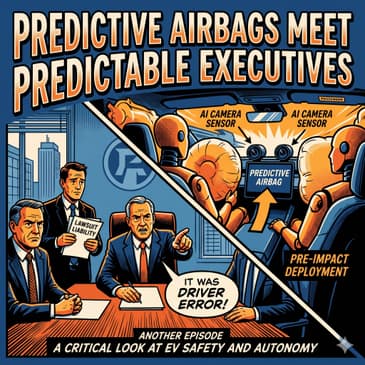
In this episode of Kilowatt, we dive into the latest developments shaking up the electric vehicle market, starting with Tesla's surprising decision to open Model S Signature Edition orders in Europe. We also examine the regulatory landscape as the NHTSA updates rules allowing the upcoming Tesla Cybercab to ditch brake pedals entirely, alongside new details on its strict weight limits and recent sightings in New Zealand. Safety and legal battles take center stage as we break down Tesla's recent settlement over a fatal Full Self-Driving crash in Texas and look at a groundbreaking feature that uses vehicle cameras to deploy airbags before an impact even occurs.
Support the Show:
- https://www.supportkilowatt.com/
Other Podcasts:
- Beyond the Post YouTube (https://www.youtube.com/@beyondthepostfm)
- Beyond the Post Podcast (https://www.beyondthepost.fm/)
- Shuffle Playlist (https://shows.acast.com/shuffle-playlist)
- 918Digital Website (https://www.918digital.com/)
News Links:
- Not a Tesla App: Tesla Opens Surprise Model S Signature Edition Orders in Europe
- Electrek: Tesla settles lawsuit over fatal ‘Full Self-Driving’ pedestrian crash
- Ars Technica Cars: Elon Musk denies Tesla’s Autopilot caused crash that killed grandmother
- Teslarati: Tesla and driver sued by family of woman killed in Texas crash: what we know
- Electrek: Tesla sued over fatal crash in Texas home that killed 76-year-old woman
- Teslarati: Tesla pushes back against unfair reporting of accidents
- The Verge: Tesla claims driver ‘manually overrode self-driving’ in deadly Texas crash
- Electrek: Tesla admits FSD was on in fatal Texas crash, blames driver for ‘overriding’ it
- Teslarati: Tesla finally clarifies fatal Texas crash, confirms driver manually overrode acceleration
- Electrek: NHTSA probes fatal Tesla crash into Texas home that killed woman
- CleanTechnica: Tesla On Autopilot Crashes Into Texas House, Killing One
- Not a Tesla App: Tesla Crashes Into Texas Home, Driver Blames Autopilot
- Ars Technica Cars: NHTSA investigating alleged Tesla Autopilot crash that killed woman in her home
- Not a Tesla App: Tesla Cybercab Won't Need Brake Pedals Under New NHTSA Rules
- Not a Tesla App: Tesla Cybercab Has a Max Weight Limit of 617 Lbs
- InsideEVs: Teslas Will Now Deploy Their Airbags Before Crashes Happen Thanks To Cameras
- Not a Tesla App: Tesla Cybercab Spotted in New Zealand for First Time
Hosted by Simplecast, an AdsWizz company. See pcm.adswizz.com for information about our collection and use of personal data for advertising.
[00:00:20] Hello everyone and welcome to Kilowatt, a podcast about electric vehicles, renewable energy, autonomous driving, and much, much more. My name is Bodhi and I am your host. And today we're going to do something a little bit different. I am going to split the show up into two different shows. Today's episode is going to be a little bit longer. So what I thought I would do is do a little experiment.
[00:00:49] I will do the EV segment as one episode and I will do the Tesla segment as one episode. Now this isn't necessarily going to happen all the time. I'm just trying it out to see how people like it. So in general, you know, if the show is 30 minutes or less, I don't feel a huge need to like split this stuff out. Or maybe the show is 40 minutes, but only three of those minutes are going to be a little bit longer.
[00:01:19] If the EV segment or the EV segment or the Tesla segment, I don't really feel the need to split that out. But if it's pretty even and they're both long, both segments are long, then I was thinking that it might be better to split it out. So I'm looking forward to hearing your thoughts on this and we'll see what everybody thinks.
[00:01:45] If you'd rather just have one long episode, it's actually less work for me. But all in all, I do get that when you typically listen to a podcast, it's under 30 minutes and all of a sudden it's over an hour, which I don't think today's will be over an hour. But even when you combine the two segments, it can feel intimidating and maybe you don't want to listen because you don't feel like you have the time or whatever.
[00:02:11] So by breaking it up, I'm trying to help kind of make it easier for people to listen when they have the time. All right. Having said all of that, let's get into our Tesla news. A neat little safety feature that are coming to Tesla's or it's already here is Tesla's will deploy airbags right before a crash happens.
[00:02:33] So just if you've ever experienced like phantom breaking or the windshield wipers turning on and off when it's not even raining, this might cause you some pause. And I would completely understand why. But this will only be for crashes that are absolutely going to happen. There's no way to get around it, right?
[00:02:59] They won't. This won't be like near misses or hopefully won't be near misses. So what happens is the cameras will spot an oncoming crash and a fraction of a second before the impact. It will give the car time to figure out like the type and severity of the impact. It will pre tighten or pre tension the seatbelt.
[00:03:25] And then it will allow the airbag to be deployed 70 milliseconds faster so that they're inflated and ready to receive impact as soon as your body moves forward. So this is great news. There is a little safety catch to this, which is also good news. The cameras cannot deploy the airbags on their own.
[00:03:49] So if you are, let's say, about to get into a crash and you're able to stop in time, but the cameras think, well, you're still going to have this accident is still going to occur. The airbags aren't supposed to deploy. It won't they won't deploy until the actual physical impact sensors that are on the car.
[00:04:14] However, they those still make the final decision or whether or not to inflate the airbags or not. So unless those sensors are activated, those impact sensors are activated, it will not deploy or it's not supposed to deploy the the airbags. So to prevent accidental deployments. So fingers crossed, we'll see how it goes. I'm sure it'll be fine.
[00:04:41] You know, I've got a couple of things for cyber cab just in terms of updates. So I just kind of wanted to go through those. One is the other day I mentioned that I had seen a cyber cab. Ben, who lives in and around Kansas City, saw one on the freeway as well. And Joe saw a few in Pittsburgh.
[00:05:03] And there are two cyber cabs were spotted on a transport vehicle in New Zealand, in New Zealand's capital, Wellington. So, I mean, crazy. I guess the nice thing about the cyber cab, once it's all done, you know, once they've figured out autonomy, Tesla, which will probably be by the end of this year if you listen to Elon.
[00:05:25] But once they've figured out autonomy and the cyber cabs don't need to have steering wheels or pedals anymore, really doesn't matter where you build them. Whether you live in a right hand or a left hand drive country, you could just get in a cyber cab. Doesn't really matter. So I thought that was interesting. Cyber cabs, a lot more. Like when I go to my Facebook, because I'm a member of a couple of Tesla groups, a lot of people are spotting the cyber cabs on the freeways.
[00:05:54] So that's super cool. We all know that the cyber cab has two seats. We now know that the maximum weight limit of the cyber cab is 617 pounds or 280 kilograms. Not a Tesla app, which is a great site to go to. Anyway, they figured this out by subtracting the vehicle curb weight, which is, you know, the battery, the motor, the frame, the skin on the car, all that stuff.
[00:06:22] When compared to the gross vehicle weight rating, which is the maximum weight that the vehicle can weigh with passengers and cargo. And they got a max weight limit of 617 pounds. Again, that two people, 617 pounds, probably not going to go over that, but two people and some cargo could potentially go over that.
[00:06:45] I wonder if Tesla will stop you from traveling if you overweighted, you know, put too much weight in the car. I doubt it. And then let's see. I think this is the last cyber cab update. The National Highway Traffic Safety Administration, or NHTSA, has updated its safety standards to remove the requirement for manual brake pedals in vehicles driven by automated driving systems.
[00:07:14] So this is not to say this is specifically for cyber cab. This is for any robo taxi that has autonomous driving systems. What this will do is will allow autonomous vehicle developers to design cabins without the traditional human controls while still enforcing, in this case, the strict stopping distances that you have to have. And they have a test for that.
[00:07:41] The updated framework provides a direct path of deployment for robotaxis, custom robotaxis, which would benefit companies obviously like Tesla, but also Uber and, you know, Lucid and Zoox and things like that. I do think if you're going to have a car that is designed like the Waymos, for instance, that is designed so that there's not a person in the front seat driving.
[00:08:08] I do think that it's probably unnecessary to have the vehicle controls in the car. However, here's the here's the change. If for some reason that car is not able to function as a robo taxi, the only way to get it back. To some places by by towing it or putting it on a flatbed and moving it to the place that you need to. And maybe that's fine for these robo taxi companies.
[00:08:35] I don't know that that would be great for people who own their own car. Right. If you say years down the down the road and you were able to buy something that was. Actually level four, level five autonomy. You would probably want to be able to if for some reason there was some sort of outage or some sort of issue with the car.
[00:09:00] You would you would want to have some sort of backup to be able to get back to where you want to be to either your home or your hotel or whatever happens to be. Without paying some big tow bill to unnecessarily have your car driven somewhere because it temporarily had a hiccup. But for companies like Waymo or Zooks or Tesla, you know, having the car towed is not going to be a big price inconvenience for them. So not a big deal.
[00:09:28] So in one way, I agree. In another way, I disagree. And that's all I'll say about that. Oh, before we go to our next story, there was something that I wanted to talk about. And this story made a lot of headlines and I don't put too much into it.
[00:09:46] But apparently people were using like heads of dolls as a way to fool Tesla's full self-driving system to drive on its own without somebody in the passenger seat or in the driver's seat. And while I do think that that is a concern, I think it's kind of an edge case just in general. Also, you know, there are a ton of different ways to get around safety features.
[00:10:14] It's what Tesla does with this to fix it that really I care about. So if they do nothing, then that's a problem. However, if somebody just found a way, a cool, interesting way of fooling the system, I don't I don't I don't that doesn't kind of bother me too much. Like, I'm not going to get too upset about it. Like people are very clever. It's when Tesla doesn't or any company, for that matter, doesn't do anything to fix that problem. Then that becomes an issue.
[00:10:43] But if somebody figures it out in a unique way, I never would have thought about doing it. One, I commend them. Good job. Very clever. And two, it just, you know, allows these companies like Tesla to see that there's a hole in their system. And how do they fix it? And how do they prevent similar hacks from happening? But I don't know.
[00:11:07] In general, I think these kind of things are good in terms of exposing flaws or the holes in the system. But I'm not going to get all frustrated about it. I think in general, you know, if Tesla does nothing, then it's a problem. If they fix it and then they add a couple of other fixes in addition to that. Great. But I still think it's kind of an edge case. Moving on to our next story.
[00:11:36] So Model S and Model X are no longer in production. Right before they stopped production, Tesla offered the final few Model S and Model Xs as a signature edition. This was initially just sold in North America. And it might have just been sold here in the United States, but we'll just say North America for good measure.
[00:11:57] So the last 100 of the Model Xs and the last 250 of the Model Ss were set aside for this signature edition. They are plaid versions. They come with the garnet red paint, carbon ceramic brakes with gold calipers, gold seat badging, gold piping. They're numbered, you know, between one in 100 or one in 250, depending on where you're at.
[00:12:24] And then they have a bunch of other upgrades as well. Well, we were told initially that those vehicles were completely sold out. And it sounds like Tesla has been recently reaching out to European customers, offering them Model S signature editions. And according to the article from Not a Tesla App, again, great, great site, by the way. You should everybody should go read them.
[00:12:52] Around 20 units are headed to Europe to be sold. And the question that I have, was Tesla telling the truth when they said, hey, we're all sold out? Or did they hold a few back? And that was always going to be the plan to hold on to a few and then sell those to their most hardened fans in Europe who may have wanted to own one of these as well. Either of these cases, well, I shouldn't say either of these cases. I guess it's the same.
[00:13:22] It could be that they were not telling the truth. Or it could be that they were telling the truth and then people canceled their reservation. Or it could be that they had planned all along to hold a few back and send them over to Europe. Doesn't really matter.
[00:13:37] If you're a diehard Tesla fan in Europe and you got one of these emails, because it's not going out to everybody, it's going out to a select few customers, you have an opportunity to own a Model S signature edition, which, you know, is not a cheap vehicle. So in the U.S., they were selling for right under $160,000. We don't have a price for what these Model Ss are going to cost in Europe.
[00:14:03] I would imagine that it's probably somewhere close to whatever the equivalent of $160,000 is U.S. to Euros. It might be a little bit more because you have to ship them over and that kind of thing. And there's probably some added fees. I don't know where we're at in the world of tariffs, but there's probably some added fees that go along with that as well. So it could be slightly more than whatever the equivalent of $160,000 is to Euros. But I would imagine it's more.
[00:14:34] Okie doke. Before we jump into our final two stories, I just want to say real quick, if you want to support the show, you can go to supportkilowatt.com. You can sign up for Patreon or what's the other one? Supercast and support the show. That way, I only ask for a dollar a month. It's really economical. You get rid of all the ads if that's something you're interested in. So yeah, supportkilowatt.com and you're supporting this show. All the money goes back into the show.
[00:15:02] All right, let's start off. In November of 2023, a 71-year-old grandmother was helping direct traffic around an accident that occurred between Phoenix and Flagstaff. And I drive this road not often, but several times a year. And it is mostly a straight road. Not a big deal. But, you know, there's no trees out there.
[00:15:31] Unless you get one, except for when you're close to Flagstaff, then you get trees. But it is like, if the sun's in the right place, the sun is directly in your eyes, depending on the time of day when you're driving. So what had happened was, while she was directing traffic, she was hit by a Model Y that had FSD activated and was driving at highway speeds. And in that section, it's not uncommon to be driving about 75 miles an hour.
[00:15:56] So the National Highway Transportation Safety Administration opened up a preliminary investigation into not only this accident, but similar accidents. And the preliminary investigation or the probe was then upgraded to an engineering analysis, which is typically a step before there's a forced recall. And I'm just going to read what the preliminary findings showed.
[00:16:23] And then we'll kind of talk about the rest of this here in just a second. According to the National Highway Traffic Safety Administration, the Tesla system did not detect common roadway conditions that impaired camera visibility until immediately before impact, giving drivers little time to react. The scope has since grown to nine incidents with one fatality and one injury.
[00:16:50] By Tesla's own analysis, its updated software fix may have affected. So camera only approach, right? If you are just like in real life, like Elon says that you have two eyes as inputs, right? And you're taking in all this data. If you're blinded by the sun, it does stand to reason that the camera, if this is the way that Tesla is in fact designing their camera systems,
[00:17:19] that the camera is going to cause a problem with the... The sun's going to cause a problem with the camera. And unfortunately, a woman lost her life. The family of the deceased woman sued Tesla, and Tesla has quietly settled with them for an undisclosed amount of money. Now, last week, a Model 3 crashed into a Texas home at very high speed, and it killed the 76-year-old grandmother.
[00:17:49] Again, this is very unfortunate. The driver of the vehicle said that the automated driver assist feature didn't specifically call out autopilot or full self-driving. So I don't know which one was activated at the time. So unless I'm directly quoting somebody, I'm not going to specifically say who, what system was being run, because I don't know.
[00:18:17] But anyway, so the driver of the vehicle said that the automated driver assist feature was active when the car lost control. So this was last week, not long after the accident occurred. Elon said on X that Tesla's tech did not cause the crash. This is what he had to say. Full self-driving, drive slowly through neighborhood streets, and this was a high-speed crash! Which doesn't necessarily...
[00:18:47] I mean, Tesla has the records. You know, all the cars phone home. So Tesla can see whether he pushed the accelerator or not. Which brings me to Ashok Alaswamy, who's the head of, I think, autonomous driving or full self-driving at Tesla. He had this to say.
[00:19:07] In this case, the driver manually overrode self-driving by pressing the accelerator all the way to 100% of the accelerator pedal in this residential area. And he went on to add that the car reached speeds of 73 miles per hour during the crash, and the accelerator was pressed even after the crash.
[00:19:34] So the driver, according to Tesla and Tesla's representatives, the driver is in full self-driving mode and then just gunned it. I'm not going to say that that's true or untrue because I don't know, but that seems like an odd thing to do, but people do odd things. So while I wouldn't do that myself, especially, you know,
[00:20:02] if you were to press on the accelerator, crash into a house, and then continue to hold down the accelerator after you've been in the crash, that just seems weird. Not to say that it's not true or anything like that, but for me, that is weird. I have been on calls where someone had a medical event, like a seizure, and they crashed into a house. And this is a specific case, actually. Somebody had a medical event, they crashed into a house,
[00:20:32] and when we got there, their foot was still on the accelerator, and the tires were spinning, and like there was just smoke, and you could just hear the screeching. And we ended up, you know, going in and pulling the person's foot off, but it was very, very sketchy, to be honest with you, because it wasn't going to go forward, but the tires are still going. So if something broke loose, and maybe the car changed direction, we could be drug underneath or with the car.
[00:21:02] Anyway, it was just a crazy time. Um, and then we treated the patient, and moved on with our day. But, uh, so it's not impossible. It's just, that's not a thing that I've seen often in my career. Not never, just it's not super common, especially if the driver is completely with it. Um, typically, in those situations, uh, you know, they're going to let off on the,
[00:21:31] on the accelerator pedal. So, anyway, the, the driver, or the family in this situation, that were of the, uh, 76 year old grandmother, they are now suing Tesla, and the driver of the vehicle. Uh, the family has two theories, as to why this occurred. One of the theories is sudden, sudden unintended acceleration, which is something we heard about, uh, quite a bit in the, you know, late 2000 teens,
[00:22:01] to early 2020s, kind of thing. We haven't, I haven't really seen, too much of this, but sudden unintended acceleration is, occurs when components of the vehicle require additional power. And the draw of the battery causes significant spikes in the system. according to the lawsuit, these voltage surges from the battery can be dangerous, causing the inverter to incorrectly interpret that an accelerator pedal has been pressed. And pressing the car, uh,
[00:22:31] causing, excuse me, and causing the car to rapidly accelerate to an extreme, extremely dangerous speed. That's according to the lawsuit. The second claim is that, the second claim is that when Tesla was building this particular Model 3, there was a global chip, chip shortage, and they did not include the necessary, uh, chips, or the, uh, the critical obstacle detection hardware that Tesla,
[00:23:01] that the car would need it to be operate on full self-driving correctly, or safely. The National Highway Traffic Safety Administration has opened up an investigation when it comes to this incident. And, you know, ultimately somebody died. So, what I kind of find, uh, what I find distasteful is Tesla coming out immediately and saying, this isn't our fault, this is the fault of the driver.
[00:23:31] And, maybe it is. Listen, I'm not saying it's not. It could very well be the fault of the driver. I'm, I genuinely have been a firefighter for long enough to see people do all sorts of foolish things that would just shock you. Like, genuinely, you just, you're thinking to yourself, what made you think that this was a good idea? And it happens more often than you think. Uh, and these are not dumb people, by the way. These are people who,
[00:23:59] whether they were tired or stressed or whatever, made a temporary, really dumb decision. So, I am not saying that this can't be the driver's fault. I'm also saying it's not, you know, can't be Tesla's fault. Because, it absolutely could be. Uh, but what I don't like is, Tesla, if you want to make a statement, say, hey, we're really sorry to hear that somebody passed away. We're going to be cooperating with investigators, and we're going to get to the bottom of this.
[00:24:29] And then at some point, release a report after the investigation is done. But before the investigation, I mean, the best, the investigation, this happened last week. The investigation has barely started. So by kind of putting this out here, uh, putting out a statement so early that no, it's the driver's fault. This wasn't on us. I don't like that. Uh, it, it does not. Um, it, it's, it seems callous and gross.
[00:24:59] So the driver or somebody in the car could have been there, uh, injured or, or deceased. I'm not saying in this case they were, cause they weren't, but it's just, there's so many different, um, outcomes that could happen before making a statement like this. One, have a little bit of compassion. And two, uh, just wait for the, the report to come out. And then you can tell your side of the story. You're a multi-billion dollar company, a trillion dollar company.
[00:25:27] You can weather a little bit of criticism. You're already doing it. There's already constant criticism about Tesla. So anyway, that is, um, that is my thought on that. But an unfortunate to, you know, I don't know. I, I've, in my career, I have been on lots of things that like this, that have happened, whether it's, you know, unintentional or intentional. Um,
[00:25:58] I, man, I'm so tempted. I can't, I, there's some things that I probably shouldn't say. So I'm just going to keep my mouth shut. Hmm. Okay. So I'm not going to say anything else. Uh, it's just, they're just wait till the, for the investigation to be done. Um, speak with some compassion and, you know, there, it is entirely possible that Tesla did have a statement before this that said, you know, we're sorry that somebody lost their life and all this other stuff.
[00:26:28] Very possible. But I don't know by, by calling out the driver so early on, maybe we do the investigation first. Maybe we get the report and then you can have, you know, say what you wanted to say in a compassionate and kind way. Cause this, this just sucks. So anyway. All right. Well, everybody, that is it for me on this particular episode. What'd you think?
[00:26:53] Did you like the Tesla and EV episode on the same day? Um, especially when they're longer again, if I only have a 20 minute episode, it doesn't make sense to do this kind of thing. But did you, was this something that was interesting to you or no? Um, did it make it easier to listen to this show? I'm, I'm really interested. So send me your email and your feedback. Bodie B O D I E at nine one eight digital.com.
[00:27:19] And then what's the other thing you can follow me on LinkedIn at nine one eight digital. And then you can also follow me on, uh, X. I'm not very active on X for not any other reason other than it's just not been a place that I find fun anymore, but I still go there and I, I look at what other people are saying. So, but I just don't personally post on X and I never really did all that much anyway. So I guess it's not even that big of a deal,
[00:27:49] but you can follow me at nine one eight digital there as well. All right, everybody. Thank you so much. And I will talk to you soon.