Description:
In this episode, We examine Stellantis' Third Quarter 2024 earnings call, focusing on key insights regarding CEO Carlos Tavares' scrutiny and the company's North American market challenges. Newly appointed CFO Doug Osterman addresses strategic questions about integrating Leap Motors and reflects on the successful launches of the Citroën C3 and EC3, as well as the upcoming Dodge Charger Daytona and Wagoneer S. We discuss Stellantis' proactive approach to adapting to evolving emissions regulations. The episode also touches on the implications of the U.S.-Mexico-Canada trade agreement, highlighting the company's flexibility in navigating market uncertainties.
Support the Show:
Other Podcasts:
News:
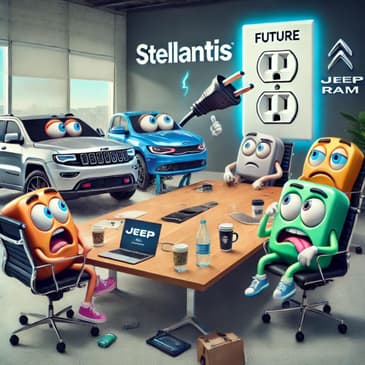
*ART PROVIDED BY DALL-e
Support this show http://supporter.acast.com/kilowatt.
Hosted on Acast. See acast.com/privacy for more information.
Hosted by Simplecast, an AdsWizz company. See pcm.adswizz.com for information about our collection and use of personal data for advertising.
[00:00:00] Ladies and Gentlemen, welcome to the Stellantis 3rd Quarter 2024 Shipments and Revenues Call.
[00:00:08] Before we begin, I want to point out that any forward-looking statements we might make during today's call are subject to the risks and uncertainties mentioned in the safe harbor statement included on page 2 of today's presentation.
[00:00:21] As customary, the call will be governed by that language.
[00:00:24] I will now hand you over to your host.
[00:00:27] Hello everyone and welcome to Kilowatt, a podcast about electric vehicles, renewable energy, autonomous driving and much, much more.
[00:00:51] My name is Bodhi and I am your host and on today's episode we are going to cover Stellantis' Q3 2024 Earnings Call.
[00:01:01] Now a couple things that we need to get into before we talk about this earnings call.
[00:01:07] The first thing is we need to thank some patrons.
[00:01:11] So let's start with Dale, Don F, Don M, Electron Raceway Fabricator, Fallen N.C., FriendlySleet66, Gene Howard, Isaiah, Jamie, James, Jerbo, John, Joseph and just another Nick.
[00:01:34] Thank you to all of the folks that I just mentioned and thank you to everyone who supports this show.
[00:01:40] If you would like to support the show, go to patreon.com forward slash kilowatt or support kilowatt.com.
[00:01:45] And for as little as a dollar you can sign up and make the ads go away.
[00:01:51] Probably going to have to raise the prices because Apple is now charging 30% on top of whatever Patreon charges when you sign up at the dollar level and you use an Apple device to do that, which is really convenient.
[00:02:07] And I do that a lot with the subscriptions that I have.
[00:02:10] However, if you are offering something at a dollar and Apple's taking 30% and Patreon's taking, I don't know, it's like somewhere around 20%, doesn't leave a lot left over for the creator at a dollar.
[00:02:23] So that might be going away.
[00:02:26] I have to go through Patreon and do a bunch of stuff that's not important for this show, but we'll see.
[00:02:31] What I'm trying to say is if you sign up for a dollar, I'm not kicking anybody off.
[00:02:36] Now is your chance.
[00:02:37] Let's move on to our earnings call.
[00:02:40] A few things you should know.
[00:02:43] Carlos Tavares is the CEO of Stellantis.
[00:02:47] Stellantis is a large automotive group that has, you know, Citron and Alfa Romeo, Chrysler, Fiat, Jeep, Maserati, Opel, Peugeot, you know, Ram trucks, Dodge, that kind of thing.
[00:03:02] There's just, there's a lot of companies that are under the Stellantis automotive group.
[00:03:08] Recently, the CEO, Carlos Tavares, has come under some scrutiny.
[00:03:16] Dealers are accusing Stellantis and Carlos of ignoring the American automakers.
[00:03:21] And I should say North American dealers are accusing Stellantis of ignoring the North American auto dealers like Jeep, Dodge, Chrysler, and Ram.
[00:03:31] They are saying that the company is making short-term decisions to make money now, but it's not good for the overall company.
[00:03:41] And in turn, it's not good for the dealers in the long run.
[00:03:44] So these are very short-sighted decisions.
[00:03:47] As a coincidence to this, the union also agrees with the dealer's assessment for different reasons.
[00:03:59] Right now, Stellantis isn't selling cars as quickly as maybe they could.
[00:04:07] North American customers either can't afford Stellantis' vehicles or they're unwilling to pay a premium price.
[00:04:17] So, yeah, a little bit of pressure for old Carlos.
[00:04:22] Usually, the CEO runs the earnings call.
[00:04:25] But for whatever reason, the CEO on this earnings call was absent.
[00:04:30] So newly appointed chief financial officer, Doug Osterman, was the one who ran the earnings call.
[00:04:39] And I think he did a good job on this.
[00:04:42] He's brand new to the position.
[00:04:44] They just kind of threw him right into the fire.
[00:04:46] And I think he handled it pretty well.
[00:04:48] Now, Carlos Tavares is set to retire in 2026.
[00:04:52] So it'll be interesting if they are grooving Mr. Osterman to take his place.
[00:04:58] But I thought he did well.
[00:05:00] And there were some hard questions asked.
[00:05:03] So let's go ahead.
[00:05:04] We're not going to do any of the opening remarks because there's nothing of note in there.
[00:05:08] And actually, I can't remember.
[00:05:10] This first clip might have been in the opening remarks, so I might be lying to you.
[00:05:13] But we're going to talk about Leap Motors, which is a joint venture led by Stellantis and a Chinese automaker, Leap Motors.
[00:05:23] Stellantis actually owns 51% of the company.
[00:05:26] So let's go ahead and listen to this clip.
[00:05:30] And then we'll come back on the other side.
[00:05:31] Let's turn to something that I'm especially passionate about because of my prior role developing our strategy in China, the Leap Motors International Partnership.
[00:05:42] We've launched this partnership on time with the initial European launch commencing in late September through a scale distribution network that already features over 200 European dealers.
[00:05:54] And with plans for sales in IAP and the Middle East set to begin in Q4 and South America in 2025.
[00:06:03] What I think is important to note right now is that we're going to continue to move quickly because we think the market is very receptive.
[00:06:10] To the high-tech, affordable, and efficient Leap Motors products.
[00:06:15] The latest example of that would be the announcement that we made at the Paris Auto Show in October that we're going to increase the nameplates offered in Europe from the initially launched TO3 and C10 BEVs to include a range extender C10 variant, the BEV B10 by the end of 2025, and three more models by the end of 2027, giving us a very complete range of Leap Motors products in the region.
[00:06:38] We're also evaluating possibilities to utilize the European assembly capabilities of Stellantis to localize more quickly than competitors.
[00:06:47] Long-term, we retain an unchanged view on the potential for over 500,000 annual sales globally through the Leap Motors International JV by 2030.
[00:06:58] Okay.
[00:06:59] I should say that there is a joint venture.
[00:07:02] I need to correct some things.
[00:07:03] There's a joint venture between Leap Motors and Stellantis.
[00:07:08] When I spoke earlier and I said that Stellantis owns 51% of Leap Motors, not true.
[00:07:12] They own 51% of that joint venture.
[00:07:16] So I misspoke there.
[00:07:17] But Stellantis is acquiring or has already acquired 21% of Leap Motors in a deal worth more than $1.6 billion.
[00:07:28] All right.
[00:07:29] Now that we got that out of the way, initially, the joint venture will have Stellantis building these vehicles in Poland at a Stellantis plant in Poland.
[00:07:41] And the first units of the T03, which is a small, smart car-like, compact, European-style battery electric vehicle,
[00:07:51] they started rolling off the assembly line in 2024, and mass production was supposed to start in September.
[00:07:57] So they should be delivering those vehicles either now or very, very soon.
[00:08:01] Doug talked about the T03 and the C10, but there's actually another model that is set to come out, I think, in the first quarter of 2025, and that's the A12.
[00:08:15] Also planned for production at this Polish plant.
[00:08:19] And the A12 should be an SUV.
[00:08:21] I would imagine a larger SUV, but I don't know that for a fact.
[00:08:25] I'm just going to say the T03, small, compact car.
[00:08:30] The C10 is, based on pictures anyway, it gives off, in terms of styling, Neo BYD vibes.
[00:08:39] It's a good-looking vehicle, but it looks to be a smaller SUV, maybe like a Ford Escape style or sized SUV.
[00:08:50] Anyway, this is all really good for Leap Motors and Stellantis because the European Commission, not that long ago,
[00:08:59] announced that there's going to be extra duties or tariffs on imported Chinese EVs.
[00:09:04] That started in July.
[00:09:06] And that was an additional 21% cost for the vehicles, which is significant.
[00:09:13] So Leap Motors, partnering with Stellantis, offers this huge dealer network, but it also gives them access to manufacturing plants,
[00:09:24] which should hopefully, and I don't know all the rules on this, avoid tariffs.
[00:09:30] All right.
[00:09:31] That is a very quick, down-and-dirty, not super detailed synopsis of the Leap Motors and Stellantis partnership.
[00:09:39] Let's go ahead and move into our second clip, which is about new and notable vehicles.
[00:09:47] Okay.
[00:09:48] Now let's turn on the next page to a few quick highlights on some of the notable new products we've launched recently.
[00:09:56] First is the Citroen C3 and EC3.
[00:10:01] These Citroen vehicles are incredibly exciting because they show how Stellantis can leverage significant advantages from the global nature of our business.
[00:10:12] In this case, leveraging a very innovative vehicle originally conceived for our third-engine markets,
[00:10:18] but adapted in rapid fashion for the needs of the European customer.
[00:10:22] They deliver to customers a new level of capability and appeal at extraordinarily affordable price points.
[00:10:29] The C3 and EC3 began shipping in late September with a very healthy initial order book of over 50,000 units.
[00:10:37] We're especially excited by the roughly 50% bed mix that customers are asking for,
[00:10:43] and the fact that a lot of the customers are choosing the higher trim versions.
[00:10:47] The core value proposition of the C3 and EC3 will be shared with the soon-to-be-launched C3 Aircross,
[00:10:55] Opel Frontera, Fiat Grande Panda, all built on the smart car platform.
[00:11:03] The best variants of all four, with their unique combination of European design and build,
[00:11:07] at new levels of affordability, represent a powerful tool in our plans to meet the more stringent European emission requirements in 2025 and beyond.
[00:11:19] On the next page, let's look at the Peugeot 3008 and E3008.
[00:11:27] These C-segment vehicles are not only an upgrade,
[00:11:31] they're a very important, profitable, and scalable franchise, together with the 5008.
[00:11:37] And they're also the first products launched on the new Stella Medium platform,
[00:11:42] engineered bed-first, but with comprehensive multi-energy flexibility.
[00:11:47] The E3008 crossover, in particular, sets a new EV performance standard,
[00:11:53] with up to 700 kilometers of range, leading its segment, and does so with outstanding efficiency.
[00:12:02] The Q2 launch has been very successful, with not only strong order volumes,
[00:12:06] but with 60% choosing the high-end trims, and a 25% BEV powertrain mix.
[00:12:13] This bodes especially well, considering its core capabilities are shared,
[00:12:17] not only with the 5008 and E5008 models, but also Oboe Grandland,
[00:12:23] and, just announced, the Citroën C5 Aircross.
[00:12:28] Notice that he didn't reference any North American-made automobile in that clip.
[00:12:36] And that was the clip in the entirety.
[00:12:39] You know, he answered the question in its entirety,
[00:12:42] and there was no mention of North American vehicles,
[00:12:45] whether EVs or ICE-powered vehicles.
[00:12:49] Only European car companies.
[00:12:51] So that is interesting.
[00:12:54] It does sound like, you know, 50% of the models that offer an ICE version and an EV version,
[00:13:00] 50% of those are right around that number,
[00:13:02] are the EV versions, the battery electric vehicle versions.
[00:13:06] So that's good there.
[00:13:07] Our next clip is a question from an analyst,
[00:13:12] and the basic question is,
[00:13:14] what products are you excited about that are coming out in North America?
[00:13:18] And then, I think your second question was on some of the core launches in North America.
[00:13:25] You know, I'm certainly very excited about the Dodge Charger Daytona.
[00:13:31] That is a product that, from my perspective as a car guy, is just amazing.
[00:13:36] I mean, I love that product.
[00:13:38] And the sooner we can get it out, the better.
[00:13:41] We are, you know, building batches of those right now.
[00:13:46] And like I said, everybody in the company is very excited about it.
[00:13:51] Wagoneer S, same process.
[00:13:54] We're kind of in the early launch period.
[00:13:57] And look, you know, the key is,
[00:14:01] these new products offer a ton of technology.
[00:14:08] And, you know, in terms of hardware and in terms of software.
[00:14:13] And so, it really requires an additional level of attention from our entire team
[00:14:20] to make sure that the quality is absolutely flawless when we launch these vehicles.
[00:14:27] Because these early adopters who come in,
[00:14:29] remember, these are our first BEV products in North America.
[00:14:32] And the adopters who come in from our brands and get into these initial vehicles.
[00:14:39] We want their experience to be fantastic.
[00:14:42] And we want the word of mouth to spread like wildfire,
[00:14:45] that these are fantastic products.
[00:14:47] And so, you know, we're really focused on making sure that these products are right.
[00:14:53] And I think the quality is paramount and needs to take precedence over the exact timing.
[00:15:01] I think that's the right decision for the business.
[00:15:03] It's the right decision for our brands long-term.
[00:15:06] Of course, it has financial implications too, right?
[00:15:08] Because we don't want to see big warranty expenses on these vehicles and that sort of thing as well.
[00:15:11] So, it's financially beneficial as well.
[00:15:14] But, you know, we need to make sure that these brands are preserved and that our customers just have a fantastic experience.
[00:15:22] Let's talk about that last bit before we move on to the rest of that clip.
[00:15:26] And really, I don't have a lot to say on this clip anyway.
[00:15:29] He said that quality needs to take priority over timing.
[00:15:33] Like, they don't want to have a bunch of warranty issues because that costs them money.
[00:15:36] And, you know, isn't great for their brand reputation and the customers may not be super happy about it.
[00:15:43] So, I can understand that.
[00:15:45] But what I read that as when he said it is quality needs to take priority over timing or precedent over timing.
[00:15:52] I read that as, hey, don't expect these battery electric vehicles to come out anytime soon.
[00:15:59] Like, the Daytona is a really cool sports car, but it's also an EV.
[00:16:03] And there's a lot of technology going into this.
[00:16:05] And I read that those products that he talked about are going to be delayed.
[00:16:11] Now, in terms of the rest of the clip, obviously, you know, there's not a large presence of EVs from Stellantis' North American brands.
[00:16:23] We need more EVs from Stellantis and their company.
[00:16:28] And this is coming from a completely selfish point of view on my side because we're going to buy my wife a new car soon.
[00:16:41] Her car has a ton of miles on it.
[00:16:44] It's not that old, but we drive it everywhere.
[00:16:47] And it's a great car.
[00:16:48] It's a minivan.
[00:16:48] It's Chrysler Pacifica.
[00:16:49] We've had very little problems with it the entire time we've owned it.
[00:16:53] And my wife wants a minivan.
[00:16:57] She doesn't want an SUV.
[00:16:59] She wants a minivan.
[00:16:59] They're very easy to get into.
[00:17:01] They haul kids around.
[00:17:02] I've got two 12-year-olds with friends.
[00:17:05] So we can...
[00:17:05] And then on top of that, we also have family members that travel on vacation with us and all that other stuff.
[00:17:10] And it allows us to put a ton of things in the back of this vehicle.
[00:17:15] So when we travel, we've got everything that we need, right?
[00:17:21] Right now, there's no minivan in the United States that is fully electric, save the ID Buzz, which is too expensive for what you get.
[00:17:32] Honestly, it's too expensive, just period.
[00:17:34] So that's not an option for us.
[00:17:37] So I need Chrysler to come out with a Pacifica minivan.
[00:17:42] And this is just my plea.
[00:17:43] So if somebody from Chrysler is listening to this, pretty please.
[00:17:47] All right, let's move on to our next clip, which is about North American and European EVs.
[00:17:56] The next question comes from a line of Patrick Harmon from UBS.
[00:18:01] Please go ahead.
[00:18:02] Yeah, thank you.
[00:18:03] Hi, Doug.
[00:18:05] First question on the U.S. business.
[00:18:08] Your launch pipeline for the next few quarters is quite EV heavy.
[00:18:13] And I'm just wondering what that's going to do to the mix from an AOI standpoint.
[00:18:21] Where would you see yourself relative to GM and Ford in terms of EV profitability?
[00:18:26] You obviously have a very different approach with the multi-energy platforms.
[00:18:30] And I'm hopeful that profitability would be better for that reason.
[00:18:35] But if you can just give a little bit of context, how you see the U.S. mix evolving from an AOI standpoint with these EV launches kicking in over the next few quarters.
[00:18:47] And my second question as far as enlarged Europe is concerned.
[00:18:52] And despite the delays now, is Q4 already more or less a normal quarter in Europe, in your view, in terms of the run rate?
[00:19:04] Or is there still a bit of lag here to be expected that gives us some more momentum in 2025?
[00:19:13] And how in Europe do you think about this complex of CO2 compliance and EV?
[00:19:18] I'm wondering because there were some comments out of Stellantis.
[00:19:21] You would push for more EVs production schedule from November onwards accordingly.
[00:19:25] My impression was that Stellantis is doing relatively well compared to competition.
[00:19:32] So why are you pushing EVs aggressively?
[00:19:35] And are you actually aiming at monetizing a long position in the European CO2 market here?
[00:19:41] Or what's the strategy behind?
[00:19:43] Thank you.
[00:19:45] Okay.
[00:19:46] Well, thanks for all the questions.
[00:19:48] Let me see if I can cover all those.
[00:19:51] Look, when we look at North America in our EV mix and EV profitability, it's a little bit tough to predict this time.
[00:20:03] We're just kind of in the very early stages of the start of production of our first EVs.
[00:20:10] But I can tell you that we've been pretty open about the fact that we are profitable on our EV products in Europe.
[00:20:18] And that we are driving with a clear objective to hit profitability parity over time between our BEV products and our ICE products.
[00:20:32] Now, that's a very challenging goal, but we've been making steady progress on it.
[00:20:36] And it's probably going to take a few more years, frankly, for some of the EV componentry, battery cell prices, et cetera, to come down.
[00:20:45] But we're very, very focused on that.
[00:20:49] And North America, of course, we are excited about these BEV products.
[00:20:56] I think customers are going to love them.
[00:20:59] But I think even if they have very successful launches, ultimately, in 2025, there's still going to be a pretty small percentage of our North American mix.
[00:21:10] Now, when we look at Europe, to your question about BEVs, well, look, the regulations are getting much stricter in Europe.
[00:21:23] And we've known that for a long time.
[00:21:26] So we've made the investments.
[00:21:28] We have a fantastic lineup that is deep and long across all of our brands of BEV products.
[00:21:38] And not just because of the regulations, of course, but because we think that products are very exciting.
[00:21:43] And we think our customers are exciting.
[00:21:45] And I talked about a couple of them and the high percentage that mix that we have among the initial customer orders.
[00:21:51] So that's very encouraging, of course.
[00:21:53] Now, when we think about Europe's performance next year and you ask the question, is this quarter and next quarter really kind of at what we expect to see in terms of European performance for 2025?
[00:22:11] I would say no, because we still have a lot of products that will launch in the first half of 2025 across our brands.
[00:22:25] I mentioned a number of them in the presentation, but those are certainly going to add to our product offer and a lot of segments that we're blanking right now and should help to drive more volumes in market share.
[00:22:40] Okay, I've talked a lot during the other clips.
[00:22:44] So I'm going to make this one nice and short.
[00:22:47] Just so everybody knows, they say AOI, and I should have mentioned this before I played the clip, but they say AOI a lot during this particular earnings call.
[00:22:57] That is adjusted operating income, which is a financial metric.
[00:23:01] I kind of have an understanding of it, but not enough to really explain.
[00:23:05] But it has to do with the operating income and the net sales or the adjusted operating income and the net sales.
[00:23:09] The difference between the two.
[00:23:11] Anyway, that's a financial thing.
[00:23:16] And even though we're on an earnings call, I don't understand it enough to really give you a good answer.
[00:23:21] Just AOI is adjusted operating income, financial metric.
[00:23:25] That's what we're going to go with.
[00:23:27] Let's see.
[00:23:28] Moving on to our next clip, which is about experiences and dealer groups.
[00:23:35] So Doug is new to the position.
[00:23:37] Let's listen to what he has to say about that.
[00:23:40] I think this is a good question, too.
[00:23:42] The next question comes from a line of Stephen Rittman from Bernstein.
[00:23:46] Please go ahead.
[00:23:49] Yes, good afternoon.
[00:23:50] And again, congratulations on the new position.
[00:23:52] I'd like to ask you a little bit about your experience so far and the kind of feedback loops that are within the organization.
[00:23:59] Because I think it's quite clear that the issues came about.
[00:24:04] And, you know, we obviously saw that a lot of it was reported or a lot of the dealers had been complaining for a long period of time.
[00:24:12] So I'm just wondering, how do you feel the feedback loops are developing within Solantis to avoid a service-to-miss situation happening again?
[00:24:20] And can you maybe talk about if you've been meeting with the dealer groups already?
[00:24:24] Thank you.
[00:24:27] Well, the answer to the second question is no, I have not had time to meet with dealer groups yet.
[00:24:33] That being said, you know, I just relocated to the United States.
[00:24:38] My office is right next to Antonio's office and we're going to be working very closely together.
[00:24:43] So I would love to be included in those dealer meetings and I look forward to it.
[00:24:49] As you may know from my background, I was a zone manager for a while during my time at General Motors.
[00:24:57] I worked with dealers in the Northeast region, you know, every day, all day.
[00:25:01] I have a very healthy respect and admiration for dealers.
[00:25:06] I understand their business.
[00:25:10] And, yeah, I look forward to being a part of that feedback loop that you mentioned.
[00:25:17] But look, when you look at our inventory build last year in 2023, which happened for a number of reasons, right?
[00:25:28] We were going into labor negotiations.
[00:25:33] And so we built up some inventory.
[00:25:35] We did not want our dealers to run out of vehicles to sell.
[00:25:40] We didn't know how those labor negotiations were going to go, if they were going to lead to a protracted strike, et cetera.
[00:25:46] And so we built some inventory.
[00:25:48] We knew that some of the vehicles were going to be in an extended changeover period, charger, challenger, et cetera.
[00:26:00] And so we built some inventory again at the dealerships to make sure that they would have product to sell until the new product came out.
[00:26:07] And then, you know, as I think we were pretty clear in the Q2 call on, you know, we had some marketing initiatives where, you know, while we recognized that the end of kind of the scarcity period, if you will, was coming to an end, our marketing initiatives in the first half in North America just were not as effective as we were hoping they would be.
[00:26:28] And when you have dealers that have taken a bunch of inventory for good reasons, but you then come out with marketing programs that aren't as effective as you'd like to, of course, it's going to impact their business.
[00:26:41] And that's not where we want to be.
[00:26:43] And so we do need to have more effective marketing, of course, number one.
[00:26:48] But also we need to work with the dealers to understand, you know, what kind of headwinds they're experiencing and where can we be more effective.
[00:26:58] And, of course, it's not just about price.
[00:27:01] It's about how we provide high-quality leads, how we work with them to get those customers familiar with the products and treat them well and all that kind of stuff.
[00:27:13] So it's pretty broad.
[00:27:14] But, look, I think given my background, you know, I hope I can be helpful in those discussions and support the business.
[00:27:24] But I think it's a very important area to your point.
[00:27:28] Thank you for the question.
[00:27:29] And on the subject of inventory, I mean, on the subject of inventory, could you comment on the quality of the dealer in inventory?
[00:27:36] Obviously, you've made progress in reducing the absolute figures.
[00:27:38] But in terms of where it stands at the moment between 23s and 24s and 25s in the mix, is there anything you could say about that?
[00:27:47] Yeah.
[00:27:47] I mean, look, the majority of our incentive dollars have been put on the 24 and older products, literally.
[00:27:54] Right.
[00:27:54] I mean, that's where we're focused on bringing down the inventories is kind of the aged stock.
[00:27:59] And that's obviously crucial to the health of our dealers because those are the older units that, you know, they're eating up their floor plan dollars.
[00:28:08] And, of course, interest charges for them and the like.
[00:28:15] So we're very focused and I think very aligned in that regard.
[00:28:20] I thought this was a really good question.
[00:28:26] Obviously, he's, again, new in this position.
[00:28:28] He needs some time to help sort some of this stuff out.
[00:28:31] And some of this stuff is partly his job, but not really his job.
[00:28:35] I mean, he's there to answer for the company in the position that he's in today or when this was recorded.
[00:28:41] But really, he's the chief financial officer.
[00:28:43] Like, again, this is usually covered by the CFO.
[00:28:46] So it was interesting.
[00:28:49] Interesting answer.
[00:28:50] I thought it was good.
[00:28:51] They did talk about underperforming marketing throughout the call.
[00:28:55] It wasn't like hit upon super hard, but it was mentioned a couple of times.
[00:28:59] So I thought it was a good question and a good answer.
[00:29:03] What did you think?
[00:29:04] You can email me if you have thoughts.
[00:29:06] Bode, B-O-D-I-E at 918digital.com.
[00:29:11] All right.
[00:29:12] We have two more clips.
[00:29:13] The first one is around the presidential election.
[00:29:17] By the way, this earnings call was recorded before the election.
[00:29:21] So at the time, they did not know that Donald Trump got elected president here in the U.S.
[00:29:27] So take that for what it's worth because with the information that we have today,
[00:29:33] this may seem like a odd answer.
[00:29:36] So let's go ahead and listen to that clip.
[00:29:39] The last question comes from a line of Michael Jacks from Bank of America.
[00:29:45] Please go ahead.
[00:29:46] Hi, Doug.
[00:29:47] Thanks for taking my question as well.
[00:29:48] I just have one left.
[00:29:50] The U.S.-Mexico-Canada agreement and more broadly imports from Mexico are one of the
[00:29:56] focus points for the U.S. presidential race.
[00:29:58] Could you perhaps try to frame for us what the potential challenges are here for Stellantis
[00:30:03] and the measures or levers you might have to help offset a more adverse trade outcome here?
[00:30:10] Thank you.
[00:30:10] Yeah.
[00:30:13] Look, the U.S. presidential election, as a fellow American, it's just so close.
[00:30:22] It's too close to call.
[00:30:24] And, of course, everybody in the industry is trying to study the different policy positions of the two potential administrations, right?
[00:30:36] And when things could take effect and how they could impact us, of course, on trade and emissions and other things.
[00:30:47] You know, I think the key for us is not being able to accurately predict which way things are going,
[00:30:55] but to put in place the type of flexibility that regardless of which way things go, that we can adjust and adapt.
[00:31:04] And to your point, look, you know, in terms of emission policy, which I know wasn't part of your question,
[00:31:11] but I think it's an important issue as well,
[00:31:14] our multi-energy platforms clearly can allow us the type of flexibility to adjust to adoption rates of EVs
[00:31:27] that may get accelerated by fiscal policies or may get retarded by fiscal policies.
[00:31:32] So I think we've built in flexibility there.
[00:31:34] Likewise, we have plants all over North America,
[00:31:37] and there are many products that are built in multiple locations even.
[00:31:42] So, you know, in the near term, we can adjust on the edge.
[00:31:48] In the longer term, of course, it would be more significant to really move away and make big, big adjustments.
[00:31:58] But like I said, we have plants all over North America,
[00:32:01] and I think we have the flexibility to deal with these policy changes.
[00:32:05] Again, I think overall, Doug did a very good job on this earnings call.
[00:32:10] I don't know how many earnings calls he's run in the past, but, you know, really seemed to nail this one.
[00:32:17] So I thought this was a good earnings call.
[00:32:19] I thought we learned some things.
[00:32:21] You know, we didn't get a lot of information in terms of battery electric vehicles,
[00:32:25] but we did get, I think, some more detailed answers on what Stellantis is doing,
[00:32:34] not only with their North American brand, but their European brand.
[00:32:37] Because from the, say, from my perspective here in the United States,
[00:32:43] they are failing on a lot of points, right?
[00:32:45] I don't see a lot of people buying Dodges when they're buying new cars or any Stellantis product.
[00:32:52] You know, it's usually if they're going to buy a truck, they'll buy a new Toyota or a Ford or a Chevy.
[00:32:59] You know, Dodge, I haven't seen a new, any of my friends, let's say, buy a new Dodge pickup in quite a while.
[00:33:07] Now, I will say 10 years ago, I most, and I should say Ram pickup because it's not a Dodge anymore.
[00:33:15] But I will say like 10 years ago, maybe leave them a little bit, you know, 15 years ago, between 10 and 15 years ago,
[00:33:22] I had a lot of friends with Dodge pickups.
[00:33:25] My father-in-law bought a really nice Dodge pickup and then wanted a four-door instead of a two-door,
[00:33:33] and he bought an even nicer one.
[00:33:35] And so, you know, I don't see that as much as I used to.
[00:33:40] The parking lot of the fire station I work at used to be filled with Dodge pickups,
[00:33:44] and now it's Toyotas, Chevys, and Fords.
[00:33:48] I don't, I'm trying to think back if there's anybody in the, of the three shifts that work at that station
[00:33:55] that has a Dodge, and I can't think of one.
[00:33:58] So, or a Ram truck.
[00:34:00] But that also goes to, I don't want to say this.
[00:34:05] My friends and people that I know and am acquaintances with that I interact with on a regular basis,
[00:34:14] the Stellantis products are not really what they're driving save Jeep.
[00:34:21] They're a, you know, Jeep has a very, very loyal customer base.
[00:34:24] And just in my neighborhood alone, there are a ton of Jeeps.
[00:34:30] You know, just along the street that I live on, there are a ton of Jeeps.
[00:34:34] My next-door neighbor or my cross-the-street neighbor has a Jeep.
[00:34:37] So Jeep is a, and there's a mix between the older ones and the newer ones.
[00:34:41] So, I think maybe Jeep's probably doing well in terms of Stellantis American brands.
[00:34:47] But, you know, I'm just not seeing all that many new Dodge Chryslers around where I live.
[00:34:57] I see a ton of Toyotas now.
[00:34:59] I'm seeing even more and more Kias and Hyundais.
[00:35:03] There's way more Chevy trucks than I had seen in the past.
[00:35:07] You know, the Ford F-150 is everywhere.
[00:35:10] But it just seems like maybe Stellantis is losing some ground.
[00:35:17] And this is my perspective.
[00:35:20] Your perspective might be different.
[00:35:22] And I'm interested in hearing what your experiences are.
[00:35:25] Or send me an email.
[00:35:26] It's bodie, B-O-D-I-E, at 918digital.com.
[00:35:31] Okie doke.
[00:35:31] I'm going to leave you with the closing remarks from Doug Osterman.
[00:35:35] I hope you all have a really nice weekend.
[00:35:39] It's an extended weekend here in the United States.
[00:35:41] I hope everybody gets lots of rest.
[00:35:43] And just, I wish only good things is what I'm trying to say.
[00:35:47] All right.
[00:35:47] Let's listen to the closing remarks.
[00:35:49] I just like to thank everyone for taking the time to follow the Stellantis story and your interest in the company.
[00:35:58] As I think I made clear, we have a lot of opportunity.
[00:36:01] But we really have a lot to do to secure it.
[00:36:06] And I very much look forward to continuing the dialogue that we've started today in the months to come.
[00:36:13] I'll be scheduling some meetings with investors and at various conferences.
[00:36:18] And also really, you know, look forward to getting to ask you some questions and hear your views on the company as well.
[00:36:26] So thanks again for your time.
[00:36:28] And we'll talk to you soon.