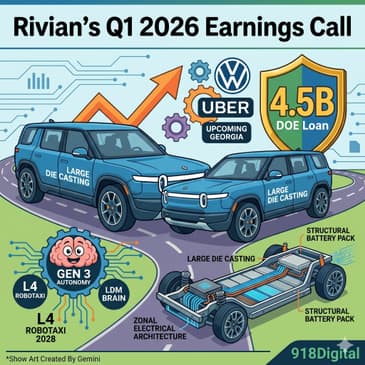
In this episode of Kilowatt, host Bodie breaks down Rivian’s highly anticipated Q1 2026 earnings call, shifting the spotlight from raw financial data to the groundbreaking vehicle technology driving the brand forward. The headline milestone is the official start of saleable R2 production in Normal, Illinois, with early midsize SUVs already hitting the road as employee daily drivers. Listeners will discover how Rivian managed to cut the R2's bill of materials in half through massive structural die castings, an integrated high-voltage electronics enclosure, and a streamlined electrical architecture that strips out miles of heavy copper wiring. The episode also dives into Rivian's massive multi-billion dollar liquidity pipeline from the Department of Energy, Volkswagen, and Uber, which is funding a 50% capacity boost at its upcoming greenfield plant in Georgia. Finally, Bodie details CEO RJ Scaringe’s progressive autonomy roadmap, charting the course from Autonomy Plus subscriptions to Level 4 "eyes-off" consumer vehicles and robotaxis hitting complex urban domains by 2028.
Support the Show https://www.supportkilowatt.com/
Other Podcasts:
News Links:
*Show Art Created By Gemini
Hosted by Simplecast, an AdsWizz company. See pcm.adswizz.com for information about our collection and use of personal data for advertising.
[00:00:00] Good afternoon, and thank you for joining us for Rivian's first quarter 2026 Earnings Call. Today I'm joined by RJ Skirinj, our CEO and founder, Claire McDonough, our Chief Financial Officer, and Javier Varela, our Chief Operations Officer. Before we begin, matters discussed on this call, including comments and responses to questions, reflect management's views as of today. We will also be making statements related to our business, operations, and financial performance
[00:00:27] that may be considered forward-looking statements under federal securities law. Such statements involve risks and uncertainties that could cause actual results to differ materially. These risks and uncertainties are described in our SEC filings and the earnings presentation we filed with the SEC today.
[00:01:03] Hello everyone, and welcome to Kilowatt, a podcast about electric vehicles, renewable energy, autonomous driving, and much, much more. My name is Bodhi, and I am your host. And on today's episode, we are going to cover Rivian's Q1 2026 Earnings Call. I feel really confident they're going to mention the R2. This earnings call was actually released about two weeks ago. We're just now getting around to, um, well, I'm just not we, it's the, I should just blame myself. I'm just now
[00:01:33] getting around to covering it. So let's go ahead and start off with RJ Skirinj, the CEO and founder of Rivian. Let's start with his opening remarks. Good afternoon, everyone. And thanks for joining us for today's call. Last week, I was thrilled to celebrate the start of Sailable R2 production with our team at our plant in Normal, Illinois. It's an exciting milestone in Rivian's history and the culmination of all the hard work and energy from so many people across the company. As I've said before,
[00:02:00] I believe the R2 will be a game changer for our customers and will be a key driver of our company's long-term growth and profitability. In an American automotive marketplace starved for high quality EV choice, I believe R2 is an attractively priced option sized for everyday ventures from school pickups to weekend trips that is targeting the very popular five passenger SUV and crossover segment. With R2, we are taking our design performance and technology and bringing it to a significantly
[00:02:27] broader audience without losing what makes Rivian unmistakably Rivian. We've started R2 deliveries to our employees and I have to say, I absolutely love having R2 as my daily driver. I could not be more excited to get this vehicle into the hands of lots of customers starting this spring. In developing R2, our team relentlessly focused on achieving structural cost reductions while maintaining the desirability of the product. For R2, our bill of materials is expected to be approximately half
[00:02:53] of our R1 platform. For non-bomb cost of goods sold, we expect to see a reduction of more than 50%, resulting from a focus on design for manufacturing and leverage fixed cost efficiencies through higher production volumes. This is how we expect to properly deliver R2 at an accessible price point at scale without compromising performance and utility customers love from Rivian. Key design changes for R2 include part eliminations and reductions through the introduction of large die
[00:03:22] castings, a structural battery pack, a new highly efficient drive unit, the evolution of our next generation electrical architecture, which removes miles of copper wire and the consolidation of our high voltage electronics into a single enclosure. We are also seeing significant sourcing leverage relative to R1 across a variety of components. Now, as we begin to scale our operations in normal with R2, we're very excited to partner with the U.S. Department of Energy to grow our manufacturing footprint in
[00:03:50] Georgia. R2 provides the opportunity to expand the Rivian brand to millions of drivers. As a result, we made the strategic decision to increase the production capacity for the first phase of our Georgia plant by 50%, bringing it to 300,000 units of annual production capacity for our mid-sized vehicle platform. This change is expected to boost cost efficiency while still providing significant room for future expansion in later phases and support thousands of jobs in Georgia as we grow American
[00:04:19] manufacturing and work to ensure the U.S. retains its leadership and innovation and technology in transportation. We remain on track for the production of our mid-sized vehicle platform to begin in Georgia in late 2028. All right, so I did not know that they were delivering R2s already to employees, so that's fun.
[00:04:41] Just a little housekeeping, just in case you didn't catch it on our Lucid or Nudes call. BOM is bill of materials, so what it costs in materials to actually build the vehicle. So non-BOM would be anything outside of that in terms of costs. But effectively, what he's saying here is the R2 is built to be profitable.
[00:05:04] And honestly, hopefully it is. Only time will tell at this point as Rivian gets everything ramped up and they kind of figure out where their struggles are and how to overcome those complications and hurdles. I do feel eventually that this will be a net positive for the company. And this isn't,
[00:05:28] that's not a, it's not exactly like a, a bold statement to be honest with you, but I think this is going to be a pretty popular car. All right. Uh, RJ gave a brief update on the Uber Rivian partnership and a little bit of a teeny tiny update on the, um, you know, autonomous technology that's going in the R1 and the R2s and they're starting to roll that out.
[00:05:54] But honestly, he didn't give a lot. There wasn't, there wasn't a lot of, uh, how do you, how are we saying this? There wasn't a lot of detail. So I just going to, I'm going to leave that out. Next up, we're going to hear a little bit from Claire's opening remarks, starting with deliveries, and then we'll kind of see where that goes. In the first quarter, we produced 10,236 vehicles and delivered 10,365 vehicles, which was the primary
[00:06:22] driver of our $908 million of automotive revenue. Automotive gross profit loss was $62 million compared to $92 million of gross profit for the same quarter last year, primarily driven by the $100 million decrease in sales of automotive regulatory credits and lower production volumes, which resulted in a $45 million increase in depreciation and stock-based compensation expense combined.
[00:06:50] While current macro and geopolitical factors are creating added complexity, cost, and uncertainty, our team continues to work hard to manage supply chain risks and offset elevated costs. Our software and services segment reported another strong quarter as depicted on slide 13. During the first quarter, the segment generated $473 million of revenue, a 49% year-over-year increase,
[00:07:15] and $181 million of gross profit. $282 million, or approximately 60% of software and services revenue was attributable to our joint venture with Volkswagen Group. We also experienced strong growth from remarketing and parts and service. During the quarter, we also recognized $506 million gain in other income in other income in our financials related to the Series A capital raise and related
[00:07:43] deconsolidation of mine robotics from our financial statements. We currently own approximately 38% of mine robotics on a shares outstanding basis. Looking at our balance sheet, we ended the quarter with approximately $4.8 billion of cash, cash equivalents, and short-term investments. With regard to our funding roadmap, in 2026, we expect to receive a total of $2.55 billion of capital
[00:08:11] from our strategic partners. Today, we received $1 billion from Volkswagen Group in exchange for equity following successful completion of the winter testing milestone by RV Tech. The testing program spans several months utilizing reference vehicles from the Volkswagen, Audi, and Scout brands. Later this quarter, we expect to receive $300 million from Uber in exchange for equity related to the
[00:08:38] signing of our partnership agreement subject to certain conditions. And later this year, we expect to receive $1 billion in non-recourse debt from Volkswagen Group and an additional $250 million from Uber in exchange for equity subject to the completion of certain milestones and conditions related to robo-taxi development. As outlined on slide 14, this brings total available liquidity and expected capital in
[00:09:05] 2026 of nearly $8 billion. Additionally, we're very excited to partner with the U.S. Department of Energy to grow our U.S. manufacturing footprint. The up to $4.5 billion DOE loan, which consists of approximately $4 billion of principal and approximately $500 million of capitalized interest, provides low-cost
[00:09:28] financing for our 300,000-unit capacity greenfield expansion in Georgia, bringing Rivian to meaningful scale. We expect the 515,000 total units of capacity between our Illinois and Georgia plants will provide Rivian a path to free cash flow positive once fully ramped. We expect to draw on the loan by early
[00:09:51] 2027, subject to certain conditions. Two weeks ago, our normal factory sustained damage from a tornado. I'm proud of the way our teams have rallied together to get production back up and running while we repair the damages. Despite the weather impact, our 2026 guidance remains unchanged. We continue to expect full-year
[00:10:13] deliveries of between 62,000 and 67,000 total vehicles across R1, R2, and our commercial vans. We also continue to expect to deliver approximately 9,000 to 11,000 vehicles in Q2, as we expect the ramp of R2 deliveries will be back half-weighted. While we continue to believe our gross profit will increase year over year, we expect the complexity of a new vehicle launch will negatively impact our automotive
[00:10:40] gross profit in the second and third quarters before becoming a benefit for our overall operations in the fourth quarter as we ramp production and deliveries. As a reminder, we believe this is a transition year for the automotive segment's path towards long-term profitability as we scale R2. For 2026, we continue to expect an adjusted EBITDA loss of between $2.1 to $1.8 billion, while economic and geopolitical
[00:11:07] conditions including supply chain and international conflicts pose risks, we remain steadfast in our plans to invest behind key growth drivers. We continue to progress our autonomy roadmap and the expansion of our sales and service footprint as we scale with R2. We believe these strategic investments will deliver long-term value to our shareholders. Finally, for 2026, we are maintaining
[00:11:31] our capital expenditure guidance of $1.95 to $2.05 billion. Our CapEx spend primarily relates to finalizing construction and tooling for R2 in normal, the continued build-out of our sales, service, and charging infrastructure, and kicking off construction of our greenfield plant in Georgia. In closing, I'd like to congratulate our teams again for the successful start of saleable R2 production and the strong execution in
[00:11:59] the first quarter. We continue to believe that R2 and our technology roadmap will be truly transformative for the growth and profitability of our business. Honestly, I did not expect to let this go that long. I thought I would maybe play at most two minutes of her opening remarks, but I thought that was all pretty interesting. Not a lot of stuff that we cover here in terms of the technology of EVs, more of kind of
[00:12:27] where Rivian's at in terms of, you know, their financial situation and what kind of money they have on the table through partnerships with like Uber and Volkswagen coming in in the next few months. So I think that's great, especially as they ramp up the R2 production and where they're at with the Georgia plant and all that stuff. So I thought it was, I thought obviously it was a good update.
[00:12:50] And again, Claire kept her opening remarks pretty short. So we have lots of questions from analysts. Our next question is from Itay McKaylee from DJ Cowan. Please unmute your line and I'll ask you a question. Great. Thanks. Hi, everybody. Just first, going back to the Georgia capacity optimization, curious if it has any impact on your previous long-term financial targets at 25% gross margin.
[00:13:19] And maybe on that as well, if you can maybe share your initial kind of takeaways on kind of R2 demand generation since you kind of launched the trims. Well, thanks, Itay. Yeah. And I think obviously the decision to increase the capacity of the first phase of Georgia coincides with, or I should say it reflects a level of confidence in our products and
[00:13:42] our business. I think most importantly, we've just started production on R2 out of our existing normal Illinois facility. And we've had early media events and early customer events. And the level of enthusiasm for the product has just been outstanding. So everything from the packaging of the vehicle to the way that it drives to the integration of technology, the overall response has been overwhelmingly
[00:14:10] positive. And so that bodes extremely well for the ramp up happening over the course of this year and into next year. But it also sets up a wonderful foundation for us as we think about further capacity on this platform, both for R2 as well as R3 and variants of those vehicles out of the Georgia facility. All right. Honestly, I thought there would be a lot more questions when it comes to the R2 and demand
[00:14:38] and all this other stuff. But the first three or four questions I skipped because they were very much financial oriented and not something that fits what we do in the show. So I missed, I skipped those. This one, I left it in because he actually asks about the demand and the feedback they've gotten from customers, which has been understandably enthusiastic. I think that's great. I wonder,
[00:15:04] I believe in the question he asked what the demand was, not what the enthusiasm was. And I do believe the demand's probably higher than your normal, you know, EV startup for the R2. But man, it would be a lot more interesting to know like what the demand was. Not what the enthusiasm is great. What's the
[00:15:31] demand? Obviously it's higher than they thought it was going to be because they bumped up capacity at the, at their, um, their, uh, Georgia plant, but the Georgia plant's not going to be up until 2028, I believe. So yeah, I mean, we'll see, I guess the next clip, we're going to hear a little bit more about the Uber and Rivian partnership. Um, on the Uber announcement, I'm curious whether the, uh, the, the robo taxis themselves will go into
[00:16:00] the Uber network. We'll have the kind of exact same hardware set as, as the personal vehicles. And I asked because if you're going to launch, um, in 2028 and in complex domains like San Francisco and Miami, would that not also imply a pretty wide ODD for, for the personal vehicles? If they're both operating on the same hardware? Yeah. You know, we talked about this during our autonomy day, uh, late last year, but, uh, I think
[00:16:27] it's important to recognize there's going to be a whole series of steps we make in terms of progressing towards level four. And so in, in that series of steps, the first later this year on our consumer vehicles is launching our point-to-point capability. And so that's the ability for the vehicle to drive entirely on its own to a, to an address. And, you know, I just, this week had, we do lots of regular rides internally and I had a great ride with James and the team. And it's so exciting to see how much
[00:16:56] it's progressed and our technology has progressed even since our autonomy day late last year. And so we're, we're very encouraged by this, but that first step of, of making point-to-point available to customers is going to be a really important, uh, step four, uh, for our consumer vehicles. As we continue to go into 2027, we'll be allowing, uh, in specific areas, eyes off. And so it's hands off, eyes off. That's a level three capability. And then as we go into 2028, as you said, that's when
[00:17:25] we'll have our first deployments of a level four capability in a robotaxi. And in the robotaxi variant, there will be some additional sensing, uh, on the vehicle. So it will be different than the pure consumer vehicle, but we are planning to have a personal version of level four as well. And we've talked about that, uh, quite a bit. We think the market for a vehicle that you own, being able to completely drive itself, do things like drop you at the airport, you know, go to the grocery store,
[00:17:51] get groceries for you, uh, pick up kids from a sports event. Uh, these are really high value, uh, creating activities for the level four capability. And we see them on, you know, both robotaxi applications and on personally owned applications. I am really looking forward to what Rivian actually has when it comes to autonomy. And, you know, it sounds like they're making
[00:18:17] incremental steps to level three and then from level three to level four. And that, that makes sense. And it makes sense that they're going to put more sensors on their robotaxi. And, you know, at some point in time, they'll release a consumer version of that. All of that makes sense to me. I'd like to know what they think their challenges are going to be, because I don't think they're going to be all that different than what Tesla's challenges are when it comes to bringing this to
[00:18:46] consumers, not so much the, the robotaxi side of things. Um, obviously like, like we said, there's more sensors in the robotaxi and all that stuff. And we don't know exactly what Tesla is doing on their side of things when it comes to their robotaxi. We just know what they say. And I guess we only know what Rivian is saying as well, but that doesn't change the fact that I would still like to know, like, uh, how long did they think that's going to take? Um,
[00:19:14] what are the challenges they think they need to overcome? Because aside from Elon's over-promising and under-delivering in a timeframe, like he generally, or the team generally delivers eventually. Um, but there is a lot of over-promising and optimistic timeframes we'll say. But I think Rivian is going to have similar problems in terms of
[00:19:43] developing the technology. Not necessarily RJ is not the same person as Elon. You know, I don't think they're going to have the same problems with, with messaging. I think that that's going to be much more tempered, but with RJ and, and the Rivian team, but also, you know, uh, once we get this software out there and once we start seeing people use it, where are the holes? What can be improved? What,
[00:20:11] what does it do really well compared to Tesla's autonomous driving suite? You know, all that stuff. I'd like to see more comparisons that way. And, and we will, as these vehicles get into other people's hands that are outside the company. All right, let's go ahead and move on to our next analyst question. Thank you. Our next question is from Dan Levy from Barclays. As a follow-up, RJ, I wanted to double click on a, on the point you gave in the, in the prior question from
[00:20:40] Mita about, uh, getting to, uh, L L four. You'll, you'll have point to point at the end of this year, and you'll only have the vehicles with the lidar end of this year, beginning of next year. It does seem like there's probably a lot of testing that has to happen between when you get those cars with the lidar out to the point where you have, uh, you know, a launch. So it just helped us understand,
[00:21:04] you know, what the, the testing curve looks like, what you need to do from when you have the cars with the lidar to, um, you know, being able to unlock L four, because it does seem like, you know, there's a lot of miles that have to be driven on, on that new vehicle. Yeah. I think a really important, uh, point to make here is just the way the self-driving
[00:21:28] systems architected. So this is, uh, the platform that we, we launched actually on our Gen 2 R1 vehicles is designed around an end-to-end approach where we're building, uh, really what we call a large driving model, but think of it as a neural net or a foundation model for driving. And that model's being fed with all of our Gen 2 R1 vehicles. And of course our launch R2 vehicles, and ultimately,
[00:21:53] as you said, uh, are, are two vehicles that include a lidar, but very different than previous architectures around self-driving where there were rules-based and, um, you know, more classically controlled. The, as you add more perception and as you add more compute, the capability in the model, uh, only grows. You don't lose the previous knowledge embedded in the model. And so I often sort of
[00:22:18] compare it to imagine if you learn to drive with bad vision and then I handed you a pair of glasses. You wouldn't forget your knowledge as a driver. You'd just suddenly be able to see and perceive things that you may have missed previously. So you'd become a better driver. And then imagine we could hand you, uh, a 10 X multiplier to your compute capability effectively make your brain 10 times smarter. Again, you wouldn't forget what you knew before, but suddenly you'd start to notice new
[00:22:44] patterns and more nuance in ways that you hadn't in the past. And so that's very important to recognize is a very fundamental difference in how the model is built today and what we're creating versus the more AV 1.0 stack where they were, as I described it, very rules-based and very classically controlled. And so because of that, the data accumulation has happened already on R1, and that will continue with
[00:23:09] the growth in our car park with R2 all feeds into our overall LDM, into this large driving model. And even as we think about introducing new sensors, things like our LIDAR, uh, this is not as if it's, uh, first on the vehicle when it's delivered to customers. We have lots of prototypes today that are running with those. Uh, if you're in the Bay Area and happen to be anywhere around Palo Alto, you'll probably see lots of Rivians with a lot of additional sensors. And those, that's part of a
[00:23:38] ground truth fleet that again is, is feeding into this large driving model, uh, to accelerate the speed at which that model is learning. You know, think of it as a brain, the speed at which we're teaching it to drive. And the work will, that will go into open and launching a customer facing version of point to point, which today, you know, I was, as I said, I was in one of our cars driving around full point to point early this week. It's, it's really exciting. Uh, but we want to have when it launches to customers,
[00:24:06] have it be extremely robust, but all that work is accretive, uh, to what ultimately will be going into our level four platform. Finally, we're talking about stuff that is interesting to me. Um, you know, Elon has said very similar things to this. Uh, he, you know, obviously Elon doesn't talk about the LIDAR in a positive way. Um, and he, he thinks that, you know, the solution that they have
[00:24:32] right now is the, well, I don't know if he really thinks this piece has the solution that they have, whatever that current solution is, they'll be able to achieve autonomy. And RJ seems to be taking a more incremental, like we'll add onto this as we go through this and build to level four, uh, which I don't know. I, I, I mentioned this earlier. I think, you know, I think the actual approach to autonomy and how they have to develop for level three and level four autonomy is going to be
[00:25:02] similar to what Tesla is doing, but the messaging is going to be different. And, you know, if we assume that what I said before is correct, then that's what we're seeing now. Uh, I don't really have anything else to add other than to, you know, fluff out my feathers and crow a little bit. So let's go ahead and move on to our next analyst question. Our next question is from Andrew Pococo from Dawkins Stanley.
[00:25:28] Great. Thanks so much for taking the question. Um, maybe just to start on the commercial side of your business, it looks like, uh, Amazon made up almost 50% of, of your auto revenue in the quarter. Um, so a little bit above, you know, historical run rates. Can you just maybe talk to what you're seeing with that relationship and maybe even outside of Amazon, um, the level of maybe interest you're seeing in the commercial product since you launched that, you know, extended range version of the commercial vehicle?
[00:25:58] Yeah. Our relationship with Amazon continues to, uh, be something that we're very proud of. We've spent a lot of time on this program, uh, from its initial kickoff, uh, quite some time ago in 2019 through its initial launch and now ramping, deploying, um, you know, that's everything from not only building the vehicles, but an Amazon side, uh, getting their operations and their infrastructure ready to ingest a lot of EVs. And what we're now seeing is a reflection of all that
[00:26:26] work, all the cumulative work that's happened to date, that's allowing the volumes for our band program within Amazon to, to grow, as you pointed out pretty meaningfully. And we expect that increased demand for our bands to continue. And that's, um, you know, that's super rewarding to see. It's fun to see all the bands on the road. Um, but that's, that's going to continue to, to ramp up with Amazon. Now, in terms of other customers and other applications, of course,
[00:26:53] Amazon's by a significant degree, the largest operator. Uh, and so they're, they're the ideal, uh, lead customer, if you will, but, but there are lots of other opportunities we see, but, uh, in, in the immediate term, our focus remains on Amazon, uh, and ramping to support them. Great update. I don't really have anything to add to this other than now I'm very surprised when I see
[00:27:16] an Amazon truck that is not a Rivian, you know, it, like every time I see one, that's one of the older ones. I was like, what, what did you do that Amazon decided to punish you with this particular truck? What happened that you were being punished? Cause everybody else is driving these really nice new Rivian fans around. And for some reason you're in this diesel guzzling box truck that
[00:27:47] is not fancy at all. So I, I'm sure they didn't do anything. Maybe the truck's down and, you know, the Rivian trucks down for maintenance or whatever, and they had to, to take this other one out. I'm, I'm sure there's not anything nefarious going on, but, uh, I do have that thought, even though I know there's probably nothing that it's not their driver's fault. That's what I'm saying. All right, let's move on to our next question.
[00:28:14] Thank you. Our next question is from George Jane Arikas from Canaccord. Please unmute your line and ask a question. So I know it's early days, but I was wondering if you could please give us any color on R2 order trends and maybe some color on the conversion ratios relative to previous orders. Thank you. And George, as you said, it's, it's, it is early days for deliveries, but, um, you know,
[00:28:40] the signals I'd be looking at are just the reception around the product and how, you know, whether it's, uh, expert journalists, you know, automotive journalists or lifestyle journalists or customers that are getting to experience the vehicle, the overall, uh, excitement around what we've been able to put together in terms of content features, packaging, just the overall value proposition is really resonating.
[00:29:07] And I'm, uh, you know, I'm, I'm really pleased with having, you know, spent, you know, a very large amount of time in the car and, you know, as my daily driver, I couldn't be more pleased with the result, the work that the teams did to make something that's truly remarkable. Uh, we had a few journalists say this might be the best, uh, vehicle ever made. Uh, that's, that's wonderful for the teams to hear. And it's really encouraging for us as we get ready to ramp the vehicle. Okay. This is neat, but I don't think we got any sort of order trends.
[00:29:37] Um, it does seem like a high mark to hit to be, to, for someone to say that this is the greatest car ever built, uh, from a test drive. I'll, I'll just leave that here. Um, again, that's not RJ saying this, this was a journalist. It's just RJ calling that out, which, you know, whatever. All right, let's go ahead and move on to our next clip.
[00:30:03] And maybe just as a follow-up, I just wanted to confirm that the Gen 3 sensor suite was going to be available later this year on the R2. Thanks. That's correct. Yep. So the Gen, Gen 3, uh, autonomy hardware suite, which is both, uh, our in-house wrap one platform. And so this is our in-house inference platform, 800 tops per chip. We have two of those chips in the vehicle. So it's extremely powerful.
[00:30:28] It's a big, a big increase, roughly a 4X increase relative to the NVIDIA based platform. And, um, and then the inclusion of LIDAR as was referenced before, along with, uh, some other enhancements across the rest of the perception stack. That's cool. I mean, you, anytime you buy a brand new vehicle, like, uh, the, uh, the R2, uh, you, you want it to come with the latest and greatest technology.
[00:30:55] So it sounds like that's going to be the case for these R2 owners, at least the initial ones, which I don't know why the ones after that wouldn't get the Gen 3 chip as well. But if you order today and you pick up your car today, it's not like you are getting stuck with old, uh, technology. You're going to get the latest technology that they have to put out. So that's awesome. Let's move on to our next clip. Our next question is from Mark Delaney from Goldman Sachs.
[00:31:25] Yes. Good afternoon. Thank you very much for taking the questions. Starting on autonomy. I'm hoping you can provide more details on the monetization of autonomy plus so far and any data points you can share on that and what that might mean for growth in the software and services business more generally, including if you still think you can grow that segment revenue by about 60% this year. We're, we're, we're encouraged by what we're seeing in the, you know, as you noted at the start of having paid autonomy plus and, you know, it's exceeding our own models on this.
[00:31:55] So we're, we're, it's, uh, the take rates higher than what we expected. And that, that bodes really well for us as we, we're, we're going to be growing the feature set quite significantly over the course of this year. And, and the introduction of point to point, uh, we think is a, is a major, uh, a major value driver for customers, you know, to be clear, this is, you know, as I said, you can put the address for the location you're going to into the car and the car will fully drive it, your drive you there.
[00:32:23] And then following that, allowing you to go eyes off in highway conditions and ultimately everywhere that, that means you get your time back. And so we're very bullish on the long-term trajectory to, to monetize our autonomy on the consumer side. And that's for both, you know, hands off, uh, eyes on hands off eyes off. And then ultimately, uh, level four for personal consumption we see is a really key driver value in the long-term.
[00:32:50] Now, in terms of, um, what that doesn't for our software and services growth, that is going to start to be something we'll see, but it's not something that, um, we're going to be breaking out separately. I think that's too bad because I would really like to know what numbers were they thinking internally? The takeaway rate would be, what numbers are, are they seeing for take rate?
[00:33:17] Also, you know, are they included, including the, um, the highest end package, whatever that package is called? It's not premium prestige or whatever the highest end package launch package that they have that includes the autonomy with the purchase price of the car. Is that technically, are they calling that, uh, uh, are they counting that in their take rate? I mean, they should, but it's not, people are buying that car maybe for different reasons than autonomy.
[00:33:45] So yeah, it's all very interesting. And one of the things when he was talking, I was, I was thinking about is, you know, this autonomy, uh, that they have, it's $2,500, which is fairly reasonable. And it wouldn't be all that painful for Rivian to offer Tesla owners, for instance, who already have full self-driving.
[00:34:08] It's like, Hey, come on over to Rivian and we'll sell you a car for whatever it costs, $58,000 or whatever, but we won't charge you for that autonomy. And you can just, you can just have that for free. If you're, if you can prove that you're coming from Tesla and you had full self-driving with them, I think that would be, um, I think that would be an easy lever for Rivian to pull to get some customers that direction.
[00:34:36] Maybe they offer it at half price. I don't know, but, uh, they definitely have a little bit of wiggle room and it wouldn't necessarily cost them all much, all that much to acquire that Tesla customer. They're $2,500, which is, you know, really nothing because they're developing the software. It's not nothing, but it's not $2,500 either. All right. Um, I had another thought on this, but I don't remember what it was.
[00:35:03] So let's go ahead and move on to our next analyst question. My other question was on demand for the R1. I'm curious if Rivian has seen any improvement in order rates for R1, maybe in response to the recent increase in gasoline prices and what that might all mean for R1 volumes this year. I think the company had assumed R1 would decline. Is that still your expectation? Thanks.
[00:35:29] We're encouraged by the continued enthusiasm for R1. It's, it continues to be one of the market share leaders in the premium category. And, um, you know, in a number of States, it's the best, not just the one of the best selling premium electric cars, but, uh, one of the best selling premium SUVs, electric or not electric. So that's true. And in a handful of States, we've talked about that in the past.
[00:35:55] Uh, I think it's hard to say ultimately what's going to happen around demand with the impact of, uh, gas prices going up. I, of course it's, it's a consideration and we, we do see that manifest in what people are trading in. We're seeing more trades of gasoline vehicles or vehicles are less efficient than what we're building. And so we do see that on the rise, but you know, I think a lot of folks are wondering how long fuel prices are going to stay, stay high like this.
[00:36:25] You know, when my wife and I were, when we bought our van, we did look at the R1S and we looked at the lucid gravity and technically we could afford the R1S or gravity, the lower trims we could afford to buy one of those cars. But that would have been a, an extra ridiculously high car payment.
[00:36:49] And just because we could afford the car payment, that was going to put a little bit of a pinch on things like, you know, being able to do not just vacations, but just being able to let the kids go to do martial arts or any, you know, gymnastics or any of these other things. Cause all that costs money too. And then on top of all that, you know, gas prices were, were kind of high when we bought
[00:37:18] our van, but they're much higher now. But I don't think there's a, there's a big enough difference that we would have been like, if gas prices cost four 60 when we bought our van, I don't think that would have pushed us into that, that realm of being, being like, you know what, it's worth it for us to buy an electric vehicle for my wife who literally drives a mile to work and back. It doesn't, it didn't make sense for us.
[00:37:44] Um, but you know, with other families, you still have rising food costs, rising, you know, uh, just things that you need to get, uh, through life costs like car insurance and, uh, you know, buying deodorant and just all sorts of stupid stuff like that. It's all, it's just a very expensive time to live right now. And then adding a very expensive car in this case, the R1 platform.
[00:38:14] I don't know that that makes sense for a lot of people, which is why I think we see more, uh, people looking at buying those used EVs that are coming off of leases and stuff. That makes a lot of sense to me, but spending that much money on a car doesn't, doesn't make that much sense to me. Cause even if, unless you were just driving a ridiculous amount, right? I don't think that math works. If you really wanted the car by the car, you really want for sure.
[00:38:43] But if you're using high gas prices as a metric to spend, to upgrade from your say $45,000 car to a 70 or a hundred thousand dollar car, I don't, I don't, I think there's a big disconnect there. And not to say that people aren't looking for sure, you know, a hundred percent. When I moved my, when I moved to my Tesla, one of the things that was a motivator for me is in my
[00:39:11] big Mazda CX-9, I was spending about $450 to $550 a month in gas. So, uh, I decided that I wanted to pay off my car very fast, my Tesla very fast. So I put a bunch of money down as much as I could afford to. And I paid $800 a month, which was over my payment so that I would be done. But it was an easy lift because I only had to come up with another $300 more than I was paying for my Mazda.
[00:39:38] So it wasn't like, uh, that was not a, uh, I mean, it was a lot of money. Don't get me wrong, but it wasn't like I was like, oh, now, you know, now I've got to come up with $800 a month. No, it's coming up with another $300 or 350 compared to what I was paying before, which was not as big of a lift for me. So I guess what I'm saying here is just because gas prices go up, that doesn't mean that people are going to start buying luxury, luxury electric vehicles.
[00:40:04] Uh, I do think that it makes more sense for them to buy things like a used EV, um, that could, they could get for 30 or $40,000. That's probably more realistic when gas prices are going up versus spending that, that, uh, you know, like I said, between 70 and a hundred and say $10,000. That I don't know that you can make a very good argument for that just based on gas prices alone.
[00:40:35] All right, let's move on to our next clip. Our next question is from Andres Shepard from Cantor Fitzgerald. I think a lot of our questions have been asked, but, um, RJ, I want to go back to a topic. I know you're very passionate about, which is autonomy. And so I guess with R2 beginning customer deliveries over the coming weeks and with the autonomy plus now having started this month, just curious on kind of your vision and how you were thinking about that, uh, autonomy customer adoption, you know, what type of
[00:41:04] autonomy penetration rate do you expect for your customer owned vehicles? Do you expect customers will, um, prefer the monthly subscription or the one-time purchase just any color here on your overall vision and, and customer penetration adoption that you might be expecting? Thank you. Yeah, well, Andres, we're, we're very, um, we're extremely bullish on the, the, the importance
[00:41:33] of autonomy for customers over the next call it five years and the rate at which we see customers adopting and, and, and selecting autonomy plus. And then ultimately as the feature set grows and the capability grows that, you know, that adoption rate growing with it. But, but I think that there's a even bigger question of just from a society point of view, we've been on, um, a journey of a, you know, when we think about autonomy work level two
[00:42:01] is, you know, where you're, let's your eyes are still on the road, but you're, you're, you're still responsible for driving the vehicle. That's like a, a small appetizer for what you can actually achieve when you get to higher levels of autonomy, where you can take your eyes off the road and truly get your time back, get your time back without the car, you know, digging you to say, Hey, look back at the road or pay attention or put your hands on the wheel. And so as that starts to occur, and as people start to experience what it's like to truly have your time back.
[00:42:31] So take, you know, a 40 minute commute and the idea of getting those 40 minutes back in both directions, we think it's going to be a very sticky experience. And it's going to be something that once you experience it, even if it's indirect, let's say in a friend's car, it's going to become a very important purchase criteria. And the reason I call this out is we really believe over the next five years, the rate
[00:42:57] of progress of what we're going to achieve with autonomy will look very, very different. And I'm talking here at an industry level versus what we've achieved over the last five years means that the topology of customer expectations and therefore the, the, the way that the vehicle purchases are made and the criteria that are being used to make those vehicles is going to look very, very different in 2030, 2031 than it does today, where autonomy
[00:43:24] will be a very critical criteria where customers are willing to pay for it because they want their time back. They want to not have to be paying attention. They want to be able to be on their phone, reading a book, um, you know, taking a nap, uh, truly getting time back while you're in the car. And so as a result, as you've heard a few times throughout this call, this is an enormous focus area for us as a business. We're very much, uh, deploying a lot of our R and D dollars towards this category.
[00:43:54] And we've made, you know, long-term investments in the hardware, uh, and in the vehicles to support that. Okay. So, uh, again, a more measured approach and long-term vision, publicly long-term vision. I'm sure Tesla actually, if you get into their internal meetings there, it's probably again,
[00:44:17] like I said, something similar to what Rivian's talking about here, but, um, you know, uh, it's a, it's an answer. It's not a super, I think, detailed answer, but we're also very early on in this. So I get, I get, uh, where RJ is, is coming from here. I would like one day to get more information, but that's where we are right now.
[00:44:45] Now I'm going to skip over the next question, but they basically asked about deliveries and what the mix would be for 2026, because we have the delivery van. We have the R1 platform and then coming out soon, we'll get the R2 into, you know, the public's hands, not just employees' hands. So they anticipate delivery of, you know, 62 to 67,000 vehicles in 2026.
[00:45:14] Of that, the R1 and delivery vans, they said those numbers are going to be close to what they had in 2025 as far as deliveries. And they had around 42,000 total deliveries in 2025. So we can anticipate, you know, 20 to 27,000 deliveries of the R2 in 2026. If we are doing that math correctly. And I believe I am.
[00:45:45] So, um, yeah. And that probably sounds right. It actually might, you know, we might be closer to 62,000 than we are to 67 just because, you know, supply chain production ramp, all of the things that can interfere as they, as they work to, to getting these deliveries or getting these, the, getting the production to scale. All right, let's go ahead and move on to our next clip. Our next question is from Edison Yu from Deutsche Bank.
[00:46:14] Please unmute your line and ask your question. Hey, thanks for taking our questions. Wanted to come back on, on RoboTaxi. Are there any sort of KPIs that you're sort of tracking or that you need to hit for, for some of the milestones with Uber? And, and I think in the past, you know, the industry has kind of turned to disengagements or miles between intervention and a flavor. That'd be great.
[00:46:39] So before we get to the answer, a KPI is key performance indicator, which are some sort of metrics that can be used to track or measure and evaluate, you know, what's going on with the autonomy package that Rivian is putting out. In this instance, I would imagine that's what the KPI he's talking about, but it could also be, you know, for financial stuff and a bunch of other things, but that's what KPI means.
[00:47:08] All right, let's go ahead and get the answer. On the path to deploying in 2028, there's a, there are a number of milestones and some of those tied to the investment unlocks with Uber. Uh, the, the first of those is later this year we'll, we'll be deploying vehicles, uh, in both San Francisco and Miami with a safety driver. Uh, so the vehicles will be running, but, but with benefit of a safety driver in the vehicle with them.
[00:47:37] And there's a handful of additional milestones ramping up to ultimately having the vehicles operate, uh, fully on their own as part of a service in 2028. But as we, as we get closer and closer to that date, there will be, you know, there'd be lots of, uh, proof points, if you will, of the progress that's being made that, that will manifest on the road that you'll, you'll actually see them, uh, not only being tested, but you'll see them as part of some of these deployed, uh, fleets. Well, this seems totally reasonable.
[00:48:05] So I don't really have anything to add on this. It just, it continues to follow the narrative that they've already set forth. So let's go ahead and move on to the next question, which is also about autonomy. Understood. And, and just, uh, kind of a separate question on, on more autonomy, more broadly. Uh, I think there was some, some reports that, you know, you guys were looking to potentially license some tech to, to other OEMs. Um, just, just wondering anything you can say about that.
[00:48:34] Is that something that we could potentially expect, you know, this year? Um, anything that would be great. Thanks. You think there's two broad categories of technology. We think, uh, that as I referenced earlier, that will be very, very important for growing or maintaining market share in the next several years. And so the first of those is, uh, shifting away from a domain-based, uh, network architecture
[00:49:01] where you have a very large number of supplier source DCUs that are, you know, little, think of them as little islands of code on little small computers where you might have, depending on the car, anywhere from 50 to 150 of those little, little ECUs, those little computers, uh, that are open in aggregate providing the software for the vehicle. But, you know, that architecture is incredibly hard to do updates on.
[00:49:26] Um, it's very, very difficult, uh, to do cross-platform or cross-domain integrations and makes the idea of integrating in a, in a deep way AI into the vehicle and vehicle experience, uh, very difficult, you know, borderline impossible, uh, to do it well. And so our view is every vehicle on the road will need to shift to a much more centralized compute where you have more of a zonal architecture.
[00:49:52] So essentially think of it as a large consolidation of all those little computers into a single or a very small number of large computers that runs a common operating system. And for which the code base that's running on the vehicle can be very easily updated without coordinating among, you know, uh, you know, among let's say 50 to 150 suppliers. And so that, that architecture I just described is of course, what's in a Rivian vehicle today.
[00:50:19] It's also the basis of our relationship that we've forged with, uh, Volkswagen group, uh, to deploy that technology. And the first application of that technology being deployed outside of Rivian as part of our partnership with Volkswagen group is going to be in the ID one, which is a, you know, it's a EV that'll be launched in Europe with a price point of just over $20,000. And I can't wait for people to buy this car. I'm sure lots of people will buy it and take it apart and tear it down.
[00:50:46] And I, I'm, I'm certain they'll be blown away with the elegance of how we've executed the ECU topology or the, I should say the network architecture and the compute stack topology. And so that's one technology category or one area that we think has a lot of opportunity to be deployed in other manufacturers. And, and of course the proof point that we're successfully deploying this into a very large, uh, established manufacturer within Volkswagen group across multiple brands, across multiple
[00:51:14] price points, different form factors, different geographies is the, is the proof point or the existence proof that the technology is scalable and that we're capable of supporting these types of complex deployments. Uh, with that said, the other large category of technology that we see opportunities to have licensing deals is in the autonomy realm. And here it's in a similar way. It's not just hardware and Sanchez software. It's the two of them together.
[00:51:41] So it's the combination of our compute platform that we've developed with this wrap one in-house inference platform I talked about and the associated, uh, computing platform we've designed around that along with our perception, uh, platform. So it's, you know, the, the cameras, radar, lidar that exist. And then very importantly, uh, the large driving model and this, you know, this foundation model is neural
[00:52:06] map that we've created, uh, that defines, uh, what driving or how to, how to drive a vehicle. And that's as, as hopefully I made it clear before is, is a much more flexible architecture to deploy into different vehicle embodiments. And so we're doing that already within Rivian. We're, we'll be deploying that across RNT, RNS, R2, uh, ultimately our commercial vans, uh, robotaxi applications.
[00:52:31] But we, we do see this as a very scalable technology that can be deployed in many ways. All right. That was a pretty good answer. It was a good detailed answer. You know, obviously the first part of this, when he's describing how the zonal architecture works and how it would benefit not only Rivian, but other companies, obviously that's that partnership with Volkswagen. I did not know that the first deployment of this outside of Rivian was going to be in the ID one in Europe.
[00:53:01] So that's cool. Can't wait for people to get their hands on that and see what they think. Um, the other thing is, you know, zonal architecture isn't exactly, uh, specifically a new thing for companies who are working on automobiles. You know, Tesla announced it quite a few years ago. So it's not, not to say that Rivian's not doing unique and innovative things. It's just that this isn't a new concept.
[00:53:29] Um, and you know, that sounds like they're open to licensing their autonomy technology, but you know, I, I think that Rivian really needs to prove that their autonomy technology is worth licensing. And I don't think we've seen that quite yet, but we'll see it here in the, the not too distant future. All right, let's go ahead and get to our next question. Thank you. Our next question comes from Alex Perry from Bank of America.
[00:53:58] Please unmute your line and ask your question. Hi, thanks for taking my question here. Um, just one, I guess a little bit further on the robo taxi strategy. So you had the Uber deal announcement. Um, I guess it's a plan to pursue a partnership model for now. Um, is it, does the deal with Uber have sort of any exclusivity and, and how else will you sort of look to, to tap into this important market?
[00:54:26] You know, when you think about the robo taxi space as a business and so putting aside the technology for a moment and I should say, and putting aside and recognizing that the technology for level four in a robo taxi or in a personally owned vehicle is the same. Meaning, uh, a personally owned level four vehicle, uh, can't drive or should not drive worse than a robo taxi level four vehicle. They're both very capable of, of managing the same levels of complexity and the same types
[00:54:56] of, um, driving situation. So it's the same tech stack, but when you think of it through the lens of a business model, the benefit of working to deploy this first with Uber is you have very large density of choice. And so if you're deploying entirely on your own, you have to build enough vehicles to have in the fleet or in the car park, such that if you're a user, when you say one tab of vehicle available, it's immediately available, um, or it's available in a matter of minutes.
[00:55:25] And so the scale of Uber's platform and the success they've had in creating a really healthy marketplace really makes them an ideal partner for us. As we think about launching this technology, uh, in an R2 to deploy into providing robo taxi services. Um, and as, as you've heard me say a couple of times, and we've talked about this in the past, uh, that technology is going to also underpin a consumer, you know, personally owned variant as well.
[00:55:55] And I think we have to recognize that there's going to be lots of innovation around business model that start to emerge as we have level four. And so if you think of it in a very simple sense, the two bookends in terms of business model are pure ownership or the vehicles dedicated entirely to your household. And the other end of the spectrum is purely mobility as a service where, uh, you, you don't own the vehicle.
[00:56:21] You're not using the same vehicle every time, but you ask for a vehicle on a purely variable basis. And it shows up that there will be things that emerge in the middle. Uh, and yeah, not to be exhaustive here in the types of things, but you can imagine different forms of sharing vehicles amongst families or within neighborhoods or within apartment buildings. Uh, but there's, there's going to be a very exciting time of innovation in terms of how we think about consuming mobility or consuming transportation.
[00:56:49] And with all that said, uh, just recognizing the trillions of miles that are driven today, the vast majority of those are driven in personally owned vehicles. And so robo taxi represents a portion of those, but we think, uh, there will be lots of new models that start to make up the topology of those trillions of miles that are driven. It is, I think a really good idea for companies like Lucid and Rivian to be partnering with companies, ride share companies like Uber, right?
[00:57:19] Like Uber already has the, the name recognition for ride sharing, but, and, and Lyft too, but we're going to use Uber in this example, since that's who Rivian is partnering with. But Rivian are Lucid is now we're going to, I'm going to screw this all up. Uber has already built that right name recognition. They've already built the platform and they already have, you know, uh, a certain amount
[00:57:46] of market concentration in a wide variety of places for a single company like Lucid or Rivian to start their own robo taxi network. You're going to see some delays like what Tesla's experiencing, for instance. So it's not to say that Tesla is not going to be successful in their robo taxi efforts, but by partnering with Uber or Lyft in this case, Uber, again, uh, Rivian doesn't have to
[00:58:14] have a massive fleet in, let's say Phoenix and a massive fleet in San Francisco. They can have a smaller test fleet and still get, you know, a decent amount of data while not breaking the bank because Uber has all these other ways to get people from point A to point B. And it's not going to cause a big service interruption. If Rivian came to Phoenix and they, they decided to start their own robo taxi network
[00:58:43] and they had 10 cars that people could take in Phoenix and availability was, was low for, for people. I don't necessarily think a company like Rivian could weather that company like Amazon with the Zooks could definitely weather it. Amazon's got other revenue sources, company like Waymo, same thing. Waymo has other revenue sources. Uh, Tesla's in a little bit of a different position than Rivian because there are more
[00:59:13] established brand, but companies, like I said, like live, lucid and Rivian, they don't need to reinvent the wheel, especially when, you know, they're trying to figure out one production for, for their vehicles, but they're also trying to figure out this whole autonomy thing. And, uh, that just takes one more thing off their plate. They get investment from these companies so that they can, you know, um, use that investment
[00:59:39] to further develop the autonomy and they don't have to build a whole, uh, platform. So just so people can use their vehicles. So overall, I think it's, you know, great that there's the partnership. Um, I don't think I have much to add beyond that. So let's go ahead and get to our next question. Our final question comes from James Picchiarillo from BNP Paribas. Please unmute your line and ask your question.
[01:00:08] So I want to ask about the Uber partnership. Can you share any color on the milestones that are associated with the four tranches of funding, right, regarding the 950 million in additional additive, uh, liquidity? And it does appear, right, that one of the tranches is already expected to hit this year, 250 million? Yes.
[01:00:32] As, as RJ had just mentioned, um, there are a handful of milestones and the, the milestone that we more specifically expect to be in position to unlock the initial 250 million, uh, this year will be the operation of, you know, some Rivian vehicles in, uh, San Francisco and Miami with safety drivers later this year. And then as you think about the subsequent years, you can think about the, the ongoing,
[01:01:00] uh, trajectory towards, uh, full deployment in, you know, a couple of cities in 2028 and then 25 cities by 2031, uh, that would, you know, fully unlock, uh, the remaining $700 million of, uh, capital from Uber. Okay. We're getting little bits of information here and there. So I think that's good. I don't have much to add on it, but it's nice to know, keep that and store that in the
[01:01:28] back of our heads as, as we find out more about Lucid's partnerships and Uber's partnerships with other organizations and companies. But so far seems reasonable to me. Let's go ahead and move on to the final question. Just to maybe level set expectations on automotive gross margins for the second and third quarters, right? This quarter was yet again, another strong showcasing, right? Of the company's momentum toward positive auto gross profit, right?
[01:01:57] And this is the last quarter before the ad too. Like, is there anything you could share for these next two quarters regarding, regarding the temporary order of magnitude impact? We can expect auto profitability. Sure. As we think about the subsequent quarters of, of Q2 and Q3, we'll see the introduction and turn on of both all of the depreciation expense, the new manufacturing team that is, is established
[01:02:26] that will be producing the vehicles. But as they're in the process of ramping up the first shift of operation, we'll see some of the complexity associated with lower volumes on the new R2 line. And so as a result of those attributes, we do anticipate seeing an impact to our automotive
[01:02:46] gross profit over Q2 and Q3 before we start to see the overall benefits of the ramp, not just on the R2's unit economic profile, but also importantly, the fixed cost leverage that we'll see across the R1 program and EDB program overall. So in total, we still anticipate that we'll exit 2026 with a trajectory of a positive automotive
[01:03:15] gross profit, with that being, you know, both R2 as well as total Rivian automotive gross profit being positive, which is important for us as we go into 27 and really fully ramp up the R2 capacity and normal. Okay. That is our final question. That's, that's, I don't really have anything else to add to that. You know, seems all very reasonable.
[01:03:40] Rivian's earnings calls are always, or most of the time, very measured and reasonable. You know, not, not a bunch of marketing hype. You know, there was a little bit of that, but nothing, nothing crazy. So overall, you know, I think, you know, R2 and Rivian are, excuse me, R2 and the autonomy
[01:04:06] plus is something that we're really going to focus on here on this show in the next couple of months. So yeah, I'm looking, looking forward to seeing what our Rivian does. And if Rivian wants to, I mean, you don't have to, but if you wanted to let me borrow a car, an R2 to test all this out, I'd love to. Bodie, B-O-D-I-E at 918digital.com. This has never worked. I don't do it very often.
[01:04:36] And there's a reason because it's never worked. But if you, you know, whatever, if you're, if you're watching this or listening to this, which is probably not watching it, um, so shoot me an email. If you would like to comment on today's show, you can also email me, Bodie, B-O-D-I-E at 918digital.com. You can support the show by going to supportkilowatt.com. You can support the show either through Supercast or Patreon. That's completely up to you.
[01:05:04] And all the money that comes through on Patreon goes directly to the show. None of the money goes into my pocket. The Patreon is what funds most of the show, but not all the show. So a big thank you to all of our Patreon and Supercast supporters. All right, everybody, that is it for me. I hope you all had a wonderful week. Um, and I will talk to you hopefully on Friday, but it might be on Saturday.
[01:05:33] We'll see what happens. Thanks, everybody. Talk to you soon. Thank you. This concludes the Q&A section of the call. I would now like to turn the call back to RJ Skirinj for closing remarks. Thanks, everybody, for joining us today.
[01:06:03] Hopefully you can tell we're really looking forward to getting R2s into customer hands. Uh, we're, you know, we're very pleased and excited with the, the, the product that we've developed and proud of the team for all the great work that went into creating such a, such a special vehicle. Along with that, we're, we are very much focused on, uh, the development of our autonomy platform. And, and with that, we'll be starting to see some of the fruit of that significant effort.
[01:06:32] Uh, as I said, first with our point to point capabilities later this year, and then adding more functionality, more capabilities over the course of 2027 and 28. Uh, and again, thank you for everybody for joining this call. We're, um, we're excited, uh, for all of you to hopefully experience an R2 and see them on the roads here very soon. This concludes today's call. Thank you for joining us.