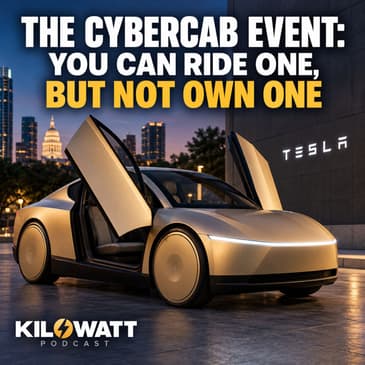
Tesla’s Cybercab is now carrying passengers in Austin, and this episode takes a comprehensive look at what Tesla revealed about the purpose-built robotaxi and how it works in the real world. The Cybercab introduces Tesla’s unboxed manufacturing process, reaction-injection-molded body panels, a smaller and lighter drive unit without rare-earth materials, a 48 kWh structural battery pack, electronic brakes, and a camera-only sensor suite. The updated Robotaxi experience lets riders choose between a Cybercab and Model Y, carries preferences between rides, and offers controls through the vehicle’s 22-inch display, the Tesla app, and voice commands. The episode also looks at accessibility, Tesla’s plans for fleet operators and mobility hubs, and the economics of putting privately owned Cybercabs onto the Robotaxi network. Other details include DC-only charging, possible support for game consoles, upcoming Cybercab displays in Asia, and the addition of the vehicle to Tesla’s 3D Supercharger maps. Finally, NHTSA is examining whether a vehicle without a steering wheel, pedals, or side mirrors complies with federal motor vehicle safety standards and whether Tesla should have sought an exemption before putting the Cybercab into commercial service.
Other Podcasts:
Publications: News Links:- Watch Replay of Tesla's Cybercab Event
- Out of Spec YouTube
- 10 Facts About The Tesla Cybercab
- The Tesla Cybercab Has No Brake Lines Or Brake Fluid. Here’s How It Stops
- Tesla’s new rare-earth-free EV motor is a big deal, but not THAT big a deal
- Tesla Updates Robotaxi App to Add Support for Cybercab Rides
- Tesla Robotaxi riders will face the best dilemma when booking a ride
- Cybercab Joins Tesla's Robotaxi Fleet With Cheaper Fares
- Tesla Cybercab Can Be Driven Using Just the Screen [VIDEO]
- Help Us Build Our Robotaxi Network
- Tesla opens search for Cybercab fleet sales, but FSD owners are still left out
- Tesla Cybercab is coming to Asia this month as US service officially begins
- Tesla Adds Cybercab to Its 3D Supercharger Site Maps
- Forget Charging the Tesla Cybercab at Home, As It Doesn't Support AC Charging
- Musk: You'll Be Able to Plug Xbox or PlayStation Into Cybercab
- Tesla’s Cybercab has been deployed, and it’s already under investigation
- Tesla Cybercab launch catches NHTSA’s attention who wants to know more
- Tesla Cybercab is barely on the road and it’s already under investigation
- Tesla Cybercab is already under NHTSA investigation after launch
Hosted by Simplecast, an AdsWizz company. See pcm.adswizz.com for information about our collection and use of personal data for advertising.
[00:00:21] Hello everyone and welcome to Kilowatt, a podcast about electric vehicles, renewable energy, autonomous driving, broken promises, and spilled coffee. My name is Bodhi and I am your host. Let's address the spilled coffee first. Right before recording today, I moved my mic boom and accidentally knocked over my coffee all over my Apple keyboard and other electronics that happened to be on my desk and pictures and notes.
[00:00:51] All that good stuff. So now my office smells like buttery coffee, but no, buttery toffee is what it smells like. And yeah, I got, I'm still finding little areas that need to be cleaned because I'm looking at one right now, but I'm going to ignore that because I'm gonna get this out before it takes too much, too much time and nobody cares about the Cybercab anymore.
[00:01:15] um, the broken promises. I told you that we'd have an episode on Thursday or Friday because of the, the Cybercab event. But here's the thing. um, there was no live stream to the Cybercab. It was only about 15 minutes long. Uh, the folks who were invited were like shareholders and the people that won the contest and influencers who generally say nice things about Tesla. I don't, I'm not gonna like a lot of the media or articles that I was reading.
[00:01:45] When it was, when it was, when they were talking about the people who were invited were written by journalists who were not invited. Um, they didn't have any journalists there and it wasn't just, they were selective. They just didn't have journalists there. They had, uh, folks like, um, Herbert Ong, who is, I think, fair.
[00:02:03] They had, uh, they had, uh, Kyle Connor from Out of Spec Studios who is fair. So it's not like they, they excluded people who ever had a critical word to say about Tesla or Elon, but you know, pro generally Tesla folks were there, but, uh, it was just kind of a weird deal.
[00:02:24] So I don't know. I, I don't want to say that Tesla made a big deal out of this because I don't think that they did leading up into the event, but in the past, you know, Tesla on these events, they've, they've made a bigger deal out of this than what, uh, this, this, this announcement that was fairly subdued.
[00:02:42] Let's put it that way. um, Elon did not make an appearance as far as I know. He wasn't even there. He might've been. um, but I didn't see anybody say that they saw him or talk to him. There was no live stream. I think I mentioned that already. Uh, the, the influencers or let's say content creators who were there had to sign a non-disclosure agreement that they wouldn't post anything until after the event.
[00:03:10] And I don't know what, after the event, what time that meant, but, um, some people did record the entire event. Uh, Herbert Ong did record and I watched it and it was basically a video of Tesla engineers up on stage. I think there was four of them and they had a really good, just kind of introduction chat to the cyber cab. Nothing crazy. Elon didn't pop out of the background or anything. He, he, again, like he, there wasn't
[00:03:40] there at all or he was hiding. So that was a different for a Tesla event. I'm not saying that's bad though, to be honest with you. Um, I think that's probably a good thing to highlight the people that are working on this and, and kind of downplay the CEO of the company, not because the CEO is not responsible for what happens at the company, but because these are the people that worked on it.
[00:04:06] I don't know. I don't know. I don't know. I'm not trying to get into their motivations, but from my point of view, not a bad deal. Um, Herbert's video, he was sitting in the front row and by far you get the best, uh, view of the screen behind the people talking and the people talking.
[00:04:27] But Kyle Connor was kind of like in the middle seems like when he was doing the recording and his recording has better audio because I think Herbert might've been sitting in front of the speakers. Whereas Kyle was behind the speaker. So you can hear it a little bit better. So it's kind of up to you, but you can't see the screen behind the presenters as well. So there's some trade-offs, but you know, I'll definitely put links to Herbert's video in there. Cause it's the one that I used. Um, I just took a quick brief look.
[00:04:57] Kyle's video. So if I remember, I'll put a link in there as well. Um, yeah, details after the event because of the non-disclosure agreement were sparse. I'm not going to lie. There wasn't a lot of details.
[00:05:14] Uh, honestly, I was having a difficult time on Friday, finding a way to cover this. That was fair. Cause it felt like the folks posting on this were either extraordinarily positive, which I tend to not believe those posts is a general rule or extraordinary negative. And I was like, well, that's really hard. Where's the middle ground? And as kind of the day went on, on Friday,
[00:05:41] we started to see more of that little middle ground. So, um, what I didn't want to do is I didn't want to base this show off of hot takes, which honestly, in terms of the ability to monetize is better, uh, to, to have those hot takes and get them out fast.
[00:06:01] But in terms of, you know, good quality, nutritious content, I don't think I would have been doing anybody a service. So I held off is what I'm saying here. Um, Saturday, I wrote the show, uh, throughout the day, about 10 30, I got done. And I was like, I'm tired and I got to go to bed. So I ended up, uh, uh, uh, calling it good and recording on a Sunday morning as this is a weekend edition and I'm allowed to do that.
[00:06:29] But, uh, yeah, so let's start with the cyber cab event. Uh, again, I'm only basing this off of a combination of articles from journalists who were not there.
[00:06:45] And then videos and posts from people who were there. And I'm, I'm trying to pull this into something that ends up being, um, useful. And let me know if, if you found it to be helpful or not. So where I started was the clean technica folks. They wrote an article called 10 facts about the cyber cab. And I was like, well, that's a kind of a good place to start.
[00:07:13] I'll write out the 10 facts and then I'll fill in the gaps with some of this other content. And, and I read a lot, went through a lot of articles, well over 20 articles. And, uh, even if the article was covering the same topic as another article, I, if I could find a new detail, I put that in there. Right.
[00:07:33] So again, trying to build a comprehensive, uh, um, coverage of a event that I did not cover and was not where journalists were not invited. Perfect. People who are professionals at this, not the Kyle Connor and Herbert and all the other people aren't good at what they do, but you know what I mean?
[00:07:54] All right. Starting off with the cyber cab details. This is the first vehicle to use Tesla's unboxed manufacturing process. And this is, uh, similar. I won't say it's the same, but it's similar to how Ford is doing their, um, manufacturing for their fathom for the $30,000 EV pickup truck. And similar to how, um, Chinese automakers build their cars as well.
[00:08:22] And now when I say similar, they're all using a different kind of process. Nobody's using the exact same process, but it's not the body in white frame that comes down and then parts are put in, you know, in a specific order down the assembly line until a car comes out. Like in a lot of these cases, they're built in sections or modules and then assembled into one car as it kind of, and the modules are built not on the line, but somewhere else.
[00:08:49] And then flown into the line to be put on. And there's a lot of reasons for, uh, positive reasons for this kind of a manufacturing process. Starting with, you can have shorter assembly lines like Tesla or manufacturing line. Tesla says that their manufacturing line is 50% shorter and cuts costs and increases line output. So that's great for somebody who wants to keep their prices down and still make money.
[00:09:18] Uh, Ford has said similar things. And again, there's not one way that Chinese automakers do this, but they typically will build in modules or sections and then put everything together in their own way. The way that makes sense for that company. One of the other things that they're doing with the cyber cab is they're using reaction injection molding, and that's used for the body panels.
[00:09:42] Uh, it doesn't need to be painted. So the positive there is they reduce, uh, savings or they reduce costs by not having to have a paint booth that specific for that car. It also reduces emissions. And these panels are made of recycled materials. Um, a lot of folks are asking why gold.
[00:10:04] I have my thoughts, but they are just speculation. I don't have any idea why gold, but, uh, I do have thoughts. And if you want to know those thoughts, you can email me Bodhi, B O D I E at nine one eight digital.com. Um, I don't think they add anything to here. Um, this version of the cyber cab has two seats and I see this version cause we might get a consumer version at some point, or we might get another version of the cyber cab that has four seats.
[00:10:30] Um, but the current version has two seats, a 22 inch center console infotainment screen and navigation tracking, uh, that is on that infotainment screen. It's got built in star link, which allows for 4k streaming on a 22 inch screen. I don't think you need 4k streaming. I think you're probably okay with 1080p if I'm being honest, but it's there if you need it.
[00:10:57] Uh, of course, as you know, we've been talking about for the last several weeks, there's no steering wheel, there's no pedals, there's no side mirror, there's no human input at all. Or other than, you know, you can hit a button that's just behind the B pillar to open up the doors if they don't automatically open up for you, which they will. Um, and then there's a button to close the doors. I mean, that's the human input. Basically, you don't need human input to drive anywhere.
[00:11:25] Anywhere. I'm sure somewhere on the screen you will be able to hit, you know, start ride when you're ready to go. Early riders, uh, who attended this event have reported that first of all, it works really well. We'll just get that out of the way. Uh, not, I haven't heard anybody talking about any weird thing that the cyber cab was doing during the event.
[00:11:49] We don't know how much input a person in a, you know, Tesla office building that was monitoring the cyber cab had during, during the drives. It, it seems like it would be, um, obvious if somebody was controlling it from a distance of, you know, uh, remotely, but I'm sure people, I'm sure these things were being monitored.
[00:12:17] Both remotely. And there's probably people stationed in different places to make sure that the cars act like they're supposed to act. Let's put it that way. Um, they, they don't want a crash at their big launch event. That would be a poor press on the, on the other side. I can't remember. I think it was, uh, Oh, what company was it? Shoot.
[00:12:39] Uh, Fair Day Future had a big, um, event and their car ended up, ended up crashing in the demo at their event. Their car ended up self-parking itself and ended up crashing anyway, which is funny. I'm sure they didn't find it funny, but, uh, we don't want that at this event is what I'm saying.
[00:12:58] So, uh, the nice thing is when you hail a cyber cab, and I'm guessing this will be eventually if it's not already there with the model Y robo taxis as well. When you hail one, your profile is saved. So it saves where you like your seat. It saves your climate preferences.
[00:13:19] So maybe it loads in your media, um, accounts. So if you have, let's say Hulu and you get in to the cyber cab and you, you're, you're relaxing and you're leaned back and you want to watch Tacoma FD, which is the best fire department, uh, TV series out there. They're not on the air anymore, but it's fantastic besides emergency. Those are my recommendations.
[00:13:45] But, um, if you're watching Tacoma FD, you go to dinner, you get out before the episode ended, you get out of the cab, close the door, go in, have your nice meal, get back into the cyber cab. Your climate is where you want it to be. Your seats, where you want it to be. Your media preferences are saved. So you can continue watching Tacoma FD when you get in the car. Um, Tesla has said that this is essentially like a second living room.
[00:14:12] So you can choose, do you want to be productive in your living room or do you want to be entertained? There are no sensors other than cameras. So there's no radar, no LIDAR, no ultrasonic sensors, according to Tesla. Um, another kind of cool thing about this is the drag coefficient is very, very low. It's under 0.20.
[00:14:35] And, uh, just for reference, the model, model three, excuse me, is 0.22 and that's already low. So 0.20. Oh, this is interesting. It does not have brake lines of master cylinder or brake fluid. Um, these are electronic brakes. So there's no brake pedal for anybody in the vehicle to hit.
[00:14:59] Instead, the car monitors, you know, acceleration and braking and all that stuff. And there's an individual, uh, actuator on each brake caliper that activates the brake. And that leads us to the drive unit, the electric motor, whatever you want to call it. It is 25% lighter and 18% smaller than the other drive units.
[00:15:24] I guess that Tesla's comparing it to, uh, a few, uh, benefits of this particular drive unit. It has fewer components, which makes it easier to manufacture. There's less complexity, which means there's less opportunity for failure and it's more affordable. It's, it's cheaper because there's less parts. Uh, we'll have to see how this does in terms of reliability at the moment.
[00:15:50] This drive unit is only available on the cyber cab, but I would imagine that it or a version of it will make its way into other vehicles. Um, even though it is 25% lighter and 18% smaller, it does deliver the same amount of range that the one that's 25% heavier and 18% larger does.
[00:16:12] However, I don't know if that compares, uh, to the vehicle that the bigger one is on or if that compares to the cyber cab, because the cyber cab is small. It's two seats. It's a small car. I'm always amazed that when I see them driving around here in the Phoenix area, how tiny they are. So it could be that they delivers the same amount of range simply because the truck or the vehicle is smaller.
[00:16:37] I don't know. Um, but I would imagine if I had to guess that this motor or a real safe drive unit was built with efficiency in mind. Uh, they probably weren't, um, they probably weren't thinking about acceleration or top speed or any of that other stuff. They were like, how do we get the most efficiency out of this? Um, having said that though, EV motors are already super efficient.
[00:17:03] So whatever they could eke out, I think is, you know, in terms of extra efficiency is great, but it's not to say that other EV motors are not efficient because they are very, very, very efficient. Uh, this particular EV motor contains no rare earth materials. So we are assuming it's like a permanent magnet motor, but we don't know for sure. Tesla is insane.
[00:17:29] And listen, I'm, I'm kind of going back and forth here between motor and drive unit because the motor is a part of the drive unit itself, but the drive unit makes up other components as well. So I'm based on some of the reporting. I'm a little unclear what's specific. I know the, the permanent magnet type, uh, thing.
[00:17:51] I know that that is a hundred percent due to the motor, but when I'm talking about this, I'm trying to be vague because I'm not a hundred percent sure. Uh, where everything lies just because Tesla isn't, um, isn't really telling anybody that. So at the moment we, we know some things we don't know other things. Anyway, I'm just trying to cover my basis of what it comes down to in the end.
[00:18:17] It doesn't really even matter all that much other than this motor can contains no rare earth, uh, metals, which the magnets in most EV motors are rare earth are materials, not metals. And just so you know, rare earth, if you're not aware is not, does not mean that there's not a, there's not a lot of them in the world.
[00:18:44] It just means they're usually concentrated in one part of the world. Like China has a lot of rare earths for instance. So it's not that, that it's not that we're running out. It's this, that they're not abundant across the globe. It's just using in one specific region. Uh, well, as far as materials that Tesla is using, we don't know at the moment, uh, where Tesla, what is the, what they're using or where they're sourcing it from.
[00:19:11] Um, but you know, until somebody steals a cyber cab and tears it down, I don't know that we're, we're going to find this information out at the moment. You know, we can't, and I'll talk about this here in a little bit. Nobody else can buy them. So, uh, we just have to guess, make educated guesses.
[00:19:32] And when I say we, not me, I can't make an educated guess, but because this has no rare earths in it, it's probably less likely to be affected by tariffs and geopolitics and that kind of thing. Less affected, not, not, not zero effect. In terms of this technology, if that's true, because I know a lot of companies are out there are looking to develop a motor that does not contain rare earth materials.
[00:20:01] If this is true, it has the potential to have a pretty decent impact on the EV industry. But here's the thing. Owners probably aren't going to know unless they're nerdy like us, then they don't care. Um, can they get an EV that works? Can they get an EV that's efficient? Can they get an EV that's affordable?
[00:20:27] Well, it's kind of what they care about, but sometimes breakthroughs like this in this kind of technology aren't sexy, but they do have big impacts. And we'll have to see over time what this impact is. All right. Uh, we also know that it's going to have a 48 kilowatt hour structural battery pack, uh, which will be made up of 4680 cells. We don't know what the chemistry will be, but we do know that Tesla is using their dry cathode system.
[00:20:56] That does not mean that it's a solid state just means it's a dry cathode instead of a wet cathode. Another thing we don't know is the range. And I don't know, like, obviously you don't want the range to be too low because you're constantly charging. But if the range is, you know, 200 or 250 miles and you're doing these short little hops for ride share, you probably don't need 300 plus miles. You could probably somewhere in the mid 200s.
[00:21:26] They're probably good. I would imagine because this is a small vehicle. Tesla's really good at efficiencies. This vehicle probably has close to 300, if not over 300 miles of range, but I don't know that that's necessarily needed. Now, in terms of the RoboTaxi app, there's some updates to the app.
[00:21:51] And I actually kind of thought this was maybe not the cooler part of the announcement or the overall rollout, but a pretty cool part. And I wish that Waymo would make some of these things available in their app. So right now, as far as I can tell, you can only hail a cyber cab in Austin, Texas. They have RoboTaxis in other places, but Austin is the only place you can actually get the cyber cab at the moment.
[00:22:21] And when I say hail, I mean use the smartphone app to order the car. It's not like it was in the, you know, 70s, 80s and 90s where you can just raise your hand up. And as a taxi went by to hail a cab, those days are largely gone. But when you go into the app to get a RoboTaxi in Austin, Texas, you can say, I want a cyber cab or I want a Model Y.
[00:22:51] And there's some reasons why you might not want to get the cyber cab. Obviously, one of the reasons is your party has more than two people in it. But cyber cab may not be the best bet unless you're willing to take multiple trips or not multiple trips, multiple cabs to the location that you're trying to go. The other thing is with this cyber cab is people under 13 are not allowed to ride in the cyber cab. And if you're under 18, you need to have an adult with you.
[00:23:21] So no matter what, if you're 17, you still need an adult riding with you in the cyber cab as of right now. So in the RoboTaxis, it's anyone under nine or eight, eight. Any riders under eight are not allowed to ride in the Model Y RoboTaxis.
[00:23:39] If I had to guess, and I don't know why this is, but if I had to guess, the reason for that has to do with like seatbelt laws, you know, the crash safe test, the crash testing. You know, it's not recommended that kids sit in the front seat if they're, you know, under a certain size in a lot of states and that kind of thing.
[00:23:58] So if I had to guess that those are for safety reasons, not necessarily for any reason that would be like, for whatever reason, a three-year-old couldn't ride in a RoboTaxi. I don't think there's, there's a good reason for that other than, you know, they need to make sure that they're in a car seat or a booster seat or, you know, their seatbelts fit them correctly. That kind of thing. That's just me guessing.
[00:24:27] I don't know that Tesla has said anything, but the cool thing, and maybe just my opinion, but the cool thing is you can choose between the Model Y or the CyberCab. And if you want to wait a little bit longer to experience the CyberCab, you can do that. I wish, this is one of those features that I wish Waymo had over at Offer. And, like, they have the new Zeker 009s, I think they are.
[00:24:52] But anyway, the Oje's, which are O-J-A-I, Waymo's new vehicles from Zeker that are running around my neighborhood. But there's, like, one to every 10 or 15 Jaguar I-Paces. So, if I order one, and I've done this a couple times, I'll get the I-Pace, not the Oje. And I want the Oje. I want to try it out.
[00:25:16] So, you know, I wish I had just had a choice to be like, I'll wait an additional 20 minutes for this car to be available. I'd be fine with that. But right now, you can't do that in Waymo's vehicle. If you do take a, if you're back to the RoboTaxi app in Tesla, if you do take the CyberCab, rides are about 35% cheaper. Honestly, we're going to have to see how long the strips stay this cheap.
[00:25:46] Only because I don't think it's sustainable profit-wise. Like, I believe in my heart that this is a very low margin thing. Maybe not with the CyberCab, per se, but with, like, the Model Y and other cars that are quite spendy. Like, if Tesla's doing it, obviously Tesla's not paying $30,000 for their own CyberCab. It costs them whatever it costs them, right?
[00:26:11] But if you're buying a CyberCab, you have to, and you're going to put it on the network, which Elon said you can do. Right now you can't. And you're going to put it on the network to earn yourself some money. That's great. I don't think there is, if you want to try to do that, I think that's great. But, you know, you still have to, unless you pay cash for it, you still have to make whatever the monthly payment is. You have to make enough money with the CyberCab for that monthly payment.
[00:26:40] You have to, I'm sure you have to pay insurance outside of what Tesla covers when it's on the RoboTaxi network. You will have to, you know, buy tires. And I'm sure cleaning and charging, that will largely be on you. And we'll talk about charging here in just a little bit. So with that, you know, I don't, at $0.20 a mile, which I think is what Tesla said they would be charging customers,
[00:27:09] that means your take of that $0.20 a mile is less. So I'm going to talk about this a little bit more later on. I shouldn't be getting into it now because we're just talking about the app. So rides are 35% cheaper than they are for the Model Y if you go with the CyberCab at the moment. But in terms of when you order the car, right, and you say, I want a CyberCab. But you know what?
[00:27:38] All the CyberCabs are gold. Which one is yours? Especially if you're operating in downtown Austin where all these CyberCabs are going. How do you know which one is yours? Well, two ways. One, the app will show you a compass of which direction to walk to find your car. And then you'll have a specific color in the app. And then the light in the front grill of the CyberCab will be that color. So you'll know which CyberCab is yours.
[00:28:07] You can also, if you're unsure, use the app to honk the horn, flash the lights, open the doors, or rear hatch. You can do that all from the app. So that's fantastic. All right. Now that you're actually in the car, you're sitting down, and you're ready to go to your destination. There on the 22-inch screen, you'll see live route info. You can track progress.
[00:28:33] And there's some other functions you can do as well on this massive 22-inch screen. You can do all of the same functions from the app. You don't have to touch the screen if you don't want to. You can also use HeyGrock if you want to use voice controls. I think giving these options is a positive thing for a couple different reasons.
[00:29:01] One, there's accessibility things that you may be able to do on your phone that might be hard for you to reach out and touch the screen. Especially if you have a trimmer or anything like that. Or you've had a stroke and you have limited mobility in one of your hands. Because being able to do all of these same functions on the app or with voice, I think is great. The other thing is maybe you just want to sit back and relax.
[00:29:28] You know, you don't, you'd like to recline a little bit. Maybe you just kind of want to put on some nice calm music. And you can do that from the app and you don't have to do a lean forward type experience. It's more of a lean back experience. I think that that's great. So we've talked about the CyberCab. We've talked a little bit about the app experience, the in-car experience. How many CyberCabs are going to be operating initially around Austin? Well, we know that Tesla registered 45 CyberCabs in Austin.
[00:29:58] We don't know if all of those are going to be out there operating in the same time period. It's not to say that there's probably going to be overlap. I'm not going to say there's 45 CyberCabs operating at the same time. You obviously want to have overlap and make sure that you have as few, you need to make sure you have just as many vehicles as you need in that moment.
[00:30:23] So if it's 2 o'clock in the morning and the bars are getting out, you probably want as close to 45 as you can. If it's, you know, 3 in the morning or 4 in the morning on a weekday, you probably would have less CyberCabs out. If I had to guess. You know, I'm not an expert in this stuff, but if I had to guess. I don't know if I talked about this yet, but based on the videos I saw from the event, the CyberCab seems to operate just fine.
[00:30:52] I think I talked about it. Tesla was telling people that it was just running regular hardware 4. I don't think it's running the same software that you have in your Tesla, but it was running regular hardware 4. Instead of like the 4 Plus that we thought it was going to run or even possibly hardware 5, some variant of that. It's not that way. We talked a little bit about accessibility, but.
[00:31:19] To kind of go more into that Tesla worked with different disability groups and communities. As well as first responders to ensure that the CyberCab would be accessible for everyone. So they have molded Braille labels on the door releases and emergency stop. I'm sure they have Braille. Labels in other parts of the car as well, but those are the big ones.
[00:31:48] The butterfly doors open nice and wide and they open and close automatically. So it's easy to get in and out, which I think is really nice. When they do open, it seems like if it opens up onto the street side of. Like if you're being dropped off on the street side instead of the sidewalk side. I would say you probably need to be very careful. Just by the way that the butterfly door opens up. It kind of was opening into traffic.
[00:32:17] And not to say that regular car doors don't open into traffic, but people are used to a regular car door versus the butterfly door. They may be looking in a different place because the butterfly door opens up into the side, whereas a regular door opens to the side. So your eyes may be looking for something different. I'm not saying that it's right. I'm not saying that this is a problem that Tesla needs to solve or anything like that. I'm just saying be careful.
[00:32:47] In one of the videos, it shows that somebody was putting a wheelchair in the back hatch, which I think is great. Easy. But what happens when the person needing to be in the car, you know, needing the ride is riding solo and they happen to also be in a wheelchair? Like what what's the process in that situation? I think it's probably better to to get an Uber in that situation so somebody can help you out if you need it.
[00:33:14] There does seem like there's enough room that you could potentially, you know, get in the car and then just kind of pull the wheelchair across your body and into the passenger seat. But that's not a good option. Maybe you could maybe you could get in and then slide to the other side of the car and bring the wheelchair in. I don't know. I see that as being very clumsy.
[00:33:39] If you're two people, then that's a that's a pretty easy lift, it seems like. But if you're a single person rider in a wheelchair or any other type of have any other type of mobility device, that might be a challenge. That's all. I'm not not bashing Tesla for this. I'm just saying the video showing the I would like to see that somebody in a wheelchair get into the cyber cab and be able to stow the wheelchair themselves. I'd like to see that video.
[00:34:09] But anyway, let's see in terms of that. We talked about accessibility in terms of these are still geofenced right now. They're operating about 264 square miles in Austin, Texas. That's not bad. And now we get to and I said we're going to talk about this.
[00:34:35] When can you, the normal person, buy one and put it on the robotaxi network? As of right now, you can't. But according to Electrek and some other reporting that I saw, Tesla has been circulating like a robotaxi interest form to fleet buyers who may want to build a robotaxi network. So the form includes your name, your email address, your phone number, company name, and then what you're interested in.
[00:35:03] Are you interested in a cyber cab fleet purchase? Are you interested in mobility hub and infrastructure? Like you want to build your own mobility hub and infrastructure? Or are you just interested in event collaboration? I think this is cool. Like if you have a big party and you want the cyber cabs to be there to take people home so that everybody gets home safe. I think that's cool. And then you can put additional information if you want.
[00:35:30] And then you can put what region you happen to be in and want to deploy the cyber cabs in. The next two things I want to talk about are fleet operators and this deal of working with Tesla. In addition, I also want to talk about the mobility hub and infrastructure. But let's start with the fleet operators. I do think that it's too early for regular people to just put these on the network.
[00:36:00] Like there is really one area that Tesla is operating in and that happens to be Austin. So we don't need, you know, I don't know, six cyber cab operators outside of Tesla in Austin. That doesn't seem to make sense. So as they build this out, we'll see how this works out for other, for fleet operators outside of Tesla, third parties.
[00:36:30] It just seems like it's easier for Tesla to just do it, but who am I? In terms of money for folks who want to operate these on the fleet, I told you I was going to talk about this. So let's talk about it. I would really like to know what the money looks like in terms of if you're going to invest in, let's say, 10 cyber cabs, $300,000 worth of cyber cabs. Plus, you're probably going to be paying for that Starlink subscription.
[00:37:00] You know, you're, I don't know, there's probably a cost to put the robot taxi on the network. And then you're going to be paying Tesla for the privilege of doing the rides. And then on top of that, you know, you got to buy tires and like I said, charging and cleaning the vehicle and all that stuff, all that stuff costs money.
[00:37:20] So if it's too cheap and Tesla has said that one of the things from the video that they're talking about from Herbert's video is that they're going to be doing dynamic pricing. So, which is normal, right? The higher demand, the higher price, the lower demand, the lower price. If you're a fleet operator and you buy into this whole system with Tesla, you're like, okay, well, I can do that.
[00:37:44] You know, when I can keep back some cars when demand is low and add a couple more cars when demand is high. But I don't want to add too many cars because now I'm getting a premium price. I'm not talking about for customers, right? This is not a thought process for customers. This is the thought experiment for fleet operators. They probably don't want to have their fleets out there operating at rock bottom prices. They want their fleets out there operating at the highest possible price.
[00:38:10] Not to say they wouldn't have one or two out when the prices are low, simply because maybe there's something in the contract that says that they do have to have that. But in general, they want to get the most bang for their buck. So when their Tesla has this demand pricing, prices go up. And they already said that prices are going to be cheaper than it is to ride in an Uber for that instance.
[00:38:38] So prices being cheaper than riding an Uber is great for consumers, may not be great for these fleet operators. Especially when you consider that Tesla said, one, it's going to be cheap for people to ride in. Two, we're going to have demand pricing, which is good for fleet operators. But they also said that they're going to make sure that they have plenty of cars so that everybody gets a car in a timely manner. So that's going to drive those demand periods down.
[00:39:08] So that demand pricing window is going to be narrow because Tesla is going to look at, okay, we got a lot of demand in this particular area in downtown Austin. Let's bring more cars and that's going to bring down prices. That's going to bring up availability and fleet operators aren't going to make as much. Not to say they won't make anything. They're just not going to make as much.
[00:39:32] All right, moving on to the mobility hub and infrastructure partnerships with Tesla. If this was a place that anybody could go to in terms of Tesla owners or EV owners and charge and clean out their car, then I think this would probably be a pretty great deal.
[00:39:56] You know, maybe it's near a mall or an entertainment district or, you know, an area with lots of different activities. That would be awesome. However, these are just places that empty cars are going to get cleaned.
[00:40:11] And I'm not sure why someone would want to put the money in and infrastructure in to have one of these for probably what's going to end up being very little money just to, you know, clean out, you know, wash the car, clean out the inside, scrub the various body fluids that will almost certainly be in there. Charge the car. Um, charge the car.
[00:40:41] This seems like a, for a third party, this doesn't seem like a very good business. Now, if you're already doing something similar to this, maybe it works out. But in terms of just, you know, owning a place that cyber cabs can come to and get cleaned, um, the, there's probably some, some way that this makes money. But I can't imagine that it's going to be much like Tesla's going to want to keep their costs down.
[00:41:10] If Tesla is willing to chip money in to build the, the, the, the, the, the site and the hub and the infrastructure and put, you know, different pieces of technology in there to make it cheaper for you.
[00:41:23] Then I can see that, that actually going, maybe being a positive thing, but just putting up your own mobility hub and charging for these vehicles when, you know, you're just basically servicing one customer and that's Tesla or, you know, maybe the fleet operator. Um, I don't, I don't see where this would make a lot of money.
[00:41:50] If you're an Uber or a Lyft or a big, huge company like that, that may maybe tells a different story. But in terms of general people who just want to have a, a business, this may not be the greatest business ever. Uh, but if you are buying 5,000 robo taxis or cyber cabs at a time, um, maybe that might be a, a better option. Available to you.
[00:42:15] But I'm just looking at this from like your standard fleet operator that might buy maybe a few hundred cars would be a lot. And, and maybe some, you know, decent sized location would be, make sense for a few hundred cars. But what I'm saying is, is that I, I, you would really have to have a lot of volume to make this worth it. Um, unless Tesla was helping you out. All right.
[00:42:43] Uh, as of right now, there's no plans for Tesla or no public way for you to put your own car on the network. And there's no public way for you to buy a cyber cab to put on the network. All right. So I'm going to wrap this up. Uh, first we have a couple of tiny tidbits. Uh, the cyber cab will be on display in Hong Kong, Tokyo, Beijing, or Shanghai in September.
[00:43:09] If you live in one of those locations or close to the, one of those locations, you can follow Tesla's social media in those countries and see where it's going to be displayed. So if you want to take a look at it, Tesla has also added 3d models of the cyber cab to the 3d supercharger site maps. So this is a big 3d image. It shows different cars. It'll show Tesla's now it will show a cyber cab.
[00:43:35] If you know, you're interested in that kind of thing, not huge, but interesting. According to Kyle Connor of out of spec studios, the cyber cab does not support AC charging. So if you have a level two charger at your house or you're using level one charging, the cyber cab does not support that at this time, at least this version of the cyber cab.
[00:44:00] Um, it sounds like they don't have, uh, the onboard charger that converts AC to DC power for that to work. So, um, in order to charge this, you have to do DC fast charging at the moment. We'll see, you know, over time, how this comes out and how it's iterated. The consumer version may be, may have something like this one day, but you know, if, if these vehicles are not going to be charged level two chargers or very rarely, why put it in there? So I kind of understand the decision.
[00:44:32] Elon replied to a Tesla post on X that said, you'll be able to, and he said, cause they were talking about the big 22 inch infotainment screen. Elon said, you'd be able to plug your PlayStation or Xbox into the cyber cab and play it there.
[00:44:48] Um, as far as I know, I have not seen any mention of an outlet that would allow you to power a console game or an HDMI port on the infotainment screen that would allow you to display that console game. Um, uh, X user black model three, BLK ML MDL three said that you can use the, a wired or wireless game controller.
[00:45:15] So maybe that's what Elon was talking about was the game controller, not the actual, um, not the actual console. But I mean, it doesn't seem that's what he was talking about.
[00:45:30] And as far as I know, he hasn't clarified as of yet, but if I'm being honest with you, the, when you consider the cost of going over our bandwidth data cap with Cox, our home internet service, I might want to get into a cyber cab, let it drive me around for a little bit. So I can download grand theft auto six and it doesn't count against my data cap. I just hook it to their star link and let it go nuts. I'd be okay with that. That would be neat.
[00:45:59] All right. And before I let you go, and this has been a long episode, I know, um, I have one little last bit of information on Thursday, Tesla released the cyber cab on Friday, the national highway transportation or traffic safety administration. NITSA is investigating whether or not the cyber cab is street legal. So the cyber cab has no steering wheel, no wheel, uh, no steering wheel, no pedals, no mirrors.
[00:46:30] And basically Tesla certified to NITSA that the cyber cab met all federal motor vehicle safety standards. The thing is, uh, those things, uh, those things, steering wheel pedals and mirrors, those are all required, uh, according to the federal motor vehicle safety standards. But Tesla is arguing that since it does not have any human inputs, it does not need those things.
[00:46:59] And it is street worthy or road worthy. Um, I mean, we'll see that the, from the reporting I read, it doesn't look like Tesla applied for any sort of exemption saying that, you know, we realize our, our product doesn't have this. Can we have an exemption? So that may, that may give, uh, Tesla a little bit of, uh, some extra heartburn because they didn't file for an exemption that they could have. And we'll talk about that in just a second.
[00:47:28] But if you don't know, automakers basically self-certify that their vehicles meet the federal safety standards that they need to meet. And if they don't, or NHTSA is concerned in some way, then they perform an audit. And then basically they want Tesla in this situation to show their homework as to why, how they got to the realization or self-certification that this is road worthy and meets all the, the federal standards.
[00:47:56] Uh, I, I've seen, I seen a lot of people like, oh, look, Tesla released this today. And the next, or released this yesterday. And today we have an investigation. Nah, they're doing something wrong. It doesn't necessarily mean that that's the case. It just means that NHTSA is looking into it to see if it is all on the up and up. And that's it. It doesn't mean they've done anything wrong. Tesla may have to make some changes.
[00:48:24] Um, they may have to pause robo taxi rides while they make those changes, or they may not have to at all. During the Biden administration, NHTSA performed a similar audit with the Zooks, which has, you know, they have these little driverless car pod looking things. They don't have steering wheels or other driver controls. However, they, they did ask for exemptions and they were allowed to do this under testing purposes, which was something in 2025 that they were allowed to finally allowed to do.
[00:48:53] So this all started under the Biden administration, extended on to the Trump administration. And now Zooks is operating like commercial robo taxis in Vegas under the, the, the same rules. They just have an exemption and they're able to accept actual fares. So really, if you're, if you're wanting to fault something, Tesla for something, that's just not seeking the exemption.
[00:49:18] And that seems stupid because there's already kind of a roadmap. Like we're in new chart, uncharted territory, right? In a lot of cases with the robo taxis and not having input driver input devices and things like that. But there's, there is kind of a roadmap where Zooks has already gone through this. So Tesla should probably, um, should have probably sought out those extensions or exemptions. And it doesn't sound like they have. So we'll see where it goes.
[00:49:49] Um, Tesla said again, they don't need an exemption because their car complies with all of the rules under the federal motor vehicle safety standards. But it doesn't have driver inputs and it may not follow all the rules. So does NHTSA see it this way? Probably not. They probably would have, would have liked Tesla to, um, and we don't know if they did or didn't.
[00:50:14] But if, if I'm guessing Tesla didn't seek this exemption or talk to NHTSA, they probably would have liked for them to address this before launching. So anyway, that's where we're at. Uh, this has been a really long video or a really long episode. So, um, I'm going to go ahead and end it here. But if you want to send me an email, it's Bodhi, B-O-D-I-E at 918digital.com.
[00:50:40] If you're not already supporting the show on Patreon or Supercast, you can go to supportkelawatt.com. Yesterday, I was doing some yard work and I was listening to Alison Sheridan's NocelloCast podcast. And, uh, while I was listening, uh, you know, enjoying myself, uh, her show ended and another show began and it began with ads. And it was like the dangers of marijuana smoking, the dangers of drinking and driving.
[00:51:09] I was like, what am I listening to? And then my theme music came on. I was like, oh, okay. So if you want to avoid all that for a dollar a month, you can listen to this show without ads. And a dollar a month's pretty cheap. I don't know many other, uh, podcasts out there that still offer a dollar a month ad-free experiences. But if you want to do that, you can go to supportkelawatt.com. All right, everybody. Thank you so much. And I will talk to you all soon.